UnifiedLink installs home security camera systems across Cornwall and nearby Eastern Ontario communities. We plan camera positions, cable routes, recording, remote access and exterior protection around the property. Each project starts with a site assessment before pricing, followed by a written scope so you know what will be installed, where equipment will go and how the completed system will operate.
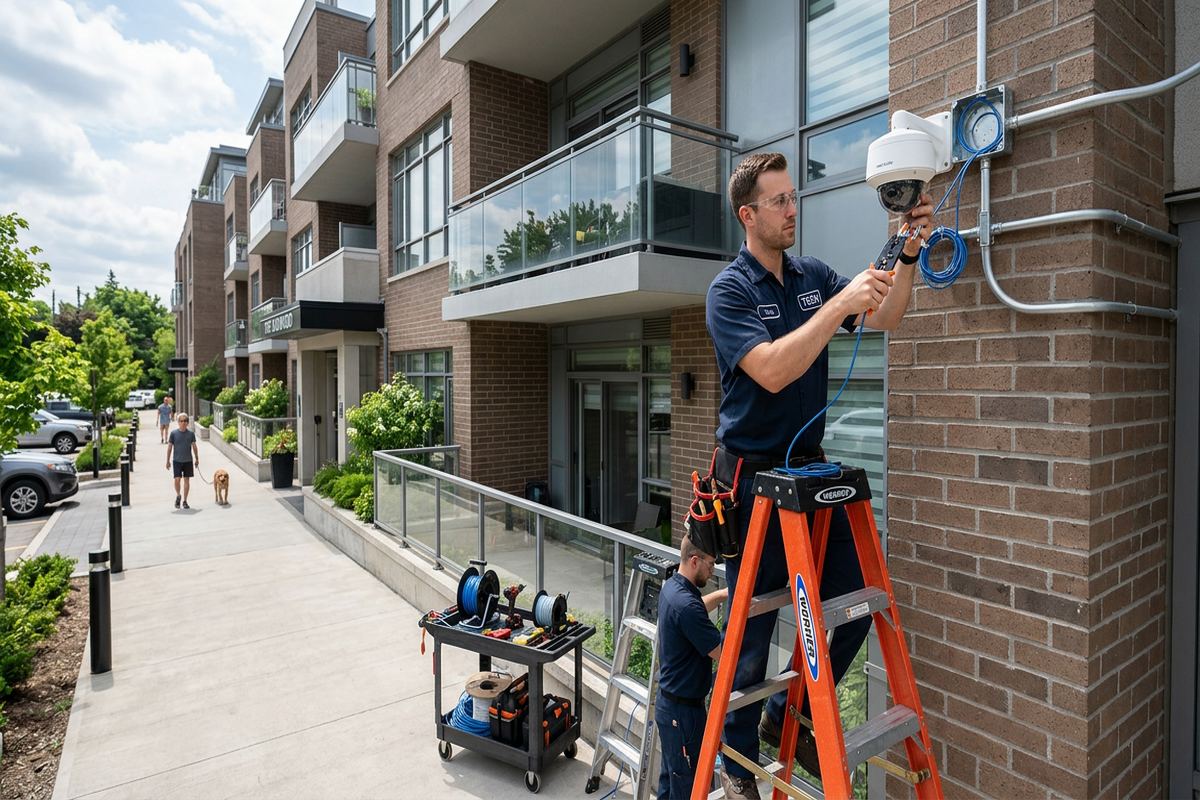
Home Security Camera Planning in Cornwall
A useful camera system begins with the property rather than a camera count. During a Cornwall site assessment, we review entrances, driveways, side passages, garages, yards and likely approaches to the building. We also check available lighting, mounting heights, neighbouring sightlines and practical cable paths. Riverfront homes may have exposed exterior walls and open approaches, while older houses can include additions built with different materials. These details affect lens selection, image angles and installation methods. Pricing follows the assessment, once the required work and site conditions are understood.
Camera placement must provide identifiable detail where it matters without collecting unnecessary views of neighbouring doors, windows or private yards. A wide image can show general movement but may not provide useful detail at a distant gate, vehicle area or front step. We plan overview and identification views separately when the site requires both. In Riverdale or Le Village, closely spaced properties can limit acceptable angles. Trees, porch columns, seasonal foliage and parked vehicles are also considered because they can block a camera that looked suitable from a simple drawing.
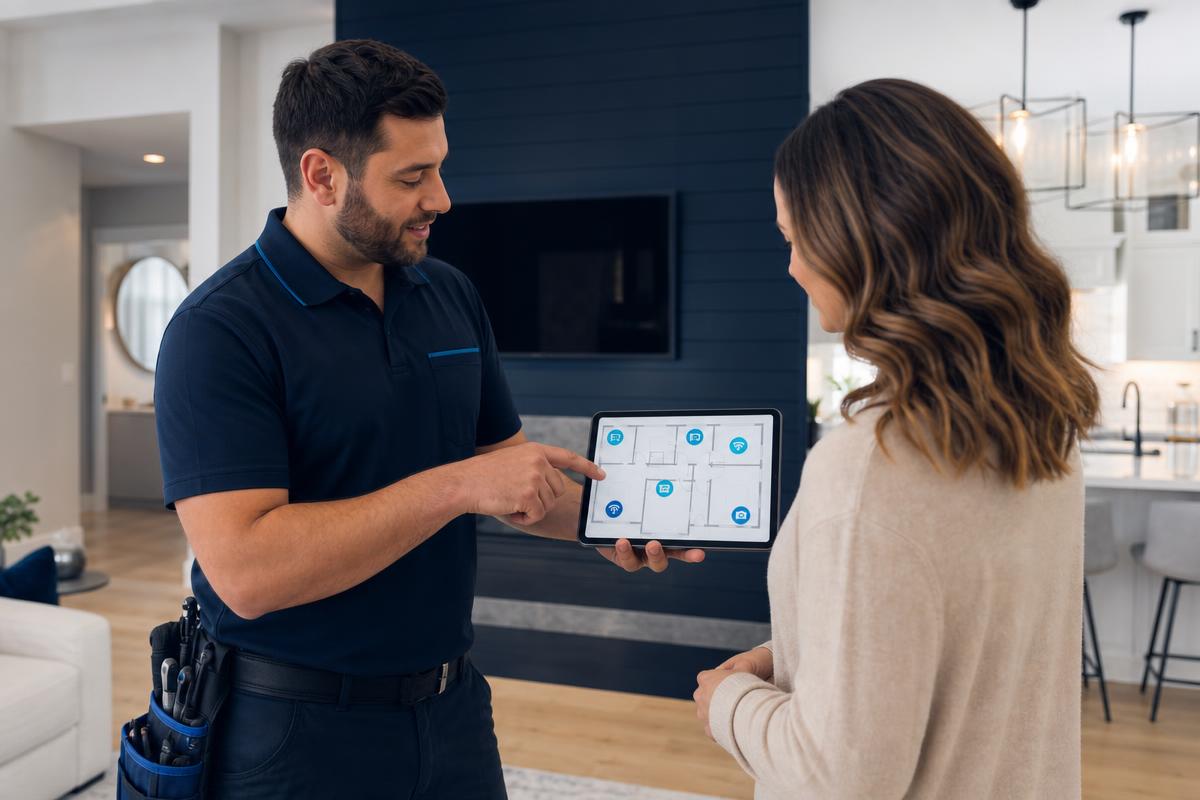
After the assessment, UnifiedLink prepares a written scope covering equipment, cable routes, device placement, exclusions, equipment ownership and warranty. This gives the homeowner a clear basis for reviewing the proposed system before installation begins. If drilling, lift access, network changes or electrical work by another trade is required, those details can be identified in advance. The same scope establishes whether footage will be stored locally, accessed through an application or integrated with existing network equipment. One accountable contractor coordinates the low-voltage camera work from planning through handover.
- Entry, driveway and perimeter sightline review
- Camera purpose defined for each location
- Cable routes documented before installation
- Written equipment and ownership details
Camera Installation for Cornwall Housing Types
Cornwall’s older housing stock often requires more investigation than a newer, open-frame build. Finished basements, plaster walls, narrow soffits and previous renovations can interrupt an otherwise direct cable route. We look for accessible joist spaces, service chases, closets and attic routes before proposing visible surface cabling. Masonry walls may need different anchors and entry methods than wood-frame walls, while siding must be supported so a camera remains stable. The objective is a secure installation that respects the building fabric and avoids speculative drilling through concealed areas.
Riverfront homes bring a different set of installation concerns. Wind exposure, moisture, glare from water and large changes in background brightness can affect both physical mounting and image quality. A sheltered position may protect a camera but create a blocked view, so each location requires a balance between coverage and weather exposure. Exterior penetrations are drilled, dressed and sealed using methods suitable for the wall assembly. Cable entry points should shed water rather than trap it, and connectors should not be left unsupported where repeated movement can weaken the connection.
Condos, rentals and shared properties require permission before work affects common elements, exterior walls or shared network spaces. A Cornwall condo owner may control the interior unit but not the hallway, balcony face, soffit or underground parking structure. Landlords may also set limits on drilling and equipment attachment. We can define the intended locations and cable paths for an approval request, but the customer remains responsible for obtaining required authorization. When permanent exterior work is restricted, we discuss compliant alternatives without representing temporary or wireless devices as equivalent to wired coverage.
- Routes adapted to older finished buildings
- Anchors selected for masonry or framing
- Exterior entries sealed against moisture
- Approval requirements identified before drilling
Exterior Cameras for Cornwall Winters
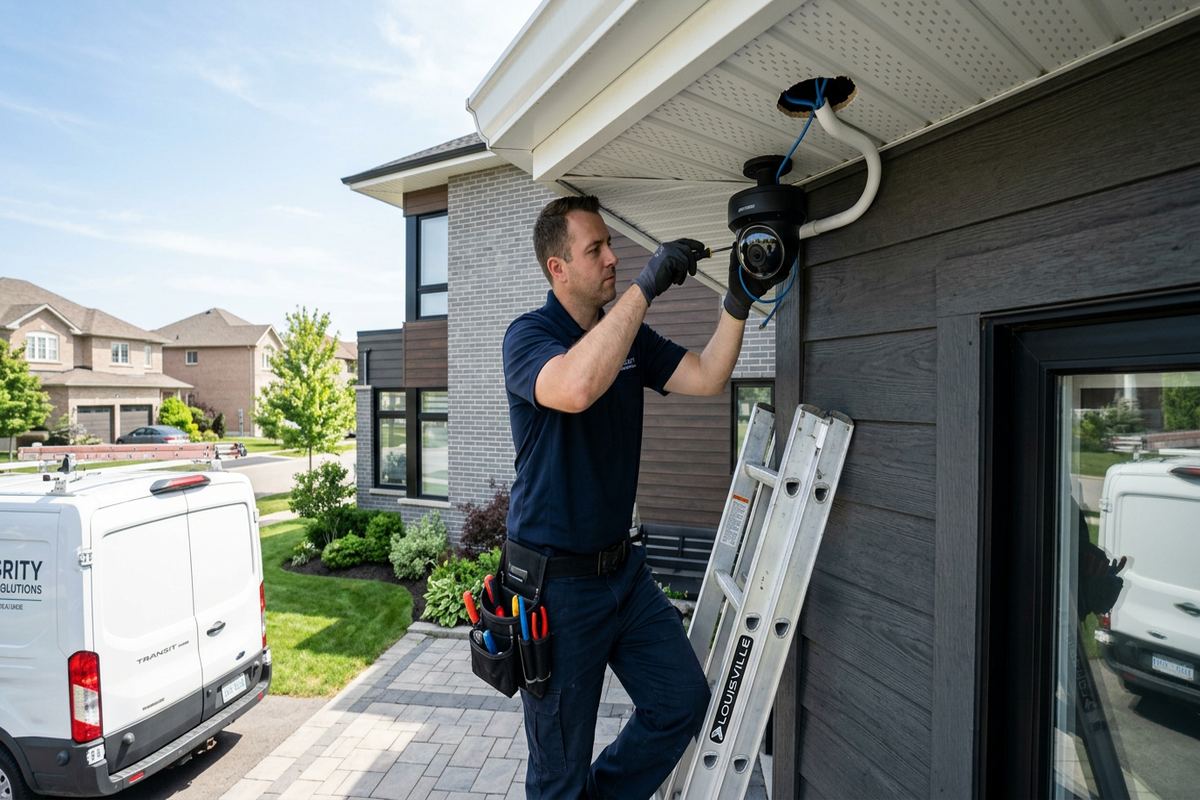
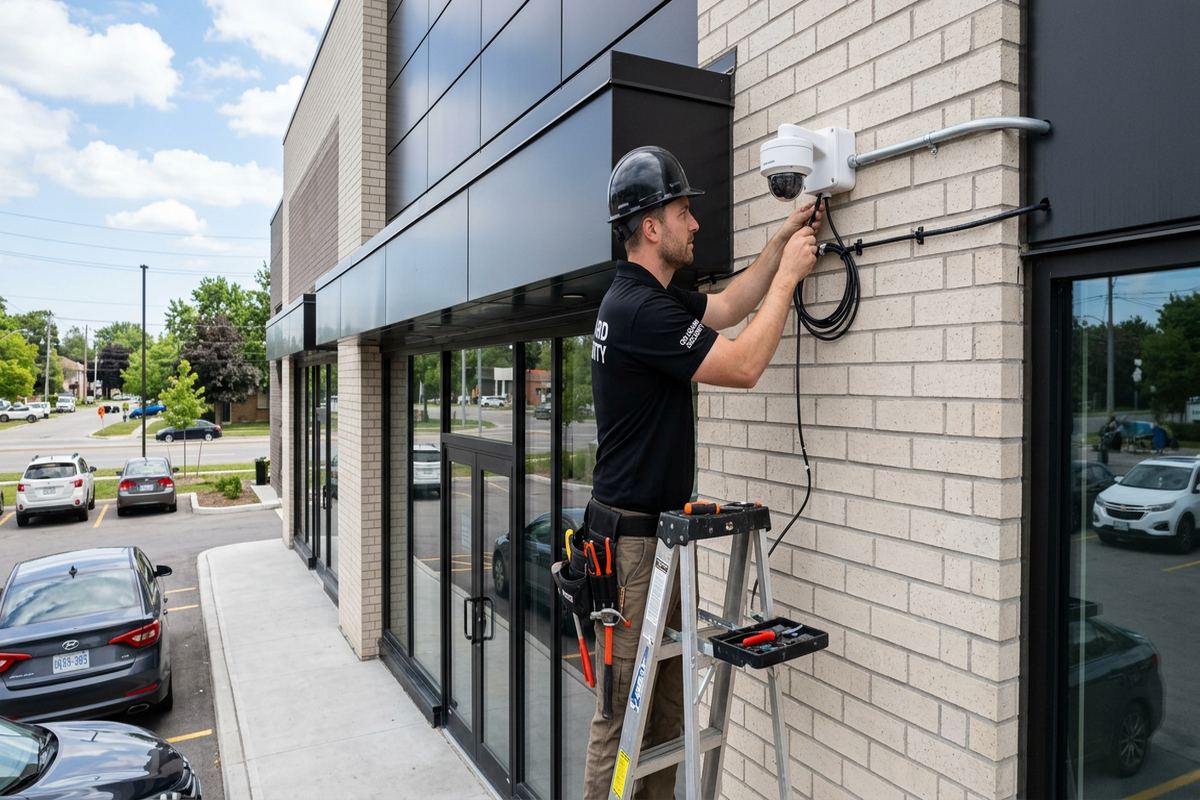
Freeze-thaw cycles can expose weak exterior installation work. Water entering an unsealed penetration may freeze, expand and damage the surrounding material, while poorly supported cable can move in wind or pull against a connector. Cornwall exterior cameras are mounted to stable surfaces with suitable hardware, and penetrations are sealed according to the wall type. Drip loops, protected junctions and sensible cable approaches help keep water away from connection points. Mounting directly where snow, roof runoff or ice regularly falls is avoided whenever another position can provide the required view.
Winter also changes what a camera sees. Snow can brighten a scene, reflect infrared illumination and reduce visible detail around a darker doorway or vehicle. At night, infrared light reflecting from soffits, walls, railings or nearby branches can create glare that obscures the subject. We check the framing and nearby surfaces before fixing the final angle. A camera should not simply point from the highest possible location; excessive height often produces the top of a person’s head rather than a useful face view at a door or gate.
Outdoor equipment must be selected for the intended location, but an environmental rating does not correct poor mounting or exposed connections. We consider temperature range, direct precipitation, sun exposure and whether the camera sits under a porch, soffit or open wall. Equipment installed near the Guindon Park area may face open wind and seasonal vegetation, while a protected Cornwall Centre entrance presents different lighting and access conditions. Final configuration includes daytime and low-light checks so image settings suit the actual scene instead of relying only on factory defaults.
- Stable mounts for seasonal movement
- Sealed and dressed wall penetrations
- Angles checked for snow and infrared glare
- Connections protected from runoff and wind
Cornwall, Ontario
Home security camera installation in Cornwall, scoped in writing first
Book a site assessment and get equipment, routes, exclusions, and warranty on paper before anything is installed.
Wired Camera Cabling and Network Design
Wired cameras usually provide the most predictable connection when continuous cable routes are practical. UnifiedLink installs continuous, labelled runs between cameras and the designated network or recording location, avoiding hidden couplers that complicate future troubleshooting. Before installation, we confirm route accessibility, cable support, separation from electrical conductors and the available pathway through the building. Cornwall homes with finished basements or multiple additions may require a combination of concealed and neatly protected surface routes. Any visible pathway is discussed in the written scope rather than introduced unexpectedly during the work.
Power over Ethernet can carry data and power on one network cable when compatible cameras and network equipment are used. The design still needs enough switch capacity, appropriate power availability and a secure place for the recorder, switch or other system components. We review whether existing customer equipment can support the proposed cameras or whether dedicated hardware is more suitable. Device traffic, remote viewing and general household internet use should be considered together. A camera system should not be attached to an unknown network arrangement without documenting where it connects and who controls its administration.
Wireless cameras can be appropriate where cabling is prohibited or physically impractical, but wireless does not remove power, signal and maintenance requirements. Exterior walls, masonry, metal cladding and distance from an access point can reduce connection quality. Battery operation also changes recording behaviour and maintenance expectations. In Cornwall’s older masonry homes, a device that connects reliably beside the router may perform differently at an exterior corner. We explain these trade-offs during planning and do not use wireless equipment as a default substitute for a feasible, properly routed wired system.
- Continuous cable runs without hidden joins
- Labels applied at both cable ends
- Network capacity reviewed before connection
- Visible pathways agreed in writing
Recording and Remote Viewing Setup in Cornwall
Recording design starts with deciding what events need to be retained and who needs access. Local recorders, camera-based storage and supported cloud services have different dependencies, administration methods and ongoing requirements. We review the selected camera resolution, recording mode, number of devices and available storage options without promising a fixed retention period before those settings are known. Continuous recording can consume storage differently from event-based recording. The written scope identifies the equipment being supplied and clarifies ownership, so a Cornwall customer knows which components remain under their control after handover.
Remote viewing depends on more than installing an application. The recorder or camera platform must be connected correctly, user accounts need appropriate permissions, and the customer must retain control of recovery details. During on-site configuration, we use the customer’s own credentials rather than creating an installer-owned account that becomes difficult to transfer. Where supported, separate user access can be configured for household members or authorized staff. We also explain basic notification controls because poorly defined motion areas can generate excessive alerts from traffic, trees, snow, insects or changing light.
At handover, we confirm live viewing, playback and the main operating steps on the customer’s available devices. The customer receives an as-built record identifying installed camera locations, cable labels and relevant equipment placement. Credentials remain with the customer, and administrative ownership is made clear. If a platform requires subscriptions, third-party services or customer-maintained internet access, those dependencies are identified rather than implied to be part of the physical installation. This process gives Cornwall property owners a practical reference for future changes, maintenance or troubleshooting without relying on memory.
- Local and supported cloud options reviewed
- Customer-controlled accounts and recovery details
- Motion areas adjusted on site
- As-built system record supplied
Coverage for Doors, Driveways and Yards
Front doors need framing that captures a person approaching and standing at the entrance. A camera mounted too high, too far away or directly beside a bright light may show activity without useful detail. We review porch depth, door swing, steps, columns and evening lighting before selecting the position. In compact Le Village properties, the viewing angle may also need to exclude a close neighbour’s window or doorway. Doorbell cameras can support conversation and package awareness, while a separate fixed camera may provide better coverage of the broader approach or front yard.
Driveway cameras must account for vehicle position, headlights, street lighting and the width of the approach. One general overview camera may show that a vehicle entered without consistently capturing useful details at every distance or angle. We discuss the actual objective, such as monitoring the garage apron, side gate, parked vehicles or pedestrian route. Cornwall driveways can be partly hidden by porches, attached garages, fences or winter snowbanks. Camera placement should preserve the required view through seasonal changes while remaining accessible enough for reasonable cleaning and inspection.
Backyards and side passages often contain several competing targets: patio doors, basement entrances, sheds, gates and narrow routes between buildings. The useful position depends on whether the priority is early detection, clear identification near an entrance or general property awareness. Vegetation is considered in both leaf-on and winter conditions, particularly around larger lots near the Guindon Park area. We avoid pointing infrared cameras through glass because reflections can overwhelm the night image. Exterior lighting may improve results, but its direction and control should complement rather than blind the camera.
- Entrance framing checked at face level
- Driveway views planned around parked vehicles
- Seasonal foliage and snowbanks considered
- Private neighbouring areas excluded where practical
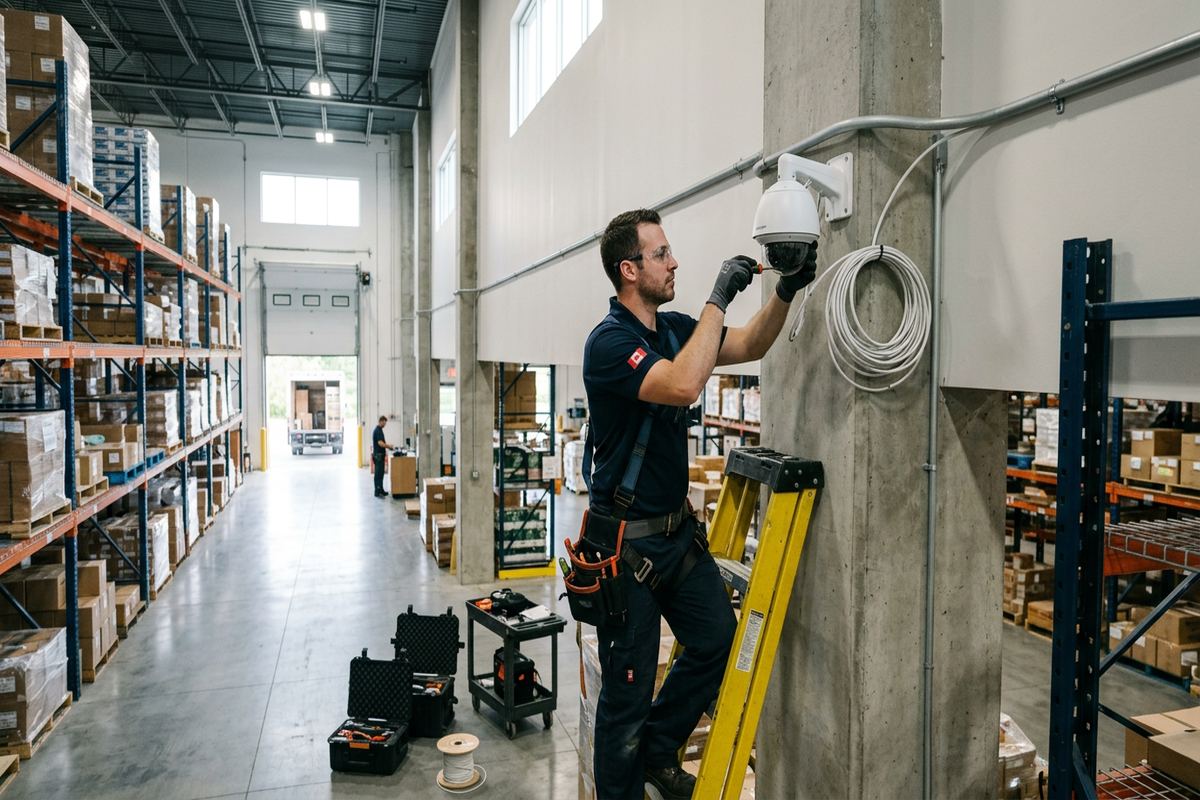
Small Business Camera Installation in Cornwall
Home security camera methods also apply to mixed-use and small commercial properties, but the operating requirements can differ. Cornwall Centre commercial strips may need coverage of a public entrance, rear delivery door, service counter or shared access route. Camera positions must respect customer and neighbouring privacy while giving the owner a practical view of priority areas. We discuss who will review footage, where the recording equipment can be secured and which users need remote access. Staff areas and public-facing spaces should not be treated as interchangeable without considering the intended purpose.
Logistics warehouses and industrial units in the Business Park can involve longer cable distances, high mounting points, metal construction and active loading areas. Those conditions affect pathway selection, access equipment, lens choice and protection from impact. A high camera can provide an overview of a yard or loading zone but may not identify a person near a doorway. Where both functions matter, separate views may be required. Installation planning also considers operational schedules so cable routing and mounting can be coordinated around occupied work areas and vehicle movement.
For a business operating from a house, converted building or small industrial bay, the network may support point-of-sale devices, office systems and general internet access as well as cameras. We identify where the camera system connects and avoid undocumented changes to critical customer equipment. Recording hardware should be placed where routine activity, dust, heat or accidental disconnection will not interfere with operation. If landlord approval is required for exterior walls or shared service spaces, the proposed Cornwall installation can be documented for review before any holes, anchors or permanent pathways are installed.
- Public, staff and delivery areas assessed
- Warehouse mounting access planned in advance
- Recording hardware placed in a controlled area
- Landlord approvals addressed before permanent work
Cornwall Installation Process and Handover
The process begins with a request describing the Cornwall property, the areas of concern and any existing cameras or network equipment. Requests sent during business hours are answered the same day; after-hours requests are answered the next business day. Site assessment timing depends on the service and travel distance. At the visit, we inspect sightlines, surfaces, cable routes, recording locations and network access. Photographs or plans may support the assessment, but they do not replace checking concealed-route limitations, exterior conditions and mounting access at the property.
Once the assessment is complete, the written scope sets out equipment, camera positions, cable routes, exclusions, equipment ownership and warranty. Installation then follows the agreed plan, with changes discussed if hidden conditions make a route unsuitable. Cables are installed as continuous labelled runs, devices are securely mounted and exterior entries are sealed for the relevant construction. On-site configuration covers recording, network connection, viewing and supported alert settings. Using one accountable contractor for the low-voltage scope reduces gaps between camera mounting, cabling, network connection and final system configuration.
Handover is completed with the customer’s own credentials and an as-built record of the installation. We demonstrate live view, playback and basic administration, then identify customer responsibilities such as account recovery, internet service, subscriptions, lens cleaning and keeping vegetation clear. Cameras should be reviewed after major property changes, new lighting, renovations or network replacement because those changes can affect coverage or access. A completed Cornwall system should be understandable to its owner, physically documented and configured for the property’s actual conditions rather than left with unexplained default settings.
- Assessment completed before pricing
- Written scope approved before installation
- On-site viewing and playback checks
- Customer credentials and as-built handover
Cornwall neighbourhoods we cover
- Le Village
- Riverdale
- Cornwall Centre
- Guindon Park area
- Business Park
Home security camera installation in Cornwall — common questions
Do you assess my Cornwall property before quoting?
Yes. A site assessment is completed before pricing so camera positions, cable routes, wall construction, network access and recording requirements can be reviewed. Cornwall properties range from older masonry and frame homes to riverfront houses and industrial units, so a remote estimate may miss important access or sealing requirements. Assessment timing depends on the service and travel distance.
Can cameras be installed on an older brick home?
Yes, provided suitable mounting points and cable routes are available. Older Cornwall homes may have solid masonry, veneer brick, plaster interiors or later additions with different construction. We select anchors and penetration methods for the actual surface, avoid unsupported mounting, and seal exterior entries. The assessment also identifies where concealed cabling is practical and where an agreed surface pathway may be necessary.
Will outdoor cameras work through a Cornwall winter?
Equipment selection and installation both matter. We consider operating temperature, precipitation exposure, wind, snow glare, roof runoff and freeze-thaw conditions. Cameras are mounted to stable surfaces, with protected connections and sealed wall penetrations. Final angles are checked for nearby soffits, branches and reflective surfaces that can interfere with infrared night images. No outdoor installation is maintenance-free, so lenses and mounts should be inspected periodically.
Can I view my cameras from my phone?
Remote viewing can be configured when the selected camera platform, customer network and internet service support it. During on-site setup, UnifiedLink uses the customer’s own credentials and confirms live view and playback on available devices. Cornwall customers retain account control and recovery details. Any third-party subscription, cloud dependency or internet requirement is identified in the written scope rather than being assumed.
Do I need condo or landlord approval?
Approval may be required if a camera, cable, anchor or pathway affects an exterior wall, balcony, hallway, shared parking area or another common element. Cornwall condo owners and tenants should obtain written authorization before installation. We can document proposed device locations and routes for review, but the customer is responsible for securing permission. Interior ownership does not automatically permit changes to shared building surfaces.
Can you install cameras at my Cornwall business too?
Yes. The same service can cover a home-based business, commercial unit, logistics warehouse or mixed-use property. Business Park and Cornwall Centre sites may involve loading doors, public entrances, long cable routes or shared landlord-controlled areas. We assess the required views, recording location, mounting access and network connection, then provide a written scope before installation and configuration.
Coverage in Cornwall is confirmed against the address before we quote. See everything we install in Cornwall or the province-wide home security camera installation page.