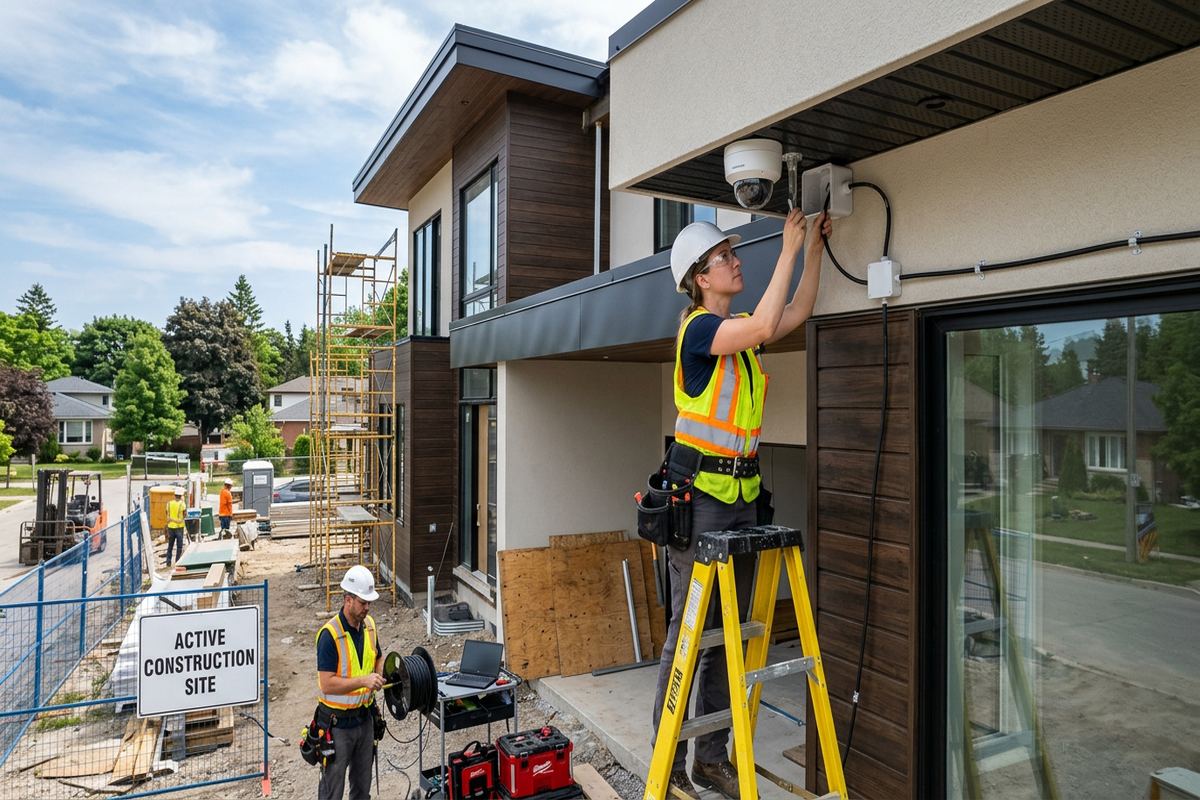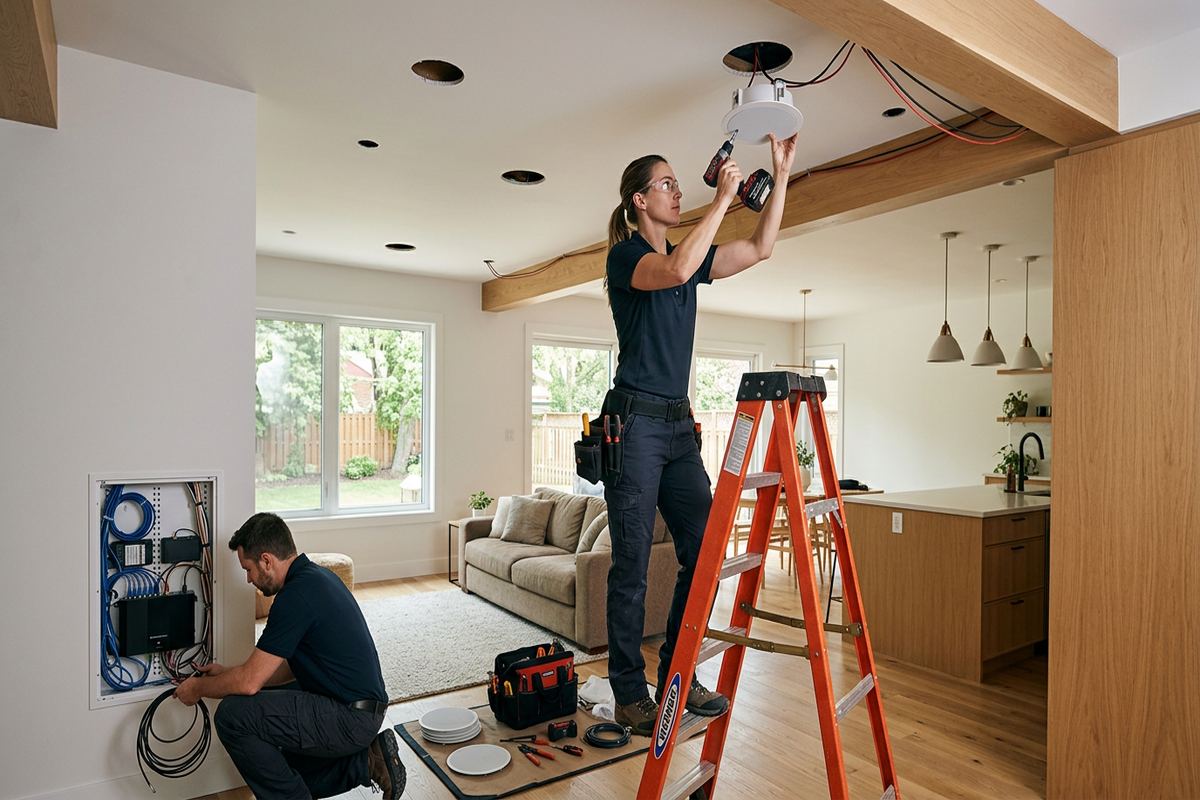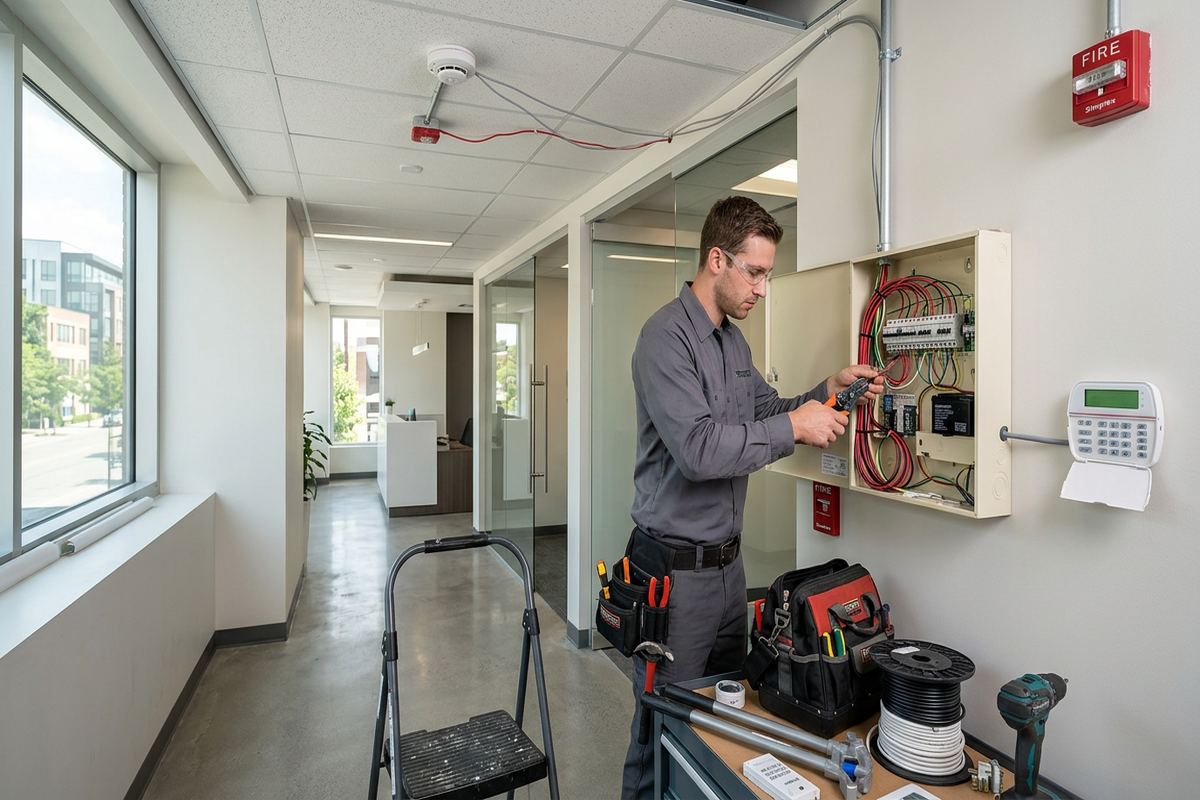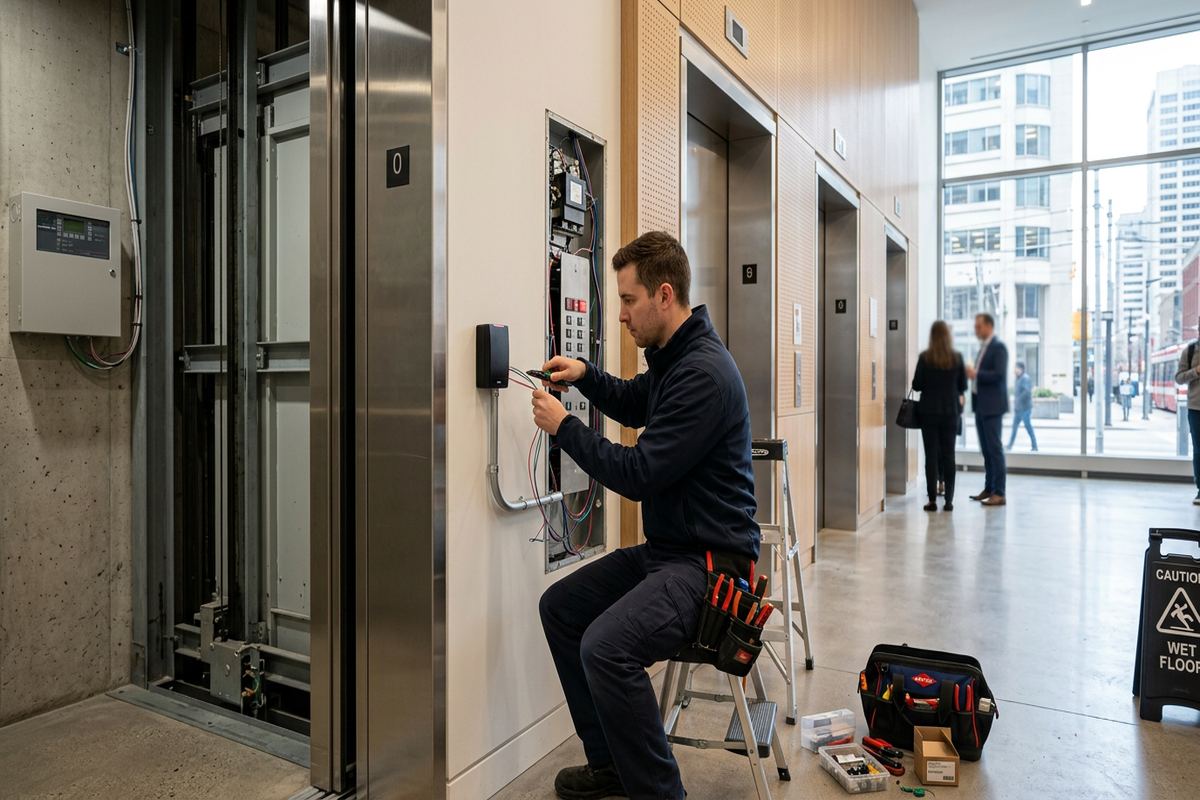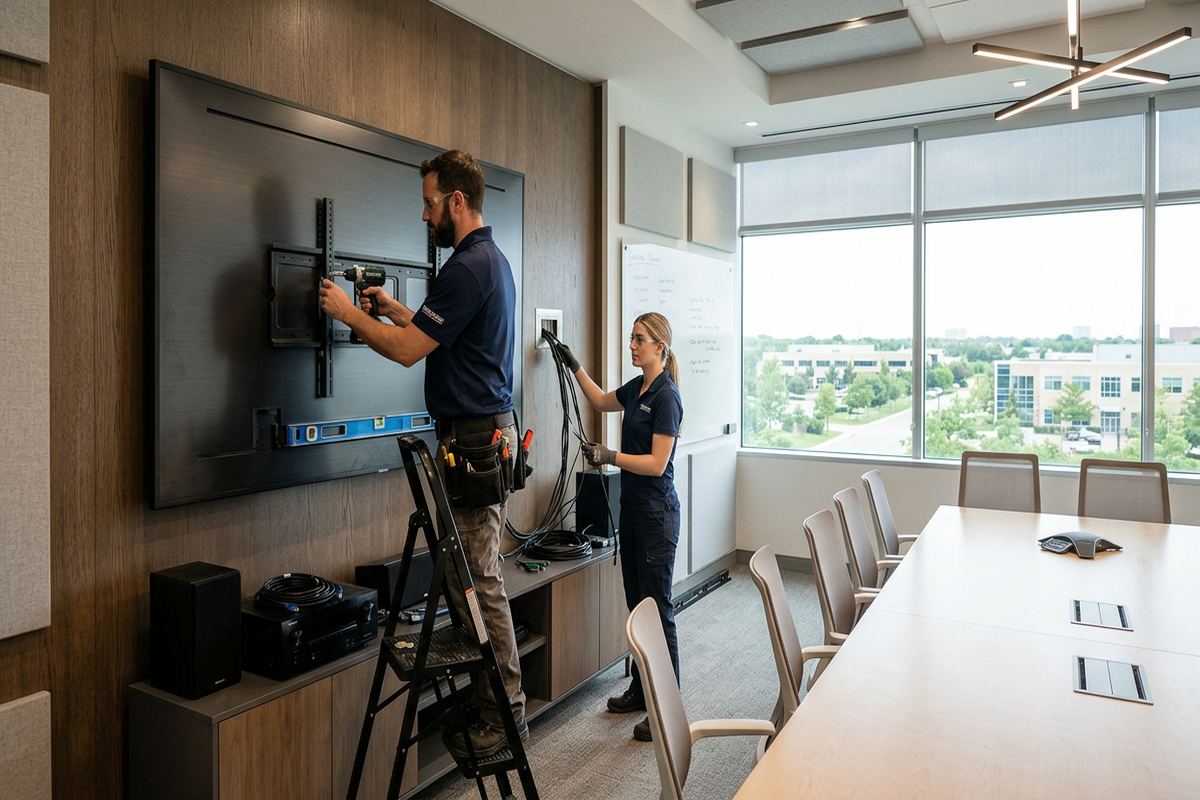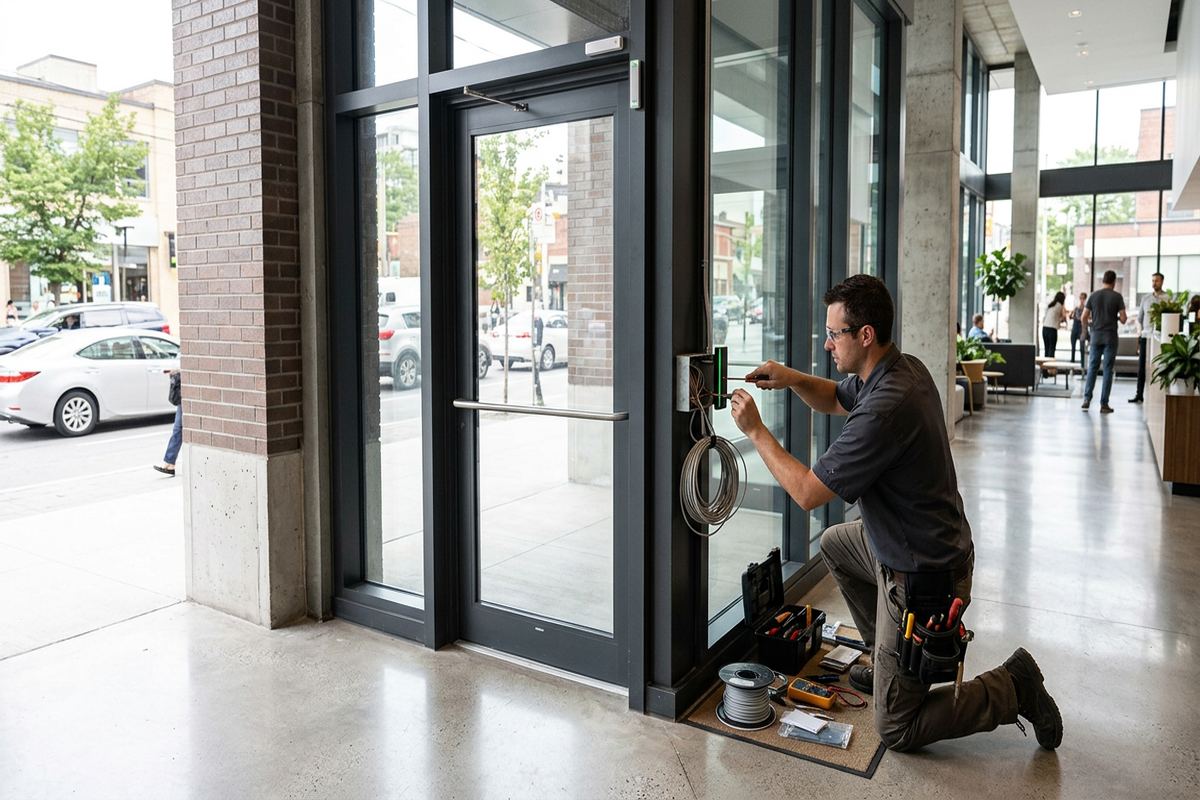
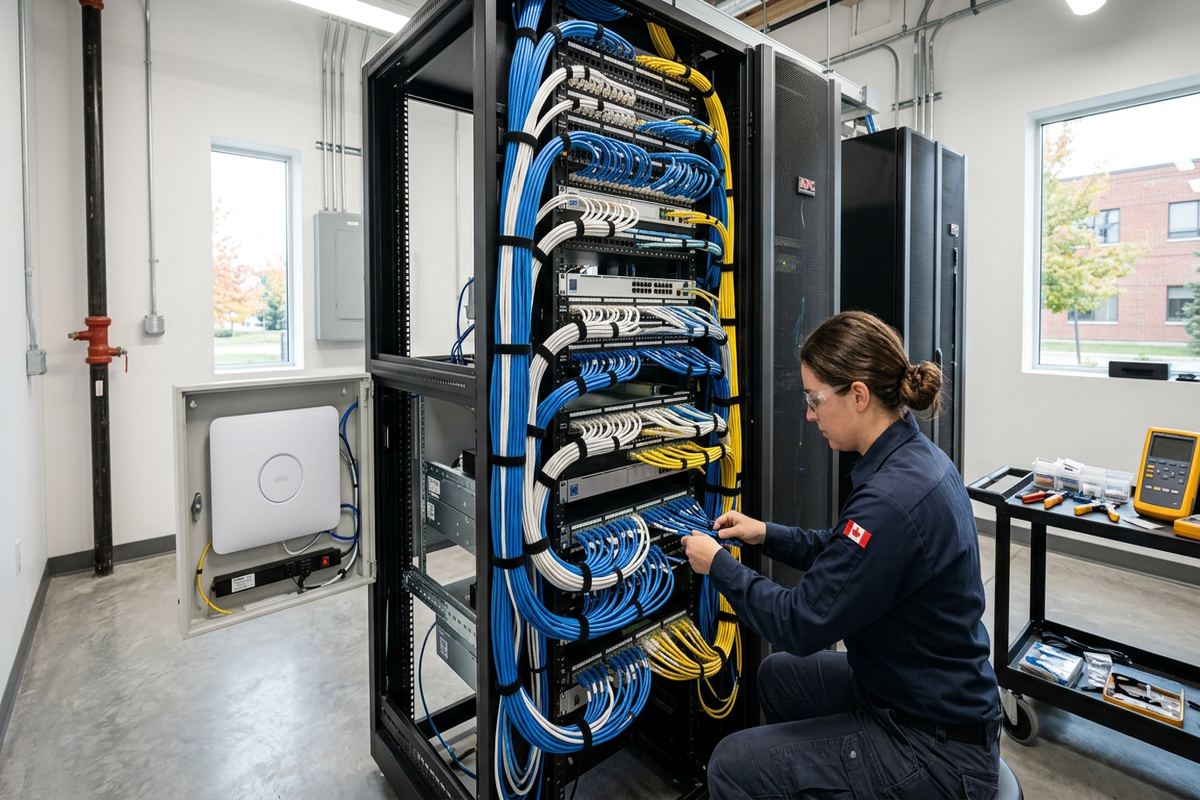
UnifiedLink installs commercial networks for offices, warehouses, shops, multi-unit properties and other workplaces in Cornwall. Each project starts with a site assessment and a practical design based on device locations, construction, coverage needs and future expansion. We install labelled cabling, racks, network hardware and Wi-Fi equipment, then configure and document the completed system.
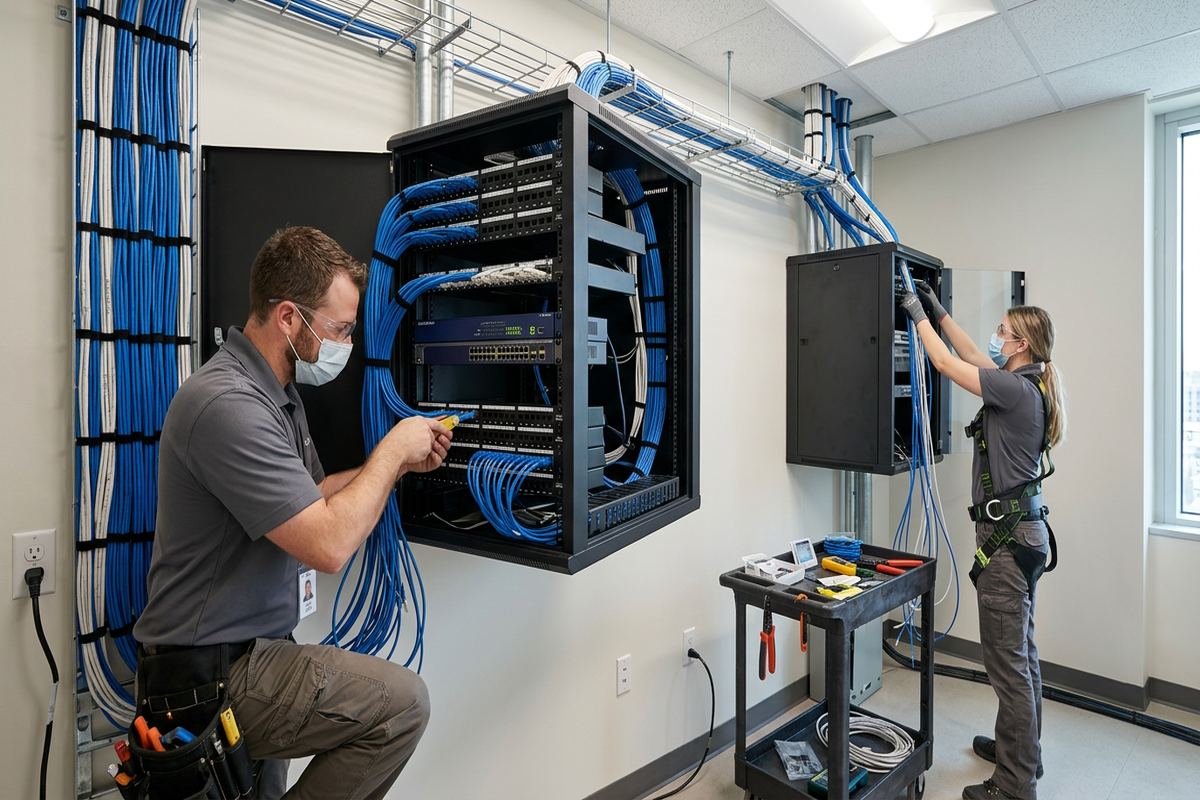
Commercial Network Installation for Cornwall Properties
A commercial network has to support the way a property is actually used, not just provide an internet connection near the modem. In Cornwall, that can mean dependable office access, warehouse scanning coverage, guest Wi-Fi, cloud applications, security cameras, phones and building systems sharing the same infrastructure. UnifiedLink assesses the number of users, connected devices, floor layout and expected traffic before recommending cable routes or hardware. This process helps avoid undersized switches, poorly located access points and improvised extensions that become difficult to maintain when the business adds staff, workstations or network-connected equipment.
Cornwall projects vary considerably because local properties include logistics warehouses, commercial strips, older housing stock adapted for business use and mixed-use buildings. Masonry walls can reduce wireless signal between rooms, while frame construction may provide easier cable pathways but still contain concealed blocking or previous renovations. Industrial units often have high ceilings, steel racking and long travel distances that affect access-point placement. The assessment identifies these constraints before installation begins, allowing the written scope to show proposed device locations, cable routes, equipment, exclusions, equipment ownership and warranty details clearly.
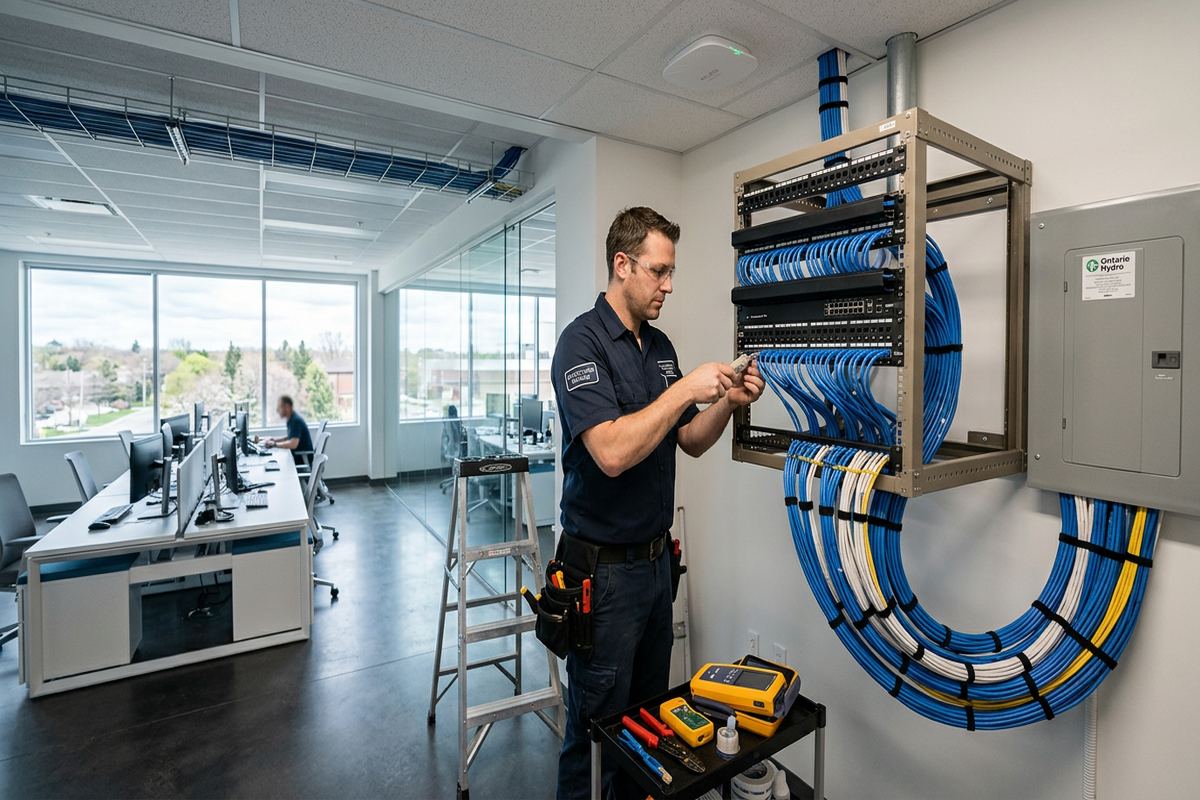
One accountable contractor handles the network installation from initial planning through on-site configuration and handover. Continuous labelled cable runs are installed between approved termination points rather than joined through inaccessible couplers. Racks, patch panels, switches and wireless equipment are arranged so future troubleshooting does not require tracing unidentified cables across the property. At completion, the customer receives access using their own credentials and an as-built record of installed runs and device locations. This gives the owner or designated IT provider useful information for maintenance, expansion, internet-provider changes and future equipment replacement.
- Site assessment before pricing
- Written equipment and installation scope
- Continuous labelled data cabling
- Network hardware installed and configured
- Customer-controlled credentials at handover
Network Design for Cornwall Offices and Workplaces
Good network design begins by separating internet service from the internal infrastructure that distributes it. The provider’s modem or optical terminal is only one component; routers, firewalls, switches, cabling and wireless access points determine how reliably users and devices connect throughout the premises. For a Cornwall office, we review desk locations, meeting rooms, printers, phones, point-of-sale equipment, cameras and other connected systems. Wired connections are prioritized where stability and predictable performance matter, while Wi-Fi is planned for mobile devices and areas where installing a permanent outlet is impractical.
Older commercial spaces around Cornwall Centre and Le Village may have thick masonry, finished ceilings, narrow service cavities or additions completed at different times. Rather than assuming one central access point will cover every room, we consider wall materials, floor separation and realistic device use. Cable pathways may use existing service spaces, surface raceway or carefully selected penetrations, depending on the building and approved finish requirements. Exterior penetrations are minimized and properly sealed where required, particularly because Cornwall winters and repeated freeze-thaw cycles can expose poorly finished openings to moisture and material movement.
Network capacity should account for planned growth without filling every port or pathway on installation day. A business may later add cameras, door controllers, phones, workstations, displays or environmental monitoring, all of which can require network access and sometimes Power over Ethernet. We discuss likely additions during design, then identify sensible spare rack capacity, switch capacity and cable pathways within the written scope. This does not mean installing unnecessary equipment. It means avoiding a layout that must be dismantled when another device is added or a tenant changes how rooms and operational areas are used.
- Wired outlets placed around actual workflows
- Wireless coverage planned by construction type
- Switch capacity matched to connected devices
- Power over Ethernet requirements reviewed
- Expansion pathways identified in advance
Structured Cabling in Cornwall Buildings
Structured cabling provides the physical foundation for a stable commercial network. UnifiedLink installs continuous labelled runs from the rack or communications area to individual outlets, access points and approved network devices. Each end is terminated consistently and identified so a technician can understand the layout without guessing. Cable type is selected according to the application, pathway and expected network requirements rather than by using whichever box is available. Routing also considers electrical interference, bend limits, support, fire separations and accessibility, helping protect performance while keeping the completed installation organized and serviceable.
Construction methods influence how cabling can be installed across Cornwall. Frame buildings may offer basement, attic or stud-space access, although insulation, blocking and renovations can interrupt an expected route. Masonry buildings often require surface pathways, core drilling or alternative risers, all subject to permission and site conditions. In warehouses within the Business Park, cable may travel through trays, conduit or high-level supports to reach offices, loading areas and wireless access points. The assessment establishes workable routes before pricing so the scope reflects the labour, access equipment, finishing and coordination the property actually requires.
Landlord, condominium or property-management approval may be necessary before cabling enters common areas, penetrates exterior walls or uses shared telecommunications rooms. Tenants should confirm what alterations are permitted and whether the building has pathway, firestopping or contractor requirements. UnifiedLink can document proposed routes and device locations for review, but the property owner or authorized representative remains responsible for granting access and approvals. This step is particularly relevant in mixed-use properties, converted homes and multi-tenant commercial strips where a route that appears direct may cross another unit or a shared structural area.
- Labelled rack-to-outlet cable runs
- Suitable pathways for masonry or frame walls
- Patch panels organized by destination
- Penetrations finished for their location
- Routes documented in the as-built record
Cornwall, Ontario
Commercial network installation in Cornwall, scoped in writing first
Book a site assessment and get equipment, routes, exclusions, and warranty on paper before anything is installed.
Warehouse and Industrial Networks in Cornwall
Warehouse networking involves different coverage and durability concerns from a conventional office. Long aisles, high roofs, loading doors, stored inventory and steel racking can all alter wireless performance. In Cornwall logistics warehouses and industrial units, access points need locations based on working areas and device behaviour, not simply equal spacing on a drawing. Handheld scanners, tablets, printers, cameras and staff devices may move between receiving, storage, packing and dispatch zones. We review those routes and determine where wired infrastructure and properly positioned wireless equipment can provide practical continuity.
Physical access also shapes installation planning in an active industrial property. High-level cable runs may require lift access, coordinated work zones or installation outside busy loading periods. Network racks need a protected, ventilated and serviceable location rather than an exposed corner where equipment can be struck, contaminated or disconnected. Where cables approach exterior doors or pass between conditioned and unconditioned areas, pathway and sealing details require attention. Cornwall’s winter temperatures, condensation risk and freeze-thaw conditions make unsuitable indoor hardware or poorly sealed exterior penetrations a preventable source of network trouble.
Industrial networks often carry more than employee internet traffic. Cameras, access control, shipping stations, voice systems, production equipment and building controls may all connect through shared switching infrastructure. Logical separation can limit unnecessary communication between device groups and simplify administration, provided the selected router, firewall and switches support the design. During the assessment, we identify connected systems, ownership boundaries and any vendor requirements. On-site configuration then follows the approved scope, with customer-controlled administrative credentials supplied at handover rather than retained in an installer’s personal account.
- Coverage planned around racks and aisles
- High-level cable pathways assessed on site
- Protected locations for network equipment
- Device groups separated where appropriate
- Loading and work areas considered
Business Wi-Fi Planning in Cornwall
Commercial Wi-Fi should be designed as part of the network rather than treated as a replacement for all cabling. Access points still require dependable wired connections, appropriate switch ports and often Power over Ethernet. Their positions should reflect wall construction, ceiling height, room density and the devices that will use each area. A small Cornwall workplace divided by masonry may need a different layout from an open frame-built office of similar size. We use the site assessment to select practical locations and avoid relying solely on maximum coverage figures published for unobstructed spaces.
Separate wireless access can be useful for staff, guests and dedicated devices. A guest network can keep visitor traffic away from business resources, while equipment such as displays or building controls may require its own access rules. The precise design depends on the router, firewall, access points and management platform selected for the property. UnifiedLink configures the approved network on site and provides the customer with its own credentials. Passwords, network names and administrative access should be controlled by the organization, allowing authorized staff or its IT provider to make future changes without installer dependency.
Outdoor or transitional coverage needs careful equipment selection and mounting. A standard indoor access point should not be placed under an eave and assumed to withstand Cornwall weather. Exterior-rated hardware, suitable cable, drip management, protected entry points and correct sealing are considered where a courtyard, yard, loading area or detached structure requires connectivity. Around riverfront properties and the Guindon Park area, exposed locations may experience wind-driven precipitation and substantial seasonal change. Mounting must also respect the substrate, whether fastening to masonry, siding, framing or an approved support.
- Access points connected by structured cabling
- Staff and guest networks separated
- Coverage matched to walls and ceiling heights
- Exterior equipment selected for exposure
- Customer retains administrative access
Network Racks, Switching and Configuration
The communications area is where internet service, internal cabling and network hardware come together. A suitable rack or enclosure keeps patch panels, switches, routers and related equipment supported and identifiable. Placement depends on available space, cable distances, ventilation, electrical supply and access for maintenance. It should not obstruct normal operations or leave active equipment vulnerable to storage, cleaning or accidental disconnection. For Cornwall businesses moving into an existing unit, we also inspect abandoned cabling and legacy hardware to determine what can be verified, what belongs to another party and what should remain outside the new scope.
Switch selection is based on port count, speed, uplink requirements, management features and the power needs of connected devices. Power over Ethernet can supply compatible access points, cameras, phones and door hardware, but the total power budget must support the actual load. Simply having enough physical ports does not confirm that a switch is suitable. We review current devices and reasonable near-term additions, then document the equipment included. Where customer-supplied or third-party hardware will remain, its role, condition and configuration responsibility are identified before work proceeds.
Configuration connects the physical installation to the intended operating design. This may include router setup, switch settings, wireless networks, device naming, software updates and logical network separation, depending on the agreed equipment and scope. Internet-provider accounts, specialized servers and third-party applications may require coordination with the customer or its IT provider. UnifiedLink completes approved on-site configuration, records installed device locations and hands over administrative access using the customer’s own credentials. The resulting as-built record supports future troubleshooting without implying that every external service or pre-existing device is covered.
- Racks sized for included equipment
- Patch panels and ports labelled
- Power over Ethernet load reviewed
- Network settings configured on site
- Credentials transferred directly to customer
Installation Across Cornwall Neighbourhoods
Site conditions differ across Cornwall’s neighbourhoods and commercial areas. A converted property in Riverdale may combine older frame construction with additions, finished basements and limited vertical pathways. Work around Cornwall Centre or Le Village may involve masonry walls, shared entrances and occupied units that require careful route approval. Business Park projects commonly present longer cable distances, industrial ceilings and active warehouse operations. These differences affect labour and equipment, which is why UnifiedLink completes a site assessment before pricing instead of assuming that square footage alone defines the installation.
Renovations can conceal earlier wiring that is unlabelled, damaged or no longer connected. Existing cable is not automatically suitable because it reaches the correct room; its category, pathway, termination and condition need to be established. In older Cornwall properties, obsolete telephone wiring and improvised network extensions may share crowded service spaces. We identify what can be inspected and tested, then explain whether reuse is reasonable or new continuous runs are preferable. The written scope distinguishes retained infrastructure from newly installed work, reducing confusion about responsibility if an old component later fails.
Exterior work is planned around both the building envelope and seasonal exposure. Penetrations require an appropriate location, slope or drip arrangement where applicable, and sealants compatible with the surrounding material. Fasteners suitable for masonry are different from those used in wood framing or siding, and mounting should not compromise drainage planes. During Cornwall winters, water entering a poorly sealed opening can freeze, expand and damage finishes or pathways. Where landlord, condominium or heritage-related consent applies, the required approval should be secured before any visible mounting or alteration begins.
- Routes adapted to local building stock
- Existing cabling assessed before reuse
- Approvals confirmed for shared properties
- Exterior openings properly sealed
- Work areas coordinated with occupants
Scoping and Handover for Cornwall Projects
Every project begins with a discussion of the property, current problems and expected network use. The site assessment then verifies construction, cable access, equipment locations, internet handoff, electrical availability and any work-at-height requirements. Timing depends on the service and travel distance. Requests sent during business hours are answered the same day, while after-hours requests are answered the next business day. This response wording applies to the initial request, not a guaranteed installation or assessment appointment. Scheduling is confirmed after the service needs and Cornwall site conditions are understood.
Following the assessment, the written scope identifies included equipment, planned cable routes, device placement, exclusions, ownership and warranty information. It can also record customer responsibilities such as arranging landlord approval, providing internet account access, confirming electrical work or coordinating another technology vendor. Clear boundaries are important when a network supports systems supplied by several parties. The scope gives the Cornwall property owner a practical basis for reviewing the design before installation and helps prevent assumptions about concealed repairs, provider services, software subscriptions or equipment that was not included.
Handover is treated as part of the installation rather than an optional final step. UnifiedLink checks the included connections, completes agreed on-site configuration and supplies an as-built record showing installed runs and device locations. Labels correspond with the rack, patch panel or outlets so future changes can be traced efficiently. Administrative access is provided through credentials owned by the customer, with no need to depend on an installer’s personal login. For a business owner, landlord or designated IT provider, this documentation creates a clear starting point for support, expansion and eventual hardware replacement.
- Assessment completed before pricing
- Written scope supplied for review
- Responsibilities and exclusions identified
- As-built information provided
- Customer credentials used at handover
Cornwall neighbourhoods we cover
- Le Village
- Riverdale
- Cornwall Centre
- Guindon Park area
- Business Park
Commercial network installation in Cornwall — common questions
Do you assess my Cornwall property before quoting?
Yes. UnifiedLink completes a site assessment before pricing a commercial network installation. The assessment reviews construction, cable pathways, equipment locations, internet service, connected devices and access requirements. Timing depends on the service and travel distance. Requests made during business hours are answered the same day; requests sent after hours are answered the next business day.
Can you install networking in an older Cornwall building?
Yes, subject to suitable pathways and property approval. Older Cornwall buildings may have masonry walls, finished additions, concealed blocking or obsolete wiring that affects routing. We inspect accessible conditions and prepare a written scope showing proposed routes and device locations. Surface raceway, existing service spaces or selected penetrations may be used where concealed cabling is not practical.
Will you reuse the network cables already installed?
Existing cable can sometimes be reused, but it should first be identified, inspected and tested. In Cornwall’s older housing stock and converted commercial properties, cables may be unlabelled, joined, damaged or unsuitable for the required connection. The scope will distinguish reused infrastructure from new continuous labelled runs and explain any limits associated with retained equipment or cabling.
Can you improve Wi-Fi in a Cornwall warehouse?
Yes. Warehouse Wi-Fi planning considers steel racking, aisle layout, ceiling height, loading areas, inventory and how mobile devices move through the building. A site assessment is needed because these conditions can alter coverage significantly. UnifiedLink can install wired access-point connections, suitable switching and approved wireless equipment, then configure the system on site using customer-owned credentials.
Do I need landlord or condo approval?
Approval may be required if work affects common areas, telecommunications rooms, exterior walls, structural materials or shared pathways. Cornwall tenants, condominium owners and occupants of mixed-use properties should confirm alteration rules before installation. UnifiedLink can provide proposed cable routes and device locations for review, but authorization must come from the property owner, condominium corporation or another party permitted to approve the work.
What documentation do I receive after installation?
At handover, you receive an as-built record covering installed cable runs and device locations, along with access using credentials owned by your organization. Rack, patch-panel and outlet labels are matched where applicable. The written scope also records included equipment, exclusions, ownership and warranty information, giving your Cornwall business or IT provider a clear reference for maintenance and future expansion.
Coverage in Cornwall is confirmed against the address before we quote. See everything we install in Cornwall or the province-wide commercial network installation page.