UnifiedLink installs whole-home audio systems for houses, condos and mixed-use properties in Cambridge. We plan speaker locations, amplifier capacity, controls and cable routes around the building rather than treating audio as a collection of separate devices. Each installation includes on-site configuration, practical operating guidance and documentation showing how the completed system is connected.
Whole-Home Audio Planning in Cambridge
A useful whole-home audio system begins with decisions about where sound is needed and how each space will be used. Background music in a kitchen requires different coverage from focused listening in a living room, while a patio introduces weather exposure and neighbourhood considerations. During a Cambridge site assessment, we review room dimensions, ceiling construction, furniture positions, likely listening areas and acceptable control methods. This process helps determine speaker type, quantity, placement and amplification before openings are made or cable is routed through finished parts of the property.
Rather than selecting speakers in isolation, we treat sources, amplifiers, networking and controls as one system. A central rack may suit a larger detached house, while distributed equipment can be more practical in a renovated property with limited pathways. We also confirm whether occupants want independent zones, grouped playback, television audio, streaming services or simple local inputs. The design accounts for equipment ventilation, accessible servicing and network reliability. Customers receive a written scope covering equipment, routes, placement, exclusions, equipment ownership and warranty, so the planned installation is clear before work begins.
Cambridge properties vary considerably between established neighbourhoods, newer subdivisions and converted buildings. Stone heritage buildings around Galt can restrict drilling and concealment options, whereas frame construction in Clemens Mill may provide more direct access through basements, attics or open joist spaces. Riverside neighbourhoods can also place patios and exterior listening areas close to adjacent homes. We consider these conditions when recommending speaker direction, zone boundaries and volume control. The objective is consistent, controllable sound without unnecessary wall disturbance, visible wiring or excessive output beyond the intended listening area.
- Room-by-room listening requirements
- Speaker type and quantity planning
- Amplifier and source selection
- Control and network review
- Documented cable routes and exclusions
Speaker Placement for Cambridge Homes
Speaker placement affects clarity, stereo imaging and how evenly sound travels through a room. Ceiling speakers are useful for unobtrusive background audio, but they need suitable spacing and clear cavities above the finished surface. In-wall models can support television or focused listening areas when stud locations and insulation permit. Surface-mounted speakers offer another option where cutting into plaster, masonry or decorative finishes is inappropriate. We map each proposed position against lights, ducts, plumbing, joists and cabinetry, then confirm the arrangement with the customer before installation work proceeds.
Older homes in West Galt and Galt may contain plaster, lath, solid masonry, irregular framing or renovations from several periods. These conditions can make apparently simple cable routes impractical once the structure is examined. A site assessment helps identify basement access, attic transitions, service chases and locations where small surface raceways may be preferable to destructive cutting. Speaker backboxes or acoustic treatments may also be considered where sound transfer is a concern. We explain visible elements and access requirements in advance rather than assuming every wire can be concealed inside an existing wall.
Open-concept rooms need a different approach from enclosed bedrooms or offices. A single large space may require several lower-output speakers instead of one loud pair, producing more even coverage while keeping normal conversation comfortable. Vaulted ceilings, hard flooring, glass and stone can create reflections that make speech or music sound harsh. Placement and level settings can reduce these effects, although electronics cannot correct every acoustic limitation. For Cambridge renovations, early coordination with the electrician, drywaller, cabinet installer and other trades provides the cleanest routes and avoids conflicts with lighting or mechanical systems.
- Ceiling, in-wall and surface options
- Coverage planned around room geometry
- Checks for ducts, joists and plumbing
- Placement confirmed before cutting
- Coordination with renovation trades
Wiring and Construction Constraints
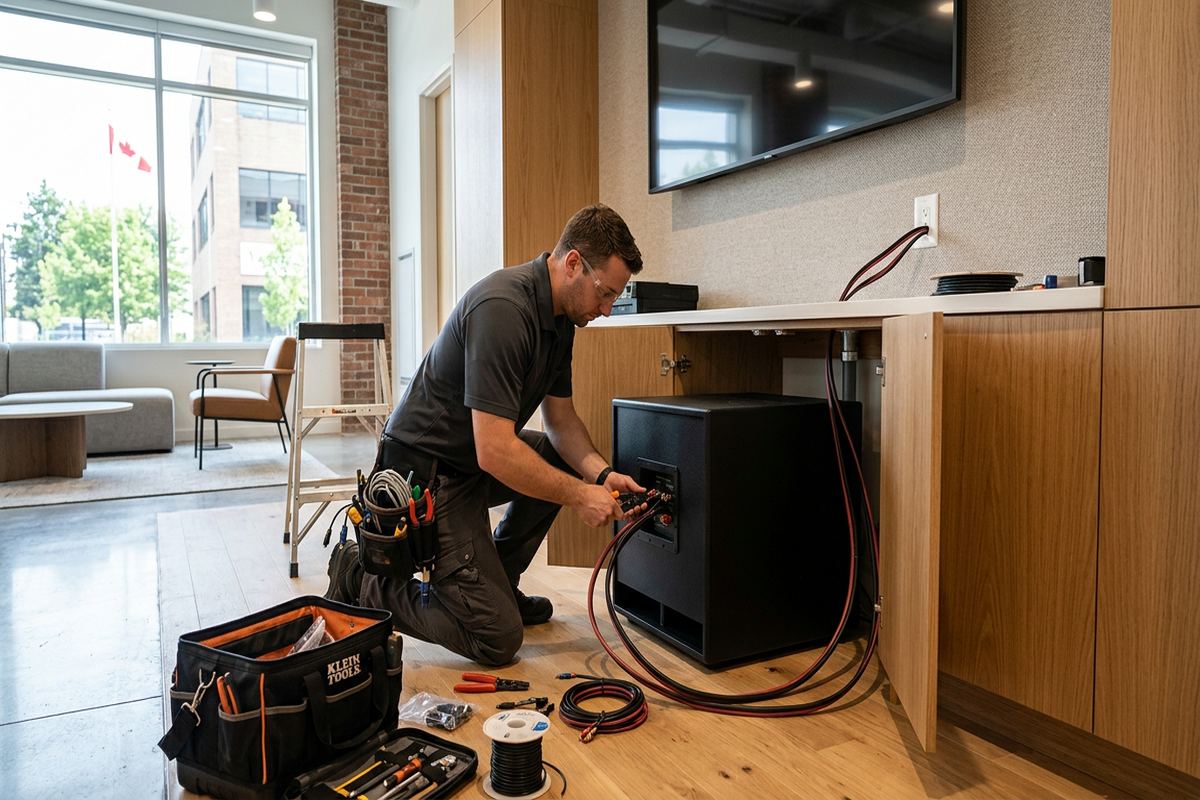
Reliable audio depends on cable that matches the speaker load, run distance and installation environment. UnifiedLink installs continuous labelled cable runs rather than leaving unidentified joins hidden inside walls. Routes are planned to reduce interference, preserve service access and avoid heat sources or sharp structural edges. Where cable passes through framing, penetrations are made carefully and sealed where required. Central terminations are organized so each zone can be identified during configuration or future service. Existing cables may be tested and reused when their condition, type, routing and termination are suitable for the proposed system.
Masonry and frame buildings present different installation choices. Solid stone or brick can require exposed conduit, discreet raceway, accessible floor transitions or routes through adjacent framed partitions. Wood-frame construction often offers more concealed pathways, but fire blocking, spray foam and finished basements can still prevent direct access. In Cambridge heritage properties, preserving trim, plaster and exterior character may be more important than achieving completely invisible cabling. We discuss those trade-offs during assessment and include the selected method in the written scope, including any areas that require access by another qualified trade.
Multi-unit properties require additional planning because walls, ceilings and utility spaces may be common elements rather than part of the individual unit. Condo boards, property managers or landlords may need to approve speaker openings, equipment locations, exterior penetrations and cable routes. Tenants should obtain written permission before permanent work is scheduled. We can provide a defined scope and placement information for the approval process, but the customer remains responsible for securing authorization. Noise transfer also matters, so independent volume control and carefully selected locations can be more appropriate than high-output speakers near shared assemblies.
- Continuous labelled speaker cable
- Routes suited to masonry or framing
- Organized central terminations
- Approval planning for shared properties
- Accessible pathways for future service
Cambridge, Ontario
Whole-home audio installation in Cambridge, scoped in writing first
Book a site assessment and get equipment, routes, exclusions, and warranty on paper before anything is installed.
Audio Zones and Controls in Cambridge
Zoning allows occupants to choose where audio plays without operating the entire property at once. A practical Cambridge system might separate the kitchen, living room, bedrooms, basement and patio, with grouping available when the same source is wanted throughout several areas. Each zone needs suitable amplification and a clear control method. Depending on the design, users may operate zones from an app, wall control, remote or local volume control. We avoid creating unnecessary complexity and explain which functions depend on the local network, an online account or a particular source service.
Control design should reflect who uses the building. A family may want straightforward room names and restricted maximum levels for bedrooms, while a small office or customer-facing space may need scheduled background audio and controls that staff can use without accessing system settings. Guest access can be separated from administrative control where supported by the selected platform. All primary accounts are established with the customer’s own credentials. UnifiedLink does not retain ownership of the system account, helping the customer maintain control when phones, staff, tenants or service providers change later.
Network performance is especially important when amplifiers and sources rely on streaming or wireless control. Before promising reliable app operation, we review equipment locations, available Ethernet connections and Wi-Fi coverage near regular control areas. Wired network connections are preferred for fixed equipment when practical, while phones and tablets still depend on usable wireless service. Industrial units and larger Cambridge homes can have concrete, metal, mechanical equipment or long distances that weaken signals. Audio installation may therefore require network improvements, but those requirements are identified separately rather than hidden inside the speaker scope.
- Independent room and area zones
- Grouped playback across selected spaces
- Customer-owned administrative accounts
- Simple room naming and controls
- Network requirements identified before installation
Outdoor Audio for Cambridge Conditions
Outdoor speakers must be selected and installed for exposure rather than treated as indoor equipment mounted outside. Cambridge winters bring freezing conditions and repeated freeze-thaw cycles that can stress housings, brackets, cable entries and wall penetrations. We use appropriate exterior mounting methods, create controlled cable paths and seal penetrations to limit water entry. Drip management and connector placement are considered so moisture is not directed into the building envelope. Equipment ratings still have limits, and the written scope identifies which components are intended for exterior use and where they will be installed.
Patios in Blair, Preston and riverside neighbourhoods often need targeted coverage rather than high volume. Speakers directed toward the listening area can provide usable sound while reducing spill toward neighbouring homes, sidewalks or the river corridor. Multiple speakers operating at moderate levels may work better than one unit driven loudly from the house. Placement also accounts for doors, windows, seating, landscaping and future maintenance access. Local noise rules, condo requirements and landlord conditions remain the property owner’s responsibility, so outdoor audio should be operated with reasonable levels and suitable hours.
Exterior mounting surfaces require different fasteners and sealing details. Brick veneer, solid masonry, siding and wood trim cannot be approached with the same hardware or drilling method. Mounting into mortar may not always be appropriate, and decorative stone can make cable concealment difficult without risking visible damage. Where a route passes from a heated interior to an exterior wall, we consider insulation, air sealing and water management. Outdoor zones are tested from normal seating positions, then level limits and controls are adjusted to support practical use rather than projecting sound beyond the property.
- Exterior-rated speakers and mounting hardware
- Sealed cable and wall penetrations
- Placement aimed toward listening areas
- Freeze-thaw conditions considered
- Independent patio volume control
Cambridge Renovations and New Construction
Pre-wiring during construction or renovation provides more speaker choices and cleaner cable routes than working after every surface is finished. Plans should be reviewed before insulation and drywall, but after major framing, ductwork, plumbing and electrical routes are known. We mark speaker positions, identify central equipment space and coordinate pathways with the project team. Cables are labelled at both ends and protected where they pass through framing. Before surfaces close, routes and termination points can be recorded for the as-built documentation, reducing uncertainty when speakers and equipment are installed during the finishing stage.
Retrofit installation is still possible, although the available routes depend on the building. Finished basements, tiled walls, built-in cabinetry and inaccessible roof spaces can limit concealment. A retrofit assessment may identify closets, utility rooms, return-air spaces that must not be used, or carefully placed raceways that keep wiring serviceable. In stone heritage buildings, the least invasive route may be more appropriate than the shortest route. We distinguish confirmed pathways from assumptions and note exclusions, patching responsibilities or specialist work before pricing, helping Cambridge owners understand the likely impact on finished surfaces.
Commercial strips and industrial parks bring different requirements from residential projects. A retail unit may need evenly distributed background sound, staff-only controls and coordination with leasehold improvements. An industrial unit can contain high ceilings, metal structures, machinery noise and large distances that change speaker selection and cable design. Landlord approval may be required for penetrations, roof areas or shared electrical rooms. We define the audio work clearly and coordinate with other contractors where necessary, while avoiding claims that a general music system provides paging, emergency communication or life-safety functions unless those systems are specifically designed and approved.
- Pre-wire planning before drywall
- Labelled cables at both ends
- Retrofit routes assessed on site
- Coordination with builders and trades
- Commercial and industrial zone planning
Installation, Configuration and Handover
Installation follows the approved scope, beginning with protection of work areas and confirmation of device positions. Cable runs are installed, labelled and terminated before speakers and central equipment are connected. Where unexpected blocking or concealed services prevent the planned route, work pauses long enough to review a safe alternative rather than forcing a damaging path. Speakers are secured to suitable structure or approved mounting surfaces. Equipment receives appropriate ventilation and accessible connections. The system is then powered, checked zone by zone and inspected for obvious noise, incorrect polarity, loose fittings or control problems.
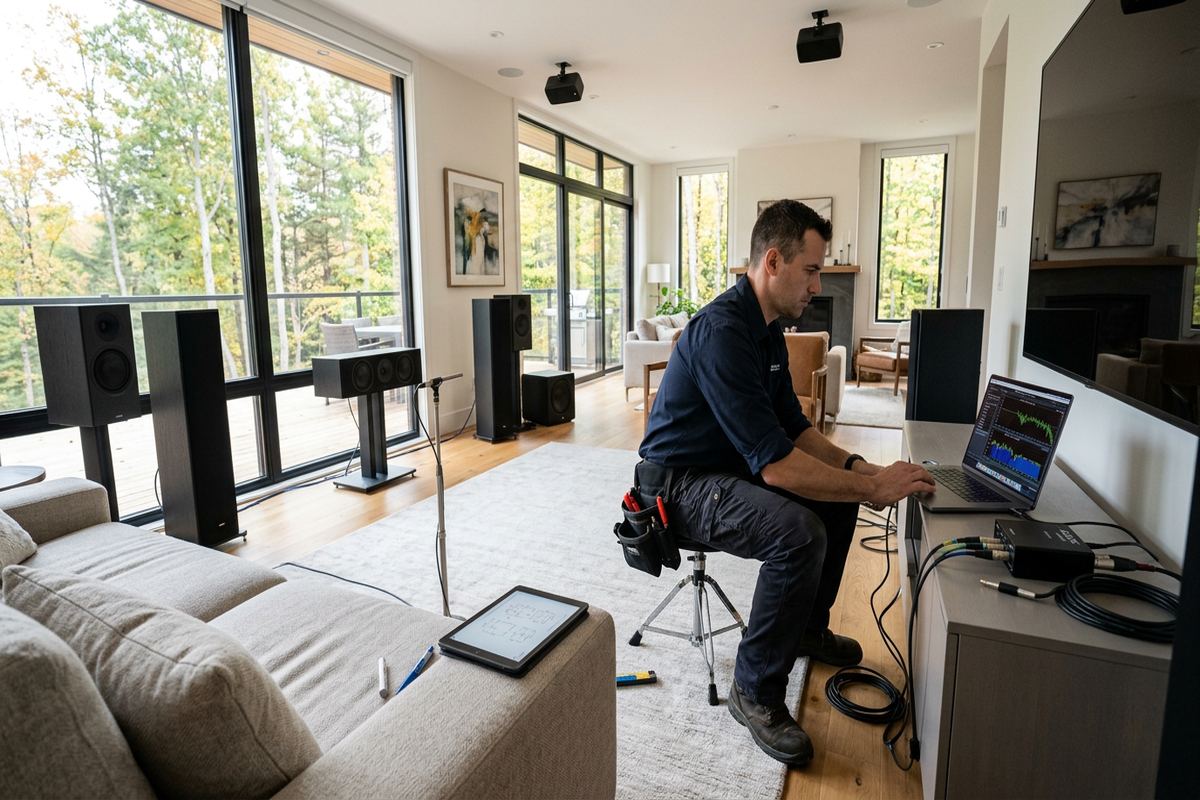
On-site configuration turns installed components into a usable system. We name rooms clearly, assign sources, set basic level limits, group zones and connect supported services using the customer’s own credentials. Listening checks confirm that every speaker operates and that left-right assignments or mono settings match the intended layout. Outdoor and shared areas may receive conservative default levels. Configuration also includes demonstrating normal operation from the selected controls. Specialized acoustic calibration is only included when stated in the scope; ordinary commissioning focuses on correct function, balanced everyday listening and understandable control.
At handover, the customer receives an as-built record describing cable destinations, equipment connections and relevant device locations. We review how to select a room, start a source, adjust volume, group zones and perform basic restart steps. Ownership of equipment and account access follows the written scope, with administrative credentials remaining under customer control. Any outstanding exclusions or work by others are identified. This documentation is particularly useful in Cambridge properties with hidden retrofit routes, multiple renovations or equipment installed away from the listening rooms, because future changes do not depend entirely on memory.
- Protected work areas and confirmed positions
- Zone-by-zone testing and configuration
- Customer-owned system credentials
- Operating demonstration at handover
- As-built connection and cable record
Getting a Whole-Home Audio Quote in Cambridge
Pricing follows a site assessment because whole-home audio cost depends on more than the number of speakers. Construction type, cable accessibility, room geometry, exterior work, zone count, control platform and existing network conditions all affect the required labour and equipment. During the assessment, we discuss priorities and separate essential work from optional additions. This is also the point to identify surfaces that cannot be disturbed, rooms with limited access and equipment the customer hopes to reuse. Site assessment timing depends on the service required and travel distance.
The resulting written scope covers equipment, cable routes, device placement, exclusions, equipment ownership and warranty. It can also identify assumptions such as open framing, available network ports, customer-provided streaming subscriptions or approval by a condo board or landlord. Clear exclusions matter when patching, painting, electrical work, hazardous-material investigation or heritage restoration falls outside the audio installation. Changes requested after approval are documented before related work continues. This approach gives Cambridge property owners a practical basis for comparing the proposed system with their rooms, construction constraints and preferred way of using audio.
UnifiedLink provides one accountable contractor for the defined low-voltage audio work, including planning, cabling, speaker installation, on-site configuration and handover. Requests sent during business hours are answered the same day, while after-hours requests are answered the next business day. That wording concerns the initial response, not a guaranteed assessment or installation time. Whether the property is in Hespeler, Preston, Galt or another part of Cambridge, useful information to provide includes the property type, desired rooms, renovation status, exterior zones, available plans and any known approval requirements.
- Site assessment before pricing
- Written equipment and installation scope
- Exclusions and ownership stated clearly
- Assessment timing based on service and travel
- One contractor accountable for defined audio work
Cambridge neighbourhoods we cover
- Galt
- Preston
- Hespeler
- Blair
- West Galt
- Clemens Mill
Whole-home audio installation in Cambridge — common questions
Can you install audio in an older Cambridge home?
Yes, subject to a site assessment. Older Cambridge homes may contain plaster and lath, solid masonry, irregular framing or finished additions that restrict concealed routes. We review accessible basements, attics, closets and service pathways before proposing a method. Where hidden cabling would cause excessive disturbance, discreet surface raceway or another documented route may be recommended.
Can speakers be installed in stone walls?
They can sometimes be mounted on or near stone, but the method depends on whether the wall is solid masonry, veneer or a protected decorative surface. Cambridge stone heritage buildings require careful route and fastener planning. We assess the substrate, cable access and risk to finishes before specifying placement, and may recommend an adjacent framed wall or surface-mounted solution.
Do I need separate audio zones?
Separate zones are useful when rooms need independent sources or volume levels. Many Cambridge homeowners separate kitchens, living areas, bedrooms, basements and patios, then group them when desired. The right number depends on daily use, amplifier capacity and budget priorities. We plan zone boundaries during assessment and avoid adding controls that do not provide a practical benefit.
Will outdoor speakers handle Cambridge winters?
Outdoor speakers must be rated for their intended location and installed with suitable brackets, cable entries and sealed penetrations. Cambridge freeze-thaw conditions remain demanding, so placement should reduce direct exposure where practical and allow inspection. Exterior-rated equipment is not maintenance-free; housings, fasteners, seals and nearby building surfaces should be checked periodically for movement, corrosion or water entry.
Can you work in a condo or rental property?
Yes, provided the required approvals are in place. A Cambridge condo board, property manager or landlord may control ceiling openings, common walls, exterior mounting and cable routes. We can prepare a written scope and placement details to support the request, but the owner or tenant is responsible for obtaining authorization before permanent installation work is scheduled.
Can my existing speakers or wiring be reused?
Possibly. Existing Cambridge installations are assessed for cable type, condition, routing, labels, speaker compatibility and safe termination. Equipment also needs to work with the proposed amplifier and control platform. Reuse is included only when testing supports it; unidentified, damaged or inaccessible wiring may need replacement. Any reused customer-owned equipment and related limitations are recorded in the written scope.
Coverage in Cambridge is confirmed against the address before we quote. See everything we install in Cambridge or the province-wide whole-home audio installation page.