UnifiedLink installs outdoor TVs for homes, restaurants, commercial patios and shared amenity areas across Cambridge and Waterloo Region. We assess the mounting surface, viewing position, cable route, power location, weather exposure and network requirements before pricing. Each installation is configured on site and handed over using the customer’s own credentials.
Outdoor TV Installation Planning in Cambridge
An outdoor television needs more planning than an indoor wall-mounted display. In Cambridge, the proposed location may face direct sun, wind-driven rain, snow accumulation and repeated freeze-thaw cycles. We begin with a site assessment covering the viewing area, expected seating positions, mounting height, glare, structural support, nearby power and available cable routes. The assessment also considers whether the screen will sit under a roof, inside a partial enclosure or on a fully exposed wall. These conditions guide equipment selection, mounting hardware, connection protection and the practical limits of the installation.
Cambridge properties do not share one standard exterior wall assembly. Stone heritage buildings in Galt may require careful routing that avoids unnecessary disturbance to original masonry, while newer frame construction in Clemens Mill may use brick veneer, siding or finished outdoor living structures. A mount must be secured to suitable structure rather than surface cladding alone. We identify the substrate, inspect accessible framing or masonry conditions and plan appropriate attachment points. Where the wall condition is uncertain, the written scope records assumptions, exclusions and any preparation required before installation can proceed.
The viewing plan should account for daily use rather than simply centring a screen on an available wall. Seating depth, standing areas, cooking zones, doors and traffic paths all affect placement. For commercial patios, we also consider sightlines from multiple tables and whether staff need simple source control. Residential installations may prioritize a sectional, pool deck or covered dining area. Before pricing, UnifiedLink documents device placement, cable routes, equipment ownership, warranty responsibilities and exclusions, giving the Cambridge property owner a clear scope instead of leaving mounting and connectivity decisions to installation day.
- Site assessment before pricing
- Viewing height and glare review
- Wall substrate and structure check
- Planned power, signal and network routes
- Written scope with stated exclusions
Choosing a Display for Cambridge Outdoor Conditions
Outdoor-rated displays are designed for conditions that ordinary indoor televisions are not intended to handle. The appropriate model depends on whether the location is shaded, partially protected or exposed to direct weather. Brightness, operating temperature range, enclosure design, ventilation and connection protection should be compared against the actual site. Cambridge winters add low temperatures, moisture and freeze-thaw movement, while summer patios can experience heat and strong afternoon glare. We help define the required installation conditions, but the customer retains control of equipment selection and receives documentation identifying who owns and warrants each supplied component.
A covered porch does not automatically make an indoor television suitable for outdoor use. Moisture can enter from humid air, condensation, wind-driven precipitation or water used during cleaning. Temperature changes can also affect internal components even when rain never reaches the screen directly. If a customer supplies the display, we review its mounting pattern, weight, connection layout and manufacturer-stated environment before confirming the scope. Any limitations are recorded plainly. This avoids presenting a sheltered location as weatherproof and helps the owner make an informed decision about protection, seasonal removal, warranty conditions and expected operation.
Screen size should be evaluated against distance, brightness and mounting structure, not chosen in isolation. A larger display may require a heavier mount, wider attachment spacing and more clearance around trim, soffits or doors. Articulating mounts introduce additional leverage on the wall and need room to move without contacting masonry, siding or nearby fixtures. Fixed or tilting mounts may suit exposed locations where movement is unnecessary. In Cambridge backyards and commercial patio areas, we balance visibility with safe clearance, structural requirements and practical access to connections for future service or equipment replacement.
- Outdoor-use rating reviewed
- Sun and shade conditions considered
- Display weight matched to structure
- Mount movement and clearance checked
- Customer-supplied equipment documented
Exterior Mounting on Cambridge Buildings
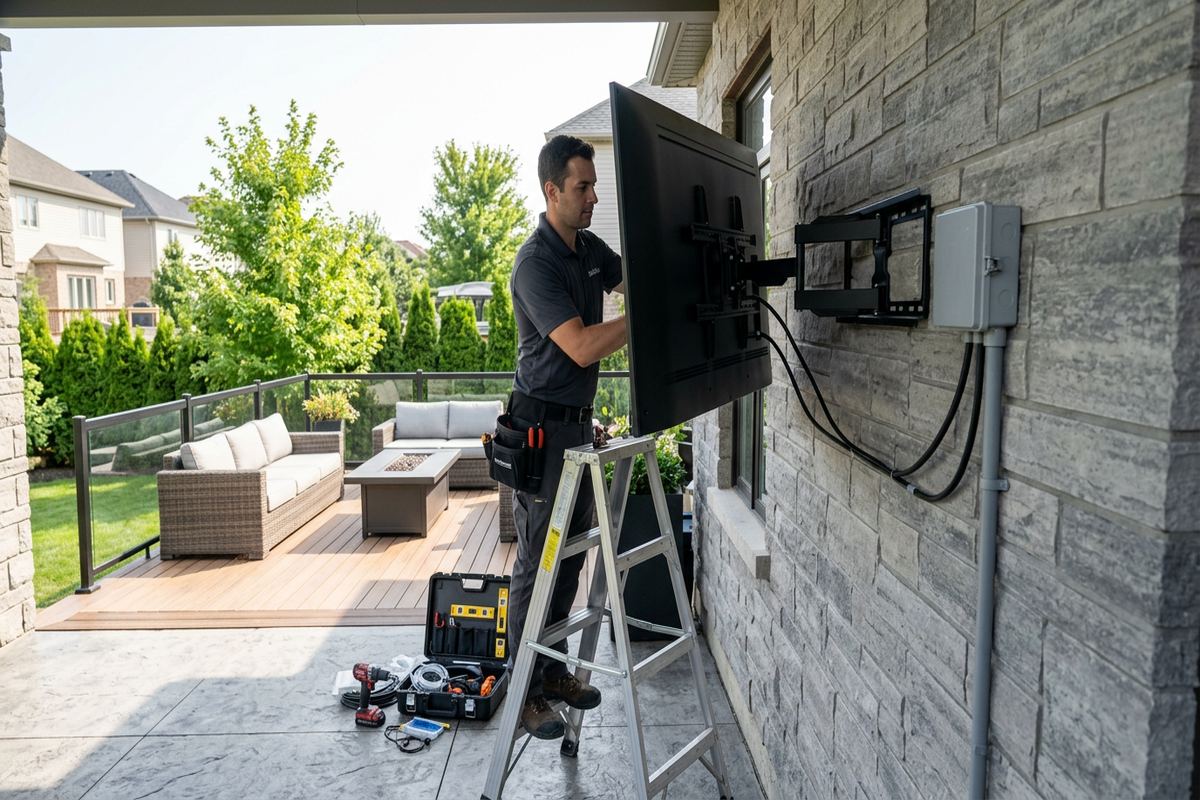
Mounting methods change with the building. Solid masonry, brick veneer, concrete, wood framing and finished cladding each require different attachment and sealing decisions. Stone heritage buildings around Galt and Blair can include irregular surfaces, deep joints and construction details that should not be treated like modern brick. We assess where loads can be supported and whether a less intrusive route is available. The installation scope identifies the intended mounting surface and accessible structure. If restoration work, engineering or specialized masonry repair falls outside the display installation, that requirement is identified before work begins rather than discovered after equipment arrives.
Frame construction presents different concerns, particularly where siding, insulation, rainscreen gaps or veneer separate the mounting plate from structural framing. Fasteners cannot rely on vinyl siding, trim boards or thin exterior finishes as primary support. Spacers, blocking or other preparation may be needed to prevent crushing and maintain drainage details. We also check for likely plumbing, electrical or mechanical services before drilling, using accessible information and site observations. No scan can reveal every concealed condition, so the written scope records relevant assumptions and the process to follow if unexpected material or an obstruction is encountered.
A reliable installation also preserves service access. The screen may eventually need replacement, connection changes or seasonal inspection, and the mount should not trap cables or make connectors unreachable. Articulating equipment requires enough slack for movement without pinching or rubbing the cable jacket. Fixed installations need connection planning before the display is lifted into place. Across Cambridge, we use continuous labelled cable runs where new low-voltage wiring is included, avoiding hidden intermediate joins. Labels and an as-built record help the owner identify each run later without dismantling finishes or guessing where a cable terminates.
- Attachments matched to wall construction
- Cladding not used as structural support
- Mount clearances checked before drilling
- Continuous labelled low-voltage runs
- Service access retained behind display
Cambridge, Ontario
Outdoor TV installation in Cambridge, scoped in writing first
Book a site assessment and get equipment, routes, exclusions, and warranty on paper before anything is installed.
Weather Sealing and Winter Protection
Exterior penetrations are planned to limit water entry while respecting the wall’s drainage design. A cable hole should slope, seal and terminate appropriately for the construction type; applying surface sealant without understanding the assembly is not enough. Brick veneer, solid stone, siding and framed outdoor structures manage moisture differently. We select routes that reduce exposure and protect cable jackets from sharp edges, movement and ultraviolet light. Where a penetration needs a sleeve, exterior fitting or compatible sealant, it is listed in the scope. Existing damaged finishes or unserviceable openings are documented rather than concealed behind the television.
Cambridge freeze-thaw conditions make water management especially important. Moisture entering a gap can freeze, expand and contribute to deterioration around masonry or fasteners. Cables also move as materials expand and contract, so exterior routing needs suitable support and reasonable service loops. Drip paths are directed away from openings and connectors, while exposed connections require covers or enclosures appropriate to their location. Weather resistance does not mean maintenance-free. Owners should inspect seals, covers and visible cable supports periodically, particularly after severe winter weather, building repairs or movement of an articulating mount.
Seasonal shutdown procedures depend on the display and connected equipment. Some outdoor screens may remain installed within their specified operating and storage ranges, while other arrangements call for removal or additional protection. Covers can reduce debris and direct exposure, but they must be used in accordance with the display manufacturer’s guidance and should not trap moisture. We explain accessible disconnect points and normal visual checks during handover. For Cambridge businesses with seasonal patios, the written scope can also distinguish permanent cabling from removable displays, media devices or speakers, making spring setup and winter storage more organized.
- Penetrations sealed for wall type
- Drip paths directed from openings
- Exterior cable jackets properly supported
- Connections protected from direct exposure
- Seasonal care explained at handover
Power, Cabling and Network Connections in Cambridge
Outdoor television work often combines several systems, but each has a separate role. The display needs suitable power, a network connection or media source, and sometimes audio, control or television service. Low-voltage cables should not be placed loosely beside line-voltage wiring or passed through openings without protection. UnifiedLink plans and installs the low-voltage portion within the agreed scope and coordinates requirements for electrical work where needed. We do not treat extension cords or indoor power bars as permanent exterior infrastructure. Required receptacle locations and electrical dependencies are identified during the assessment before final pricing.
Streaming quality depends on the network reaching the patio reliably, not merely showing a weak signal near the door. Stone walls, foil-backed insulation, masonry and distance from an indoor access point can reduce wireless performance. Riverside neighbourhoods and larger properties may also have detached structures or deep yards that need a more deliberate connection plan. We test or review available connectivity at the proposed Cambridge viewing area and may recommend structured cabling or an appropriately located access point. Any network work is defined separately, including cable routes, device placement, ownership and configuration responsibilities.
Source equipment needs a protected, serviceable location. Streaming players, receivers, distribution devices and adapters should not be left exposed behind a display unless their environmental rating and available enclosure support that use. When a source is located indoors, a continuous cable route can reduce outdoor equipment and simplify future access. Commercial installations may distribute content from a communications area, while a homeowner may use an app on the display itself. We configure agreed devices on site using the customer’s own accounts and credentials, then record relevant ports, labels and connection paths in the as-built documentation.
- Power dependencies identified before work
- Network coverage reviewed at viewing area
- Signal and control routes documented
- Source devices placed in protected locations
- Customer credentials used for setup
Audio and Control for Outdoor Viewing
Built-in television speakers may be difficult to hear outdoors because sound disperses and competes with traffic, mechanical equipment and conversation. Increasing volume is not always the right solution, especially near neighbouring properties. Speaker placement can provide clearer coverage at lower levels when it is planned around the seating area. UnifiedLink can include compatible outdoor audio in the written scope, with cable routes, mounting locations and source connections documented. In compact Cambridge yards, directional placement and reasonable zoning help keep sound focused on the intended area rather than projecting unnecessarily across fences or toward nearby windows.
Control should remain straightforward for the people who use the space. A residential system may need only the display remote and a streaming application, while a restaurant or workplace could require controlled access to sources and settings. We review how the television will start, select content, adjust volume and reconnect after a power or network interruption. Equipment is configured on site using customer-owned credentials. Where several components are involved, labels and basic operating notes reduce confusion. The handover does not rely on an installer retaining personal login information or leaving the system attached to an account the customer cannot manage.
Audio equipment and controls face the same environmental questions as the display. Outdoor-rated speakers still require secure mounting, suitable cable and correctly protected terminations. Amplifiers and distribution hardware generally need an appropriate indoor or conditioned location unless specifically rated otherwise. We plan pathways so audio wiring is not draped across roofs, doors or walking areas. For patios attached to industrial units in Cambridge, background noise and large open surfaces may affect coverage. The design should address intelligibility and control without making unsupported promises about sound isolation, volume limits or conditions beyond the property boundary.
- Speaker coverage planned around seating
- Outdoor-rated components used where required
- Volume control kept accessible
- Operating steps included at handover
- Audio cable routes labelled
Approvals for Cambridge Condos and Commercial Sites
Permission may be required before any exterior drilling or visible equipment is installed. Condominium corporations can regulate common elements, balcony walls, exterior appearance and cable routes, even when the unit owner purchased the display. Tenants may need written landlord approval, while commercial occupants may need consent from a property manager. We can provide a proposed device location and route for the customer’s approval process, but the owner or tenant remains responsible for obtaining authorization. Work is scheduled after applicable permissions and site rules are understood, avoiding preventable disputes or a mounting location that must later be removed.
Commercial strips and industrial parks introduce access and coordination issues beyond the television itself. Work areas may be near deliveries, customer traffic, production spaces or shared walls. The assessment considers safe access to the mounting point, lift or ladder positioning, hours permitted by the property and the location of communications equipment. Industrial units may use concrete block, precast panels or metal cladding, each with distinct fastening and routing constraints. Cambridge businesses should also decide who can control content and where source equipment will be secured. These operational details are recorded with the physical installation scope.
Shared amenity spaces require clear boundaries between building infrastructure and user equipment. A condominium patio television might connect to corporation-owned networking and power while the display belongs to the corporation or a specific unit. Similarly, a restaurant may lease its premises but own the screen and media hardware. Our written scope identifies equipment ownership, warranty handling, exclusions and dependencies so responsibility is not assumed incorrectly. When another trade must provide power, blocking, waterproofing repairs or network changes, that dependency is noted. One accountable contractor coordinates the agreed low-voltage and display work, while external responsibilities remain visible.
- Condo approval confirmed by customer
- Landlord requirements recorded
- Commercial access conditions reviewed
- Equipment ownership stated in writing
- Other-trade dependencies identified
Outdoor TV Installation Handover in Cambridge
Installation is completed with on-site configuration and a practical handover. We verify the agreed sources, network connection, picture orientation, audio path and mount movement where applicable. Visible cable supports, protected connections and accessible service points are checked against the written scope. The customer signs into streaming or management services with their own credentials rather than receiving a system tied to an installer-controlled account. We also explain normal operation, shutdown and any seasonal steps relevant to the equipment. This gives Cambridge owners control of the finished system without depending on undocumented settings or personal knowledge held only by the installer.
The as-built record identifies installed device locations, cable routes, labels and termination points within the completed scope. It can also note customer-supplied components, approved substitutions and conditions encountered during installation. This documentation is useful when siding is replaced, masonry is repaired, a patio enclosure is added or the display is upgraded. Continuous labelled runs make later tracing more direct and reduce uncertainty around hidden wiring. Warranty information is handed over according to equipment ownership and supplier responsibilities. Exclusions remain documented, including electrical work, building repairs or third-party services that were not part of the installation.
Cambridge service requests sent during business hours are answered the same day; after-hours requests are answered the next business day. Site assessment timing depends on the service and travel distance. During the initial conversation, we ask about the property type, proposed screen location, construction, weather exposure, available power, internet service and whether approvals are required. Photos can help identify obvious constraints, but they do not replace an on-site assessment where structure, access or routing needs confirmation. Pricing follows the assessment and written scope, allowing the work to reflect actual site conditions in Galt, Preston, Hespeler, West Galt or elsewhere in Cambridge.
- On-site system configuration
- Customer-owned accounts and credentials
- Mount and connection checks
- As-built cable and device record
- Same-day business-hour request response
Cambridge neighbourhoods we cover
- Galt
- Preston
- Hespeler
- Blair
- West Galt
- Clemens Mill
Outdoor TV installation in Cambridge — common questions
Can I use a regular indoor TV outside?
A covered location does not necessarily make an indoor television suitable for outdoor use. Cambridge patios still experience humidity, condensation, temperature swings and wind-driven precipitation. We review the manufacturer’s stated environment, the amount of exposure and the customer’s proposed seasonal use. If customer-supplied equipment has limitations, those are documented in the scope rather than represented as weatherproof.
Can you mount a TV on brick or stone?
Yes, when the wall condition and supporting construction are suitable. Cambridge properties may have solid masonry, brick veneer or irregular heritage stone, and each requires a different approach. We assess the substrate, attachment points, cable route and sealing requirements before pricing. Surface appearance alone does not confirm that a wall can safely support the selected display and mount.
Will the cables be visible outside?
Cable visibility depends on the wall assembly, access from inside and the approved route. We plan concealed routes where practical and use supported exterior-rated pathways where concealment is not suitable. New low-voltage runs are continuous and labelled. The Cambridge site assessment identifies the proposed route, visible sections, penetrations and exclusions before installation, so the expected finish is documented.
Do I need condo or landlord approval?
Often, yes. Exterior walls, balconies and patios may be common elements or controlled by a landlord, condominium corporation or property manager. The customer is responsible for securing written permission before work begins. UnifiedLink can document the proposed display location and cable route for review. Cambridge commercial tenants should also confirm drilling, access-hour and exterior appearance requirements with property management.
Can you improve Wi-Fi for outdoor streaming?
Yes, network work can be included after assessing coverage at the viewing area. Masonry, distance and exterior wall materials can weaken an indoor signal before it reaches a Cambridge patio or detached structure. Options may include a structured cable run or an appropriately placed access point. Device ownership, routes, configuration and exclusions are defined in the written scope.
What happens after the outdoor TV is installed?
We configure the agreed display, sources, network connection and audio on site, using your own credentials. Handover includes operating guidance, relevant seasonal care and an as-built record of device locations, cable routes and labels. Equipment ownership and warranty responsibilities are documented. Requests sent during business hours receive a same-day answer; after-hours requests are answered the next business day.
Coverage in Cambridge is confirmed against the address before we quote. See everything we install in Cambridge or the province-wide outdoor tv installation page.