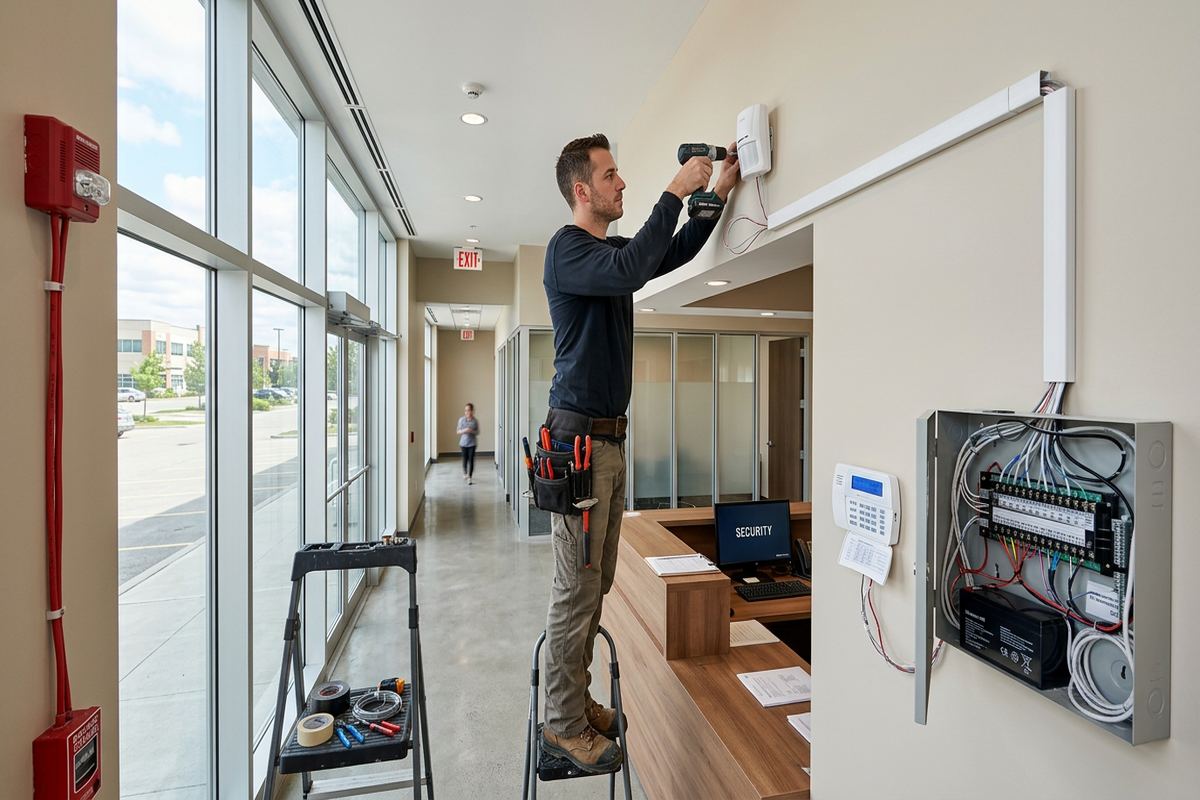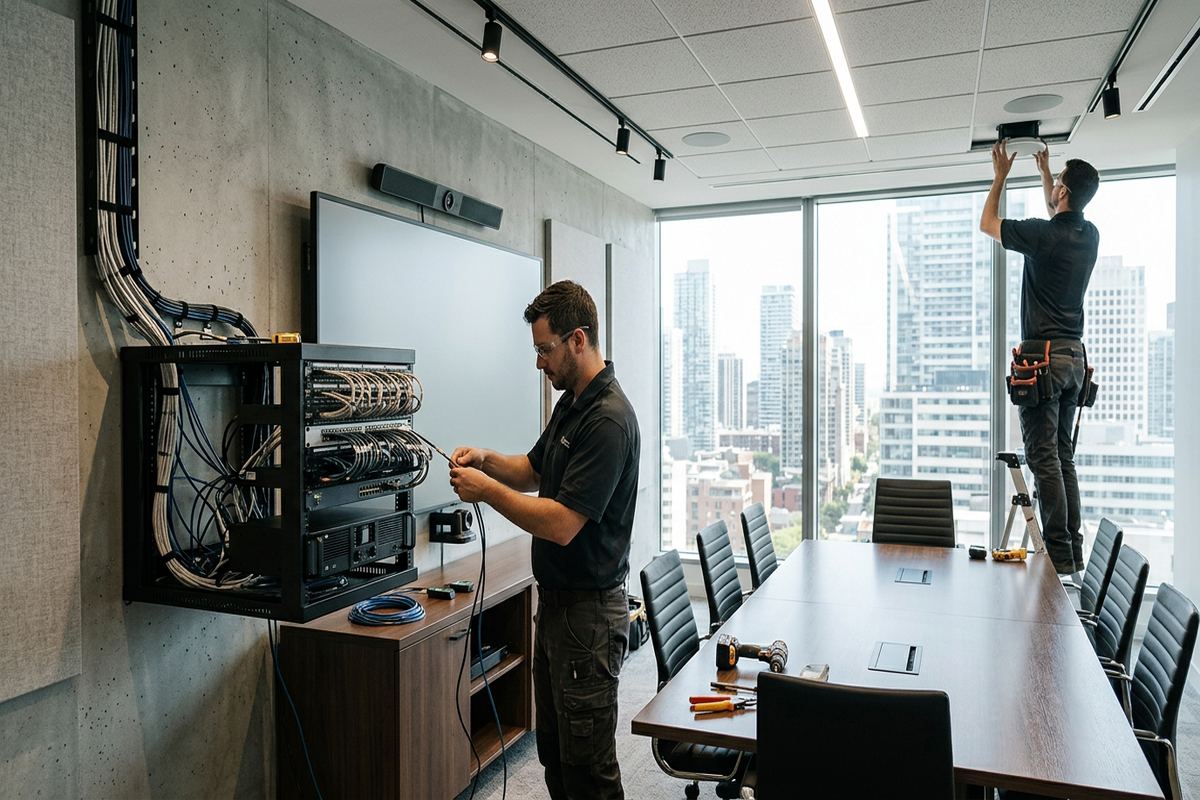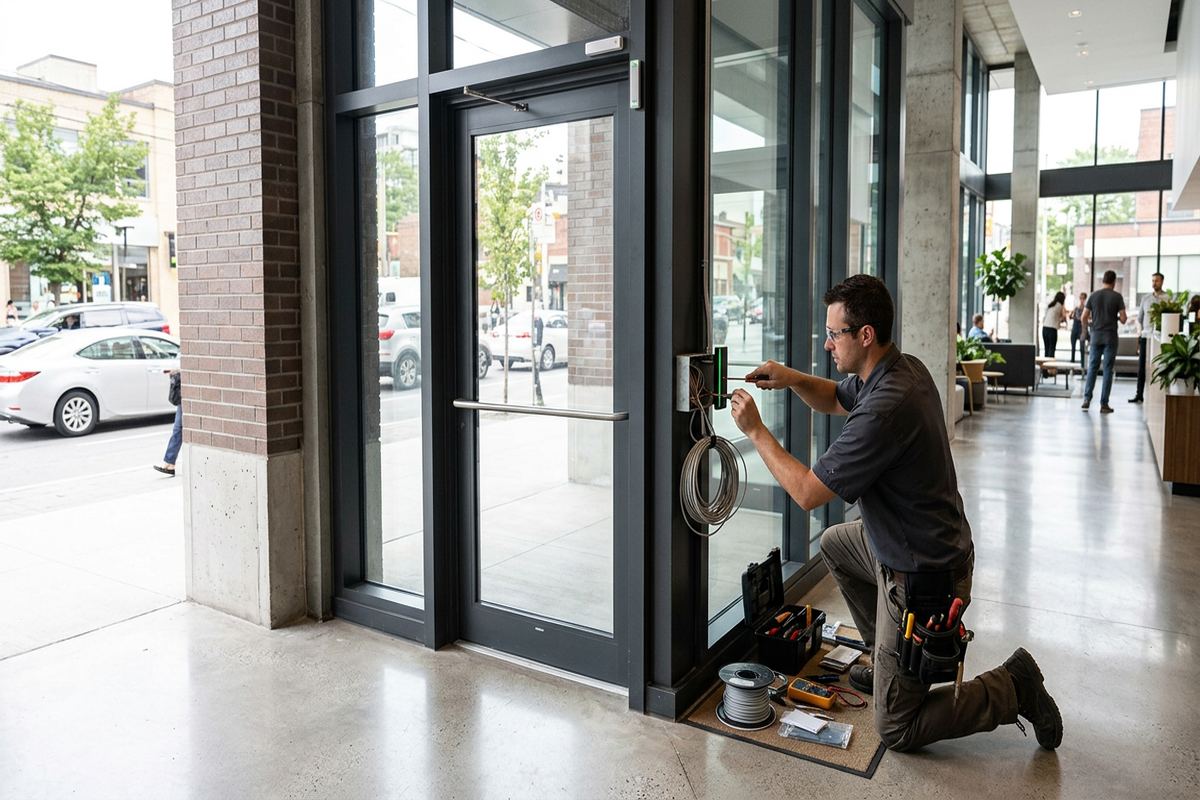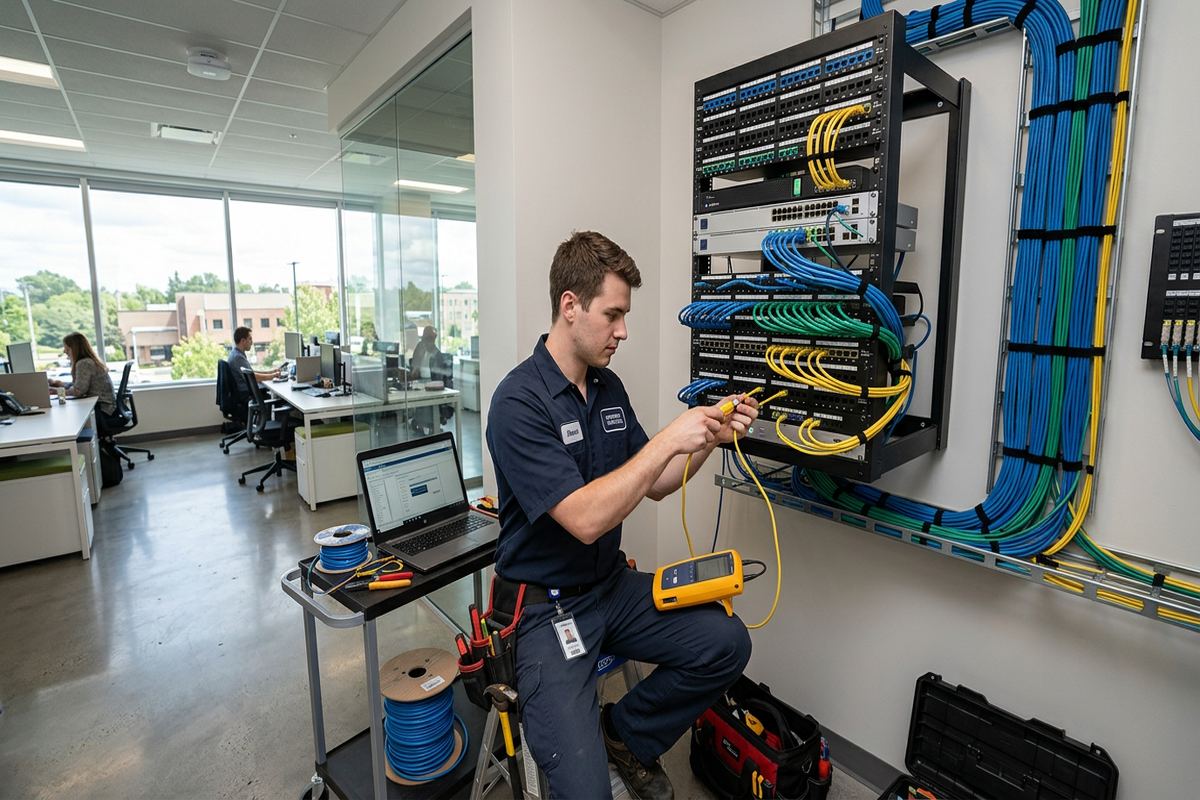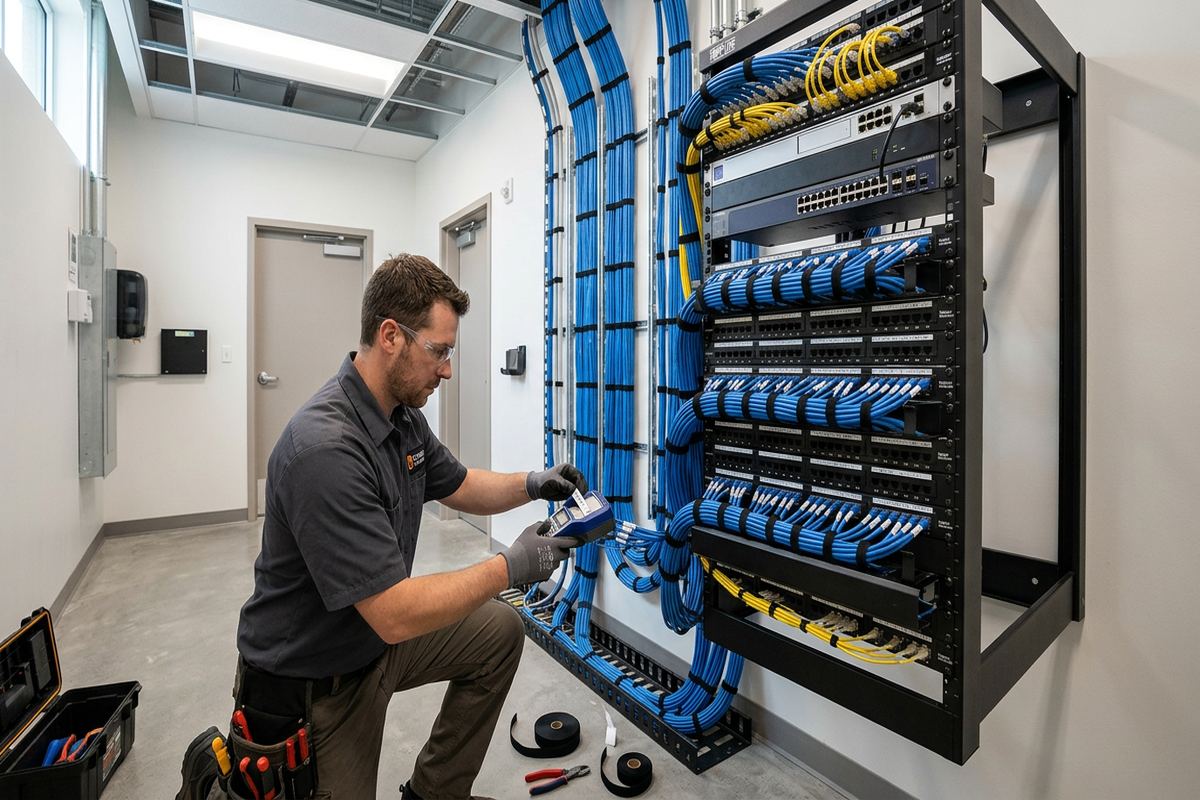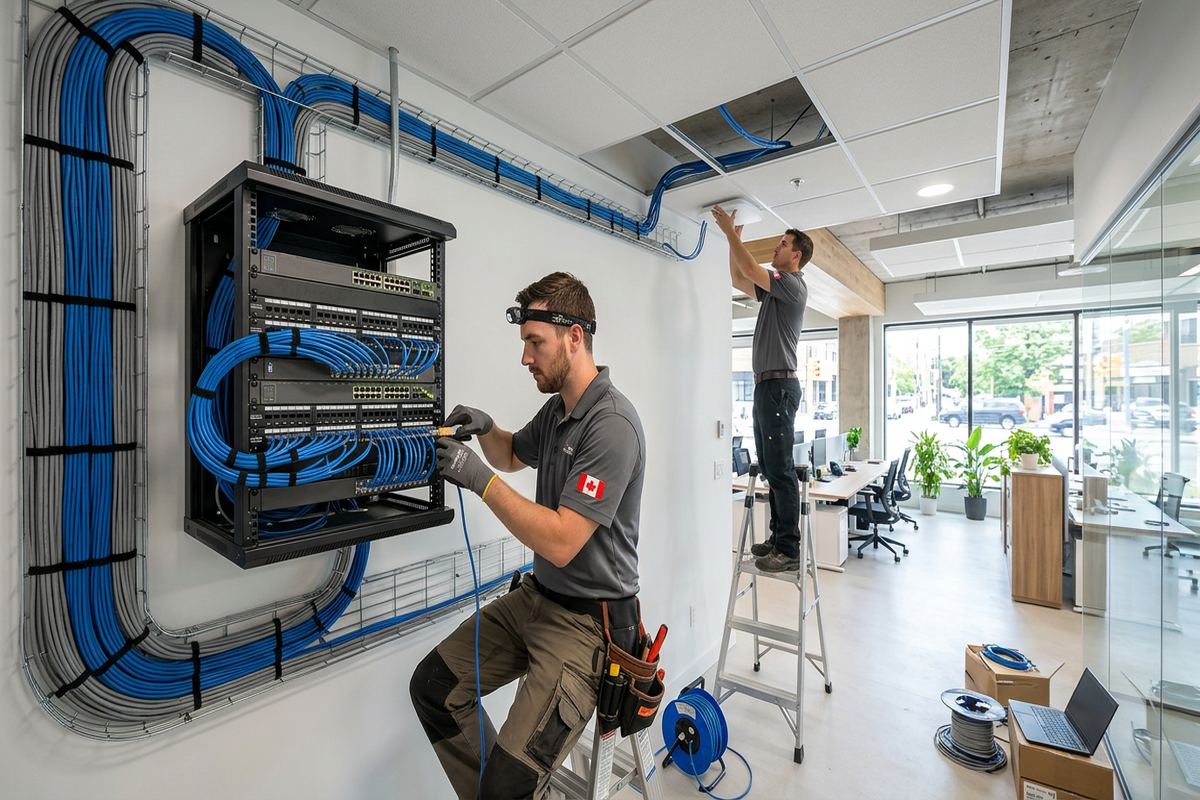
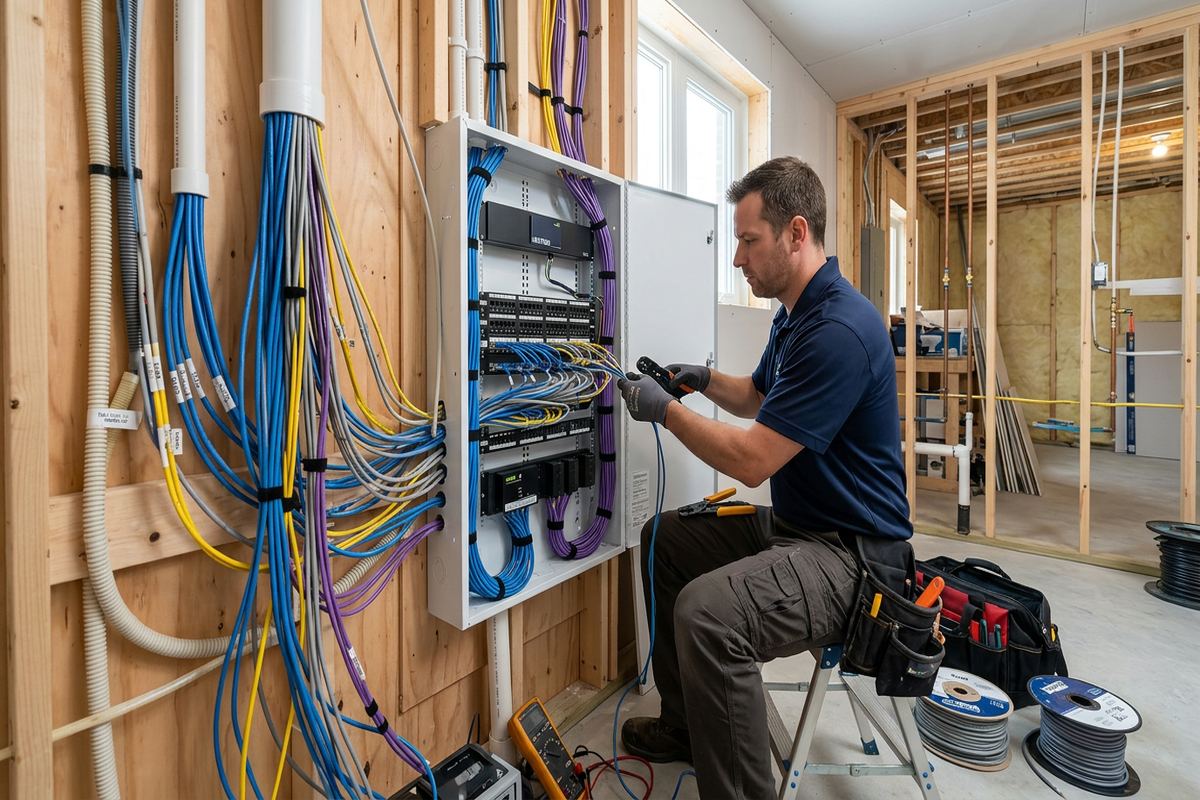
UnifiedLink installs low-voltage cabling for Brockville homes, commercial spaces and industrial units. We plan routes for data, cameras, access control, alarms, Wi-Fi, audio and displays, accounting for masonry, finished interiors and exterior exposure. Each project begins with an assessment and proceeds from a written scope, helping owners understand what will be installed, where cables will run and what the completed system includes.
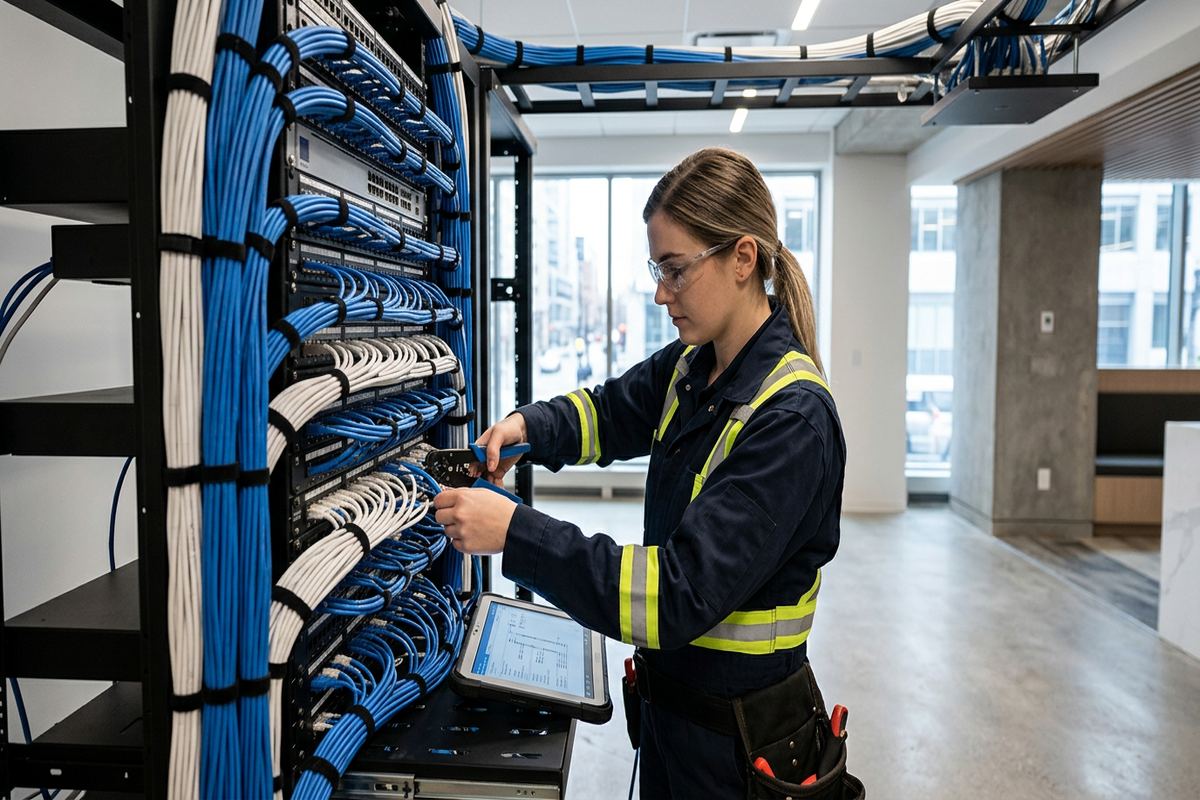
Low-Voltage Cabling for Brockville Properties
Low-voltage cabling provides the physical connection between network equipment, cameras, wireless access points, alarm devices, card readers, speakers and displays. In Brockville, the route often matters as much as the cable. Stone heritage homes may offer few concealed pathways, while newer frame construction can provide accessible basements, attics and service chases. UnifiedLink assesses the building before pricing, identifies practical pathways and specifies the cable types required by the connected systems. The objective is an orderly installation that remains understandable when equipment is replaced, expanded or serviced later.
Every property presents different restrictions. Downtown Brockville buildings may combine thick masonry walls, renovated interiors and shared service areas. Riverfront properties can expose exterior devices and cable entries to wind-driven moisture, cold temperatures and repeated freeze-thaw cycles. North Brockville homes may have more conventional frame construction, but finished basements and insulated garages still affect access. Planning accounts for wall materials, fire separations, ceiling construction, utility locations and the distance between endpoints. Visible routing is discussed before work begins rather than being improvised after concealed options prove unavailable.
A written scope establishes what UnifiedLink will supply and install. It covers equipment, cable routes, device placement, exclusions, equipment ownership and warranty details. This is especially important when cabling supports several systems or crosses areas controlled by a landlord, condominium corporation or commercial property manager. Where approvals are required, the proposed route and mounting approach can be reviewed before installation. Customers receive one accountable contractor for the specified low-voltage work instead of coordinating separate cabling, device and configuration providers without a consistent record of how the infrastructure was assembled.
- Data and network cabling
- Camera and alarm wiring
- Access control cable
- Wi-Fi access point connections
- Audio and display cabling
Planning Cable Routes in Brockville Buildings
Route planning starts by locating the equipment area and every intended endpoint. The assessment considers cable length, serviceability, electrical interference, bend limits and suitable support. In an older Brockville property, a direct route may be blocked by stone walls, plaster finishes or renovations completed in different periods. A less obvious pathway through a basement, utility area or existing chase may reduce disruption. UnifiedLink discusses concealed and surface-mounted options, including where access openings could be needed, so the owner can weigh appearance, future access and the practical limits of the structure.
Masonry and frame buildings require different methods. Cable can often pass through drilled framing members when the route is accessible and structurally appropriate. Solid stone, brick and concrete require careful selection of entry points, anchors, sleeves and sealants. Heritage character calls for discreet, low-impact mounting rather than unnecessary drilling into visible stonework or decorative finishes. Surface raceway may be preferable in some completed rooms because it creates a controlled route without opening broad wall sections. Any proposed exterior penetration is positioned to shed water and avoid creating a vulnerable path into the building envelope.
Commercial spaces introduce another set of route decisions. Retail and office units may share ceiling cavities, utility rooms or risers with neighbouring tenants, while industrial units can include high ceilings, exposed structure and machinery that affects pathway selection. Work may require landlord approval or coordination around operating hours and occupied areas. The written scope identifies accessible work zones and exclusions rather than assuming unrestricted access. For a Brockville business planning a renovation, cabling routes should be reviewed before ceilings close, millwork is installed or equipment locations become fixed, reducing avoidable surface routing later.
- Endpoint and equipment-room review
- Concealed and surface route options
- Masonry penetration planning
- Landlord or condominium coordination
- Future expansion allowances
Cable Selection for Data and Connected Systems
Cable is selected for its application, environment and installation pathway, not simply because it fits the connector. Network drops, powered cameras, wireless access points, alarm contacts, access control hardware, speakers and displays can have different conductor, shielding and performance requirements. The pathway may also require a particular jacket rating based on the space through which it passes. UnifiedLink documents the intended use of each run and avoids treating unlike systems as interchangeable. Appropriate separation from electrical conductors and noise-producing equipment helps protect signal quality and supports a clean, serviceable installation.
Power over Ethernet can carry data and power to compatible cameras, access points, intercoms and other devices, but the full channel still needs to be planned correctly. Cable category, conductor construction, run length, connection hardware and the power requirements of the endpoint all matter. Bundling and ambient conditions can also affect heat. UnifiedLink reviews the connected equipment rather than assuming every network cable will support every device. Where equipment is supplied by others, model information and installation requirements should be available during planning so the cable infrastructure matches the actual load and communication standard.
Exterior and transitional runs need materials suited to their exposure. A cable appropriate for a conditioned indoor room may not be suitable where it enters an unheated garage, travels outdoors or reaches a detached structure. Brockville winters add cold, snow and freeze-thaw movement to the design considerations. Exterior entries require sleeves or suitable protection where specified, a route that limits water tracking and compatible sealing around penetrations. Cables are not left unsupported across siding, masonry or roof edges. Device mounting, drip management and the transition back into the conditioned building are considered as one assembly.
- Application-specific cable selection
- Power over Ethernet planning
- Suitable cable jacket ratings
- Electrical interference separation
- Indoor-to-outdoor transition details
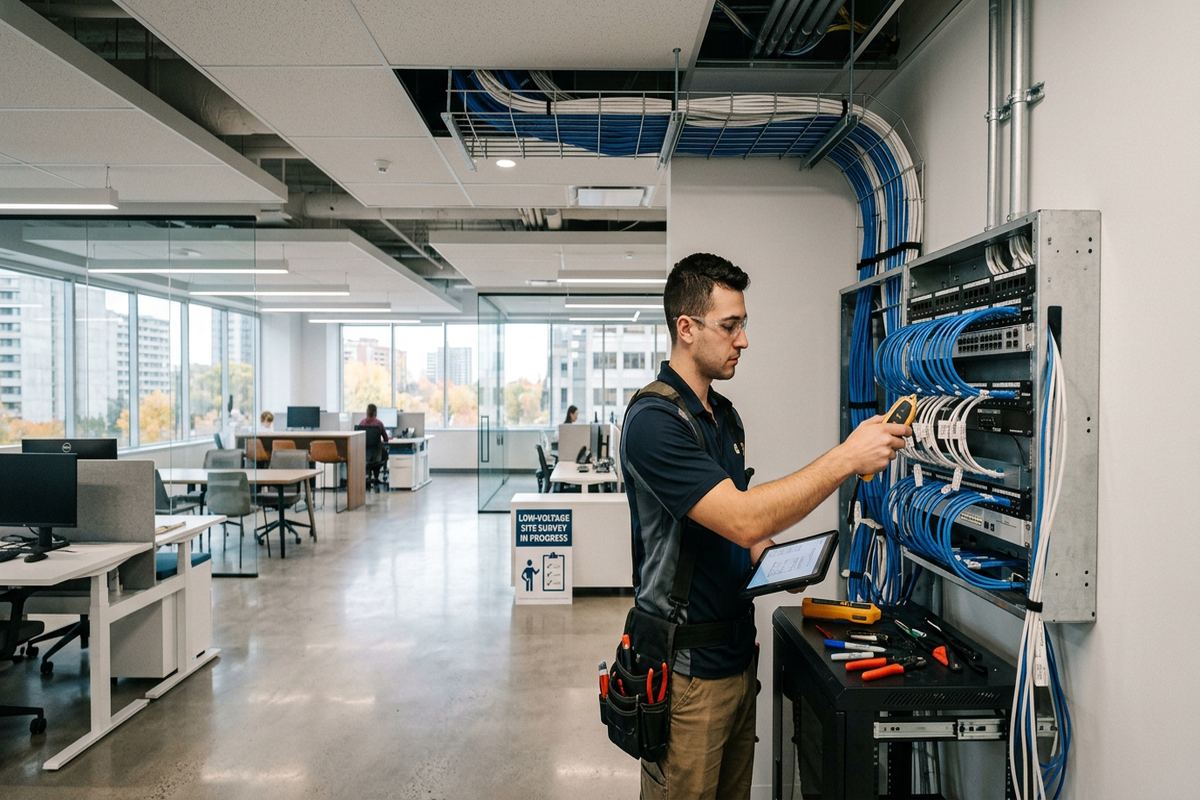
Brockville, Ontario
Low-voltage cabling installation in Brockville, scoped in writing first
Book a site assessment and get equipment, routes, exclusions, and warranty on paper before anything is installed.
Installation Standards for Brockville Cabling
Installation follows the approved route and maintains continuous labelled cable runs between defined termination points. Cables are supported using suitable pathways or fasteners rather than resting loosely on ceiling systems or being attached without regard for structure and access. Bend radius, pulling tension and separation are managed during placement. Labels correspond to the equipment area and endpoint, making each run easier to identify during configuration or later service. If site conditions reveal a blocked route or concealed obstacle, the alternative is discussed instead of silently moving the cable to a visibly different location.
Penetrations receive attention because a small opening can create a long-term moisture, air or pest pathway. On Brockville exterior walls, the mounting surface may be wood, siding, brick, concrete or irregular stone. The method must suit the substrate and the expected movement of materials through seasonal temperature changes. Entries are located and formed to reduce water exposure, then sealed with compatible products. Cabling is protected from sharp edges and unnecessary strain. For riverfront properties, discreet placement must also account for greater exposure around walls, soffits and device mounts facing open water.
Inside the property, installers work around finished surfaces, mechanical systems and occupied areas. Drilling and fishing locations are selected deliberately, but concealed construction can limit certainty about every cavity. The assessment identifies likely access requirements and any exclusions associated with patching, painting, hazardous materials or inaccessible spaces. In Butler's Creek, Centennial or other residential areas, finished basements may shift the preferred route toward utility rooms, closets, garages or carefully placed raceway. Commercial installations may instead use cable tray, conduit, open ceilings or accessible ceiling spaces where the building allows them.
- Continuous endpoint-to-endpoint runs
- Labels at both terminations
- Supported and managed pathways
- Compatible penetration sealing
- Documented route changes
Terminating, Testing and Labelling Runs
A cable run is not complete when it reaches the room. Each end must be terminated with hardware suited to the cable and connected equipment. Data cabling may finish at patch panels, jacks or approved plugs, depending on the application and scope. Camera, alarm, access control and audio wiring use their own termination methods. UnifiedLink keeps service loops controlled, protects conductors from strain and arranges the equipment end so labels remain readable. The result is easier to configure and troubleshoot than a bundle of unmarked cables entering a cabinet without an endpoint record.
Testing depends on the cable type and intended service. Network runs can be checked for wire mapping and relevant link conditions, while other circuits may require continuity, polarity or functional checks with the connected device. The written scope identifies the expected testing and whether active equipment is included. Testing cannot correct an unsuitable product selection or an endpoint placed beyond the system's supported distance, which is why those details are reviewed beforehand. Results and observed limitations are addressed before handover, reducing uncertainty about whether a fault is in the permanent run, termination or connected equipment.
Clear labels connect the physical installation to its documentation. Names should distinguish rooms, device positions or outlet numbers without relying on temporary descriptions that become meaningless after furniture moves. At handover, the customer receives an as-built record showing the installed endpoints and relevant pathways. Configuration is completed on site where included, using the customer's own credentials rather than credentials retained only by the installer. This approach gives a Brockville property owner practical control of the system and a useful reference for future equipment changes, renovations or service by authorized personnel.
- Appropriate endpoint termination
- Readable labels at both ends
- Cable-type-specific testing
- Organized equipment-area dressing
- As-built endpoint record
Cabling for Brockville Homes and Multi-Unit Properties
Residential cabling commonly supports reliable Wi-Fi, security cameras, alarm devices, televisions, work areas and door communications. Good planning places outlets and access points according to room use and building materials rather than relying only on the nearest open wall. Stone and dense masonry can weaken wireless coverage, making wired access point locations particularly important in some Brockville homes. A central equipment location should provide ventilation, power access and reasonable cable paths. It should also remain accessible without placing network or security equipment where it is easily disturbed by daily household activity.
Heritage homes require restraint. Decorative trim, original plaster, exposed stone and narrow framing cavities can make standard fishing methods unsuitable or unnecessarily invasive. Discreet surface raceway, existing service paths or routes through less prominent areas may offer a better balance. UnifiedLink reviews mounting points before drilling and does not assume old masonry has a uniform composition behind the visible face. Riverfront homes add exterior exposure considerations, especially for cameras, wireless links and gate or dock-side devices. The scope should distinguish permanent building work from cabling to seasonal or movable equipment.
Condominiums, rentals and multi-unit properties can restrict where cable may pass and what surfaces may be altered. Common walls, corridors, exterior façades, ceiling spaces and communications rooms may fall under building management rather than the occupant. Brockville owners and tenants should obtain required permission before work begins, including approval for exterior cameras or penetrations. UnifiedLink can define the proposed placement and route for that review, but does not replace the owner, landlord or condominium corporation as the approving authority. Access scheduling and restoration responsibilities are recorded in the scope when they affect installation.
- Wired Wi-Fi access points
- Home office data outlets
- Camera and alarm pathways
- Heritage-sensitive route planning
- Condominium approval support
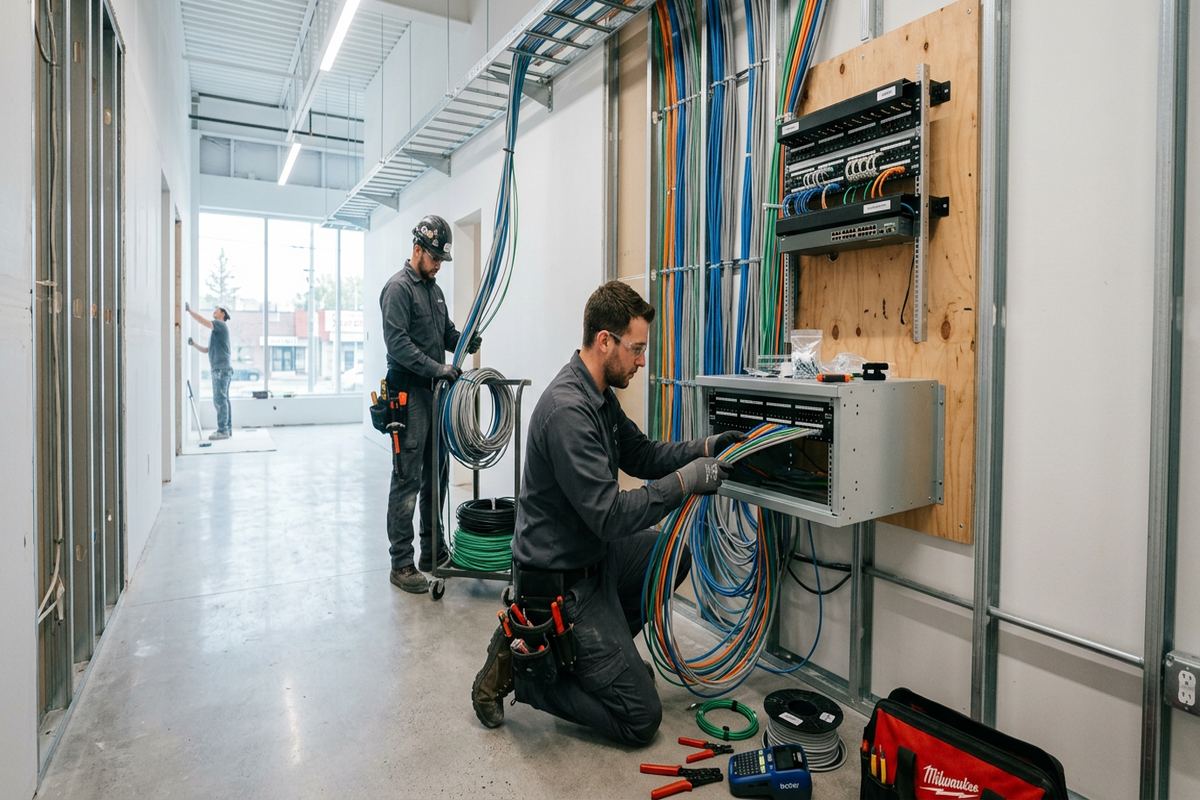
Commercial and Industrial Cabling Applications
Brockville offices, shops and service businesses depend on cabling for workstations, wireless access, phones, payment equipment, cameras, alarms and controlled doors. The layout should reflect actual operations, including counters, stock areas, meeting spaces and public zones. On commercial strips, leased units may contain cabling from previous occupants with uncertain labels or destinations. An assessment can identify reusable pathways, but existing cable is not assumed serviceable without inspection and appropriate testing. New runs are documented separately so owners and tenants know which infrastructure belongs to the current installation.
Industrial units often require longer pathways, elevated work areas and careful separation from power distribution, motors or other sources of electrical noise. Exposed structure can make routes visible and accessible, but it still requires proper support and protection from impact. Device placement must consider racks, equipment movement, doors and changing production layouts. UnifiedLink defines access needs and coordinates the low-voltage scope with available site information. Where lifts, shutdowns, specialized pathways or work by other trades are required, those dependencies and exclusions should be established before scheduling the installation.
Renovation and tenant-improvement projects benefit from early cabling decisions. Outlet positions can be coordinated with desks, displays, access-controlled openings and camera views before walls and ceilings are closed. Pathways can also include practical capacity for known additions without installing speculative devices. In Downtown Brockville, mixed-use and older commercial buildings may have limited risers or shared access areas, making early landlord involvement important. A clear division between electrical work, low-voltage cabling, internet service and customer-supplied equipment prevents gaps where each party assumes another is providing the required connection.
- Office and retail network drops
- Industrial pathway planning
- Camera and door-control wiring
- Tenant-improvement coordination
- Existing cable assessment
Assessment, Scope and Handover in Brockville
Every project begins with a site assessment before pricing. The assessment confirms endpoint counts, building materials, accessible routes, equipment locations and conditions that cannot be verified remotely. Photos and plans can support preliminary discussion, but they may not show fire separations, blocked cavities, shared spaces or the composition of an older wall. Site assessment timing depends on the service and travel distance. Requests sent during business hours are answered the same day, while after-hours requests are answered the next business day. This communication timing is separate from the timing of an on-site visit.
After the assessment, the written scope records the agreed equipment, cable routes, device placement, exclusions, equipment ownership and warranty. Customers can review visible pathway choices, exterior entry points and responsibilities for access or finishing work before installation. Changes discovered on site are handled as scope decisions rather than informal assumptions. For Brockville landlords, condominium owners and commercial tenants, this document can also support approval discussions by showing where work is proposed. It provides a common reference for the customer, installer, property manager and any other trades involved in the project.
Handover brings together the physical installation, configuration and records. UnifiedLink completes included on-site configuration, provides access using the customer's own credentials and supplies an as-built record of the installed cabling. Labels in the field correspond with that record so a future technician can identify endpoints without tracing every line from the beginning. The customer is advised of exclusions, inactive runs or equipment supplied by others that could not be fully commissioned. With one accountable contractor for the defined scope, questions about routing, termination and configuration have a clear point of responsibility.
- Assessment before pricing
- Detailed written scope
- On-site system configuration
- Customer-controlled credentials
- As-built installation record
Brockville neighbourhoods we cover
- Downtown Brockville
- North Brockville
- Rivers Edge
- Butler's Creek
- Centennial
Low-voltage cabling installation in Brockville — common questions
Can you run cable through a stone Brockville home?
Yes, subject to an on-site assessment of the wall construction and available pathways. Stone heritage homes can require routes through basements, attics, service spaces or discreet surface raceway instead of extensive drilling. UnifiedLink reviews visible mounting and penetration locations before work begins, with an emphasis on low-impact methods that avoid unnecessary disturbance to original masonry, plaster and decorative finishes.
How do you protect exterior cable from Brockville winters?
Exterior work is planned for cold temperatures, moisture and repeated freeze-thaw conditions. The installation may use suitable exterior-rated materials, supported pathways, protected transitions and compatible sealing around wall entries. Penetrations are positioned to limit water tracking, and cable is protected from sharp edges and strain. The exact method depends on the wall substrate, device location and degree of exposure.
Do I need landlord or condominium approval?
Approval may be required when cabling crosses common areas, alters an exterior façade, uses a shared communications room or penetrates surfaces controlled by a landlord or condominium corporation. This is common in Brockville rental, commercial and multi-unit properties. UnifiedLink can document the proposed route and device placement for review, but the customer remains responsible for securing required property approvals before installation.
Can you reuse cabling already in my building?
Existing cabling may be reusable if its type, condition, route, termination and performance suit the intended system. In older Brockville commercial units, abandoned or unlabelled runs should not be assumed usable. UnifiedLink can inspect accessible sections and perform appropriate checks within the agreed scope. If a cable cannot be identified or tested adequately, a new documented run may be the more serviceable option.
What documentation do I receive after installation?
Handover includes an as-built record for the installed endpoints and relevant cable routes, along with labels that correspond to that record. Where configuration is included, it is completed on site using the customer's own credentials. The handover also identifies exclusions, inactive runs and relevant equipment ownership or warranty details, giving the Brockville property owner a practical reference for maintenance and future changes.
How soon can a Brockville site assessment be arranged?
Requests sent during business hours are answered the same day, and after-hours requests are answered the next business day. The timing of an on-site assessment depends on the service and travel distance. Before pricing, UnifiedLink reviews the Brockville property to confirm routes, mounting conditions, endpoint requirements and access. This helps ensure the written scope reflects the actual building rather than assumptions made from a remote description.
Coverage in Brockville is confirmed against the address before we quote. See everything we install in Brockville or the province-wide low-voltage cabling installation page.