UnifiedLink installs in-ceiling speakers for homes, offices, retail spaces, warehouses and other properties across Brampton. We plan speaker locations, cable routes, amplification and controls around the room layout and construction. Each project begins with a site assessment before pricing, followed by a written scope so the equipment, installation work and handover requirements are clear.
In-Ceiling Speaker Planning for Brampton Properties
A useful in-ceiling audio system starts with the room rather than a speaker model. During a Brampton site assessment, we review ceiling height, seating or work areas, surface materials, background noise and the intended listening level. A finished basement used for television needs different coverage from a kitchen, open office or warehouse reception area. We also identify where amplification, source equipment and volume controls can be placed without obstructing cabinets, shelving or service access. This planning determines speaker quantity, spacing, cable routes and suitable equipment before installation work begins.
Brampton’s fast-growing subdivisions include open main floors, upper bedrooms and many finished basements. Some homes have accessible joist spaces, while others contain bulkheads, dense mechanical runs, insulation or completed ceilings with limited pathways. Downtown Brampton properties may also have older framing, plaster, masonry sections or previous renovations that are not shown on drawings. We inspect these conditions instead of assuming every ceiling cavity is clear. The assessment helps reduce unnecessary openings and identifies whether cables can run through an attic, unfinished utility room, basement ceiling or another practical route.
Commercial requirements are shaped by how the space is used. A professional office may need low-level background music, while a retail unit may require separate volume zones for the sales floor, fitting rooms and staff areas. In Brampton’s warehouse and logistics sites, office ceilings often sit beside high-bay industrial areas with very different noise and mounting conditions. We define whether the requested system is for music, paging support, presentation audio or a combination. That distinction affects speaker type, amplifier capacity, zoning, controls and the cable method included in the written scope.
- Room use and listening positions
- Ceiling cavity and cable-route review
- Speaker spacing and coverage planning
- Amplifier and source location
- Audio zone and control requirements
Speaker Placement and Coverage Design
Speaker positions should provide balanced coverage without placing every listener directly beneath one loud source. We plan locations around furniture, room boundaries, ceiling fixtures, smoke alarms, HVAC registers and lighting. In open-concept homes, separate kitchen, dining and living areas may share a ceiling but need different listening priorities. The proposed layout considers where people normally sit or move, not only geometric symmetry. Where stereo listening matters, left and right channels are oriented consistently. For distributed background audio, closer spacing at moderate levels can produce a more even result than fewer speakers driven excessively hard.
Ceiling construction affects both sound and installation. Standard drywall over wood framing usually permits conventional cut-in speakers when the cavity is clear. Concrete ceilings, masonry transitions and some condominium assemblies require a different approach because cutting or drilling may be restricted. Suspended commercial ceilings can simplify access, but speaker supports, tile condition and above-ceiling services still need review. In Bramalea and Downtown Brampton, mixed construction and later renovations are common considerations. We confirm the substrate and available depth before selecting back cans, mounting hardware or an alternative surface-mounted speaker where cutting is unsuitable.
Acoustic conditions also matter. Hard floors, large windows, stone counters and bare walls reflect sound, while rugs, upholstered furniture and acoustic ceiling tiles absorb it. A system that sounds controlled in a furnished family room may become harsh in a reflective lobby or empty commercial unit. We account for those differences when setting speaker spacing and selecting equipment. Speaker aiming, if supported by the model, is adjusted toward the listening area rather than a wall or glass surface. Final tuning occurs after installation because drawings alone cannot show how the completed room will respond.
- Balanced speaker spacing
- Clearance from lights and vents
- Stereo channel orientation
- Reflective-surface considerations
- Suitable mounting depth and support
Wiring In-Ceiling Speakers in Brampton Homes
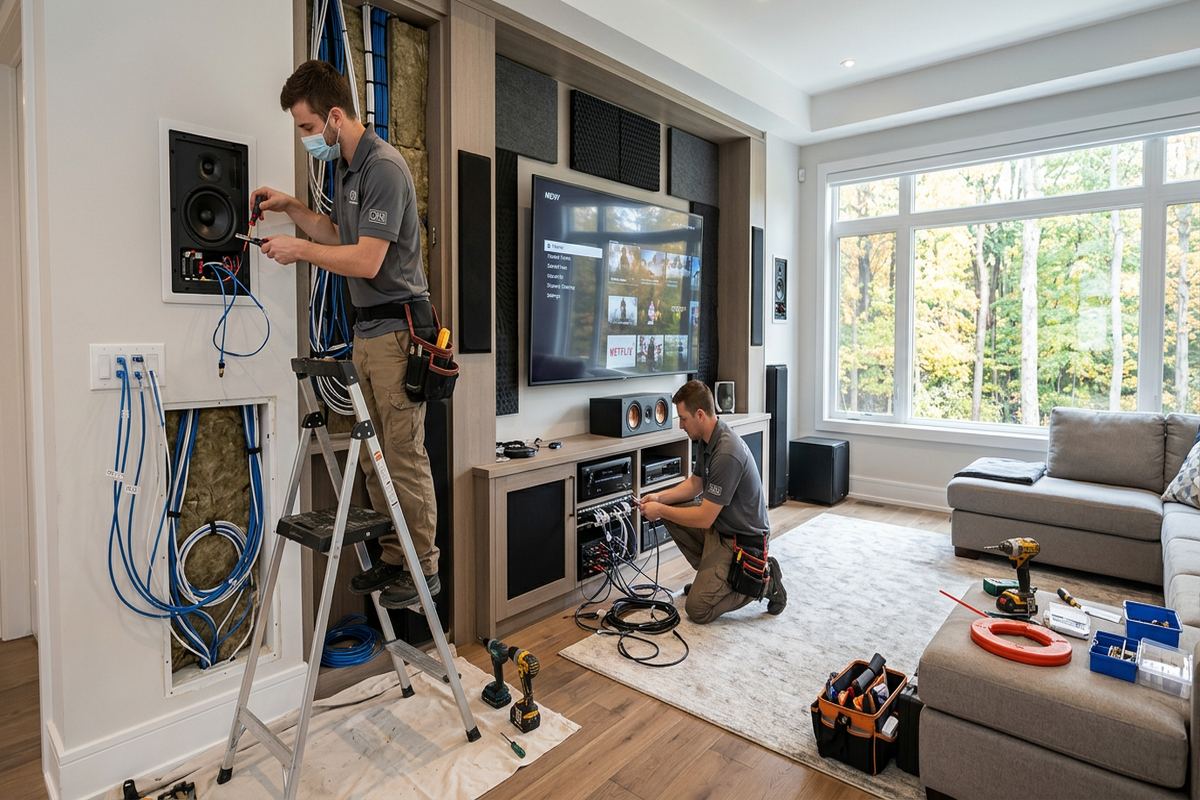
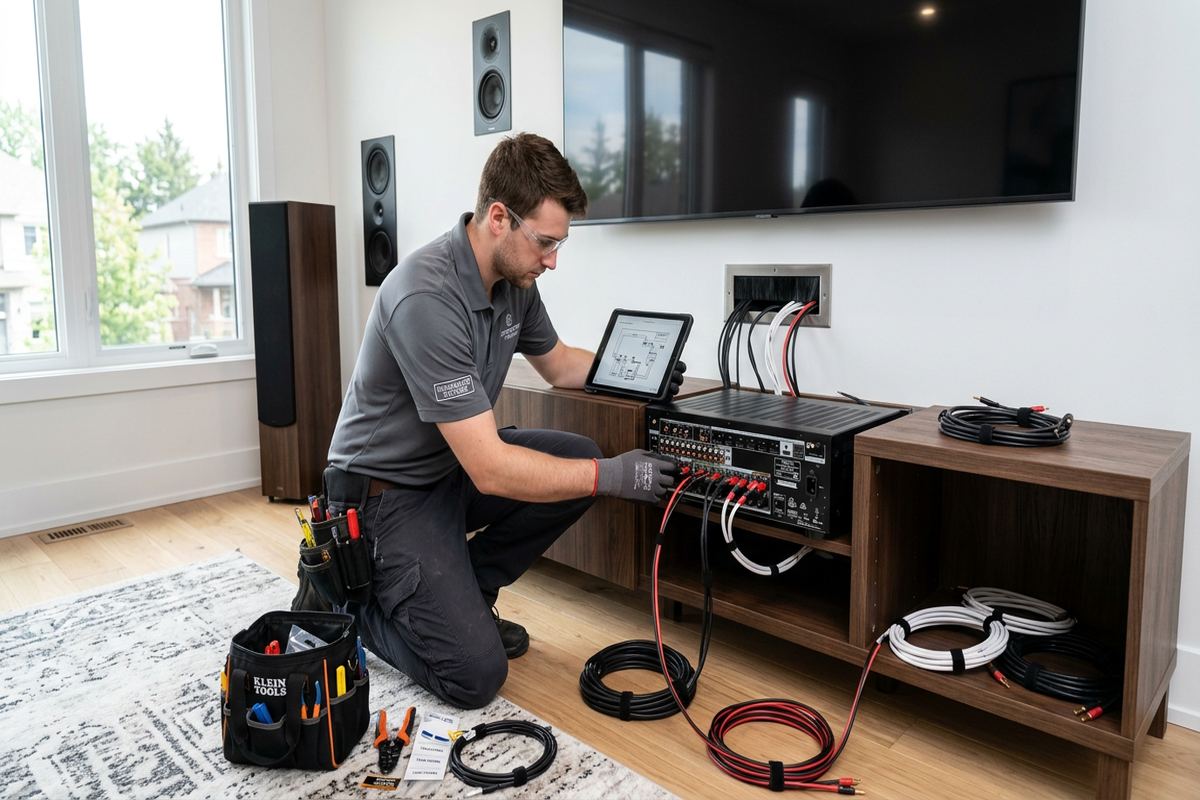
New speaker wiring is routed as continuous, labelled cable runs from each speaker or zone to the agreed equipment location. Continuous runs avoid concealed joins that complicate testing and future maintenance. Cable type and routing depend on wall construction, ceiling access, distance and the equipment design. We keep audio cabling away from electrical conductors where practical and cross power routes appropriately when separation cannot be maintained. Each end is labelled so channels and zones can be identified without tracing cables later. The as-built record documents the finished arrangement for the customer’s reference.
Finished basements across Brampton require careful route planning because ceilings may conceal plumbing, ducts, blocking and structural beams. An unfinished utility room can provide a practical home for an amplifier, but only if ventilation, power, network access and operating convenience are suitable. Where access is limited, small openings may be necessary to drill framing or guide cable. These openings and any responsibility for patching are identified in the written scope. We do not promise an invisible route before inspecting the property, especially where previous basement work has closed every accessible pathway.
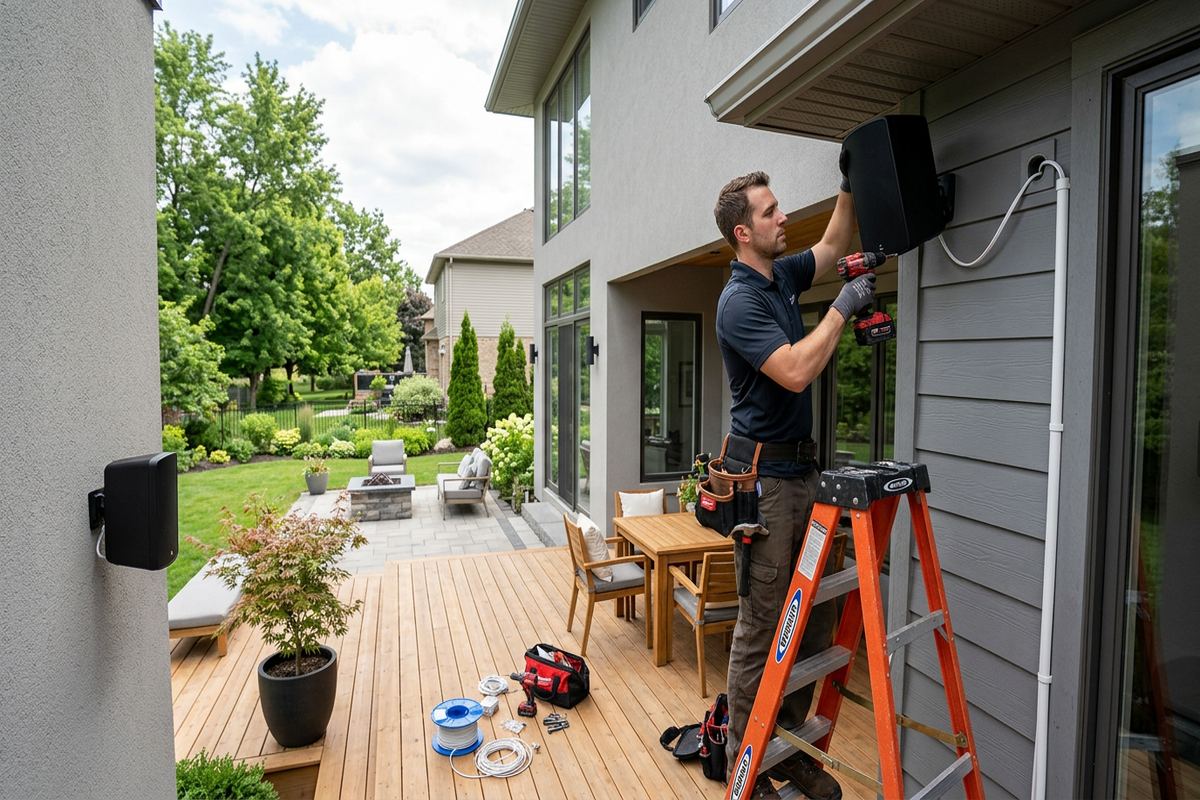
Attic routes are sometimes possible for upper-floor rooms in Springdale, Heart Lake and similar frame-built subdivisions. Ontario winters make attic work and cable selection more than a matter of convenience. Insulation must not be unnecessarily disturbed, and penetrations should not create uncontrolled air leakage between conditioned rooms and cold spaces. We assess access, safe movement and the route around mechanical or electrical services. If audio extends to a porch or outdoor area, exterior penetrations require appropriate sealing against moisture and freeze-thaw conditions, with cable and equipment selected for the actual exposure.
- Continuous cable without hidden joins
- Labels at speakers and equipment
- Routes planned around building services
- Attic and basement access assessment
- Documented cable destinations
Brampton, Ontario
In-ceiling speaker installation in Brampton, scoped in writing first
Book a site assessment and get equipment, routes, exclusions, and warranty on paper before anything is installed.
Multi-Room Audio Across Brampton
A multi-room system should let occupants use the spaces they need without making every speaker play at once. We can plan independent zones for kitchens, family rooms, finished basements, bedrooms, offices or customer-facing areas. Zoning may be handled by a multi-zone amplifier, distributed audio equipment, local volume controls or compatible network audio devices. The appropriate method depends on how many sources are required and who controls them. We clarify whether rooms need independent content, shared content at separate volumes, or simple all-area playback before specifying amplification and control equipment.
Source compatibility is reviewed before installation. A customer may want television audio, music streaming, a computer, a commercial player or an existing receiver connected to the ceiling speakers. These sources do not always provide the same connection type or control behaviour. Television integration can require an audio return connection, an external amplifier or a defined control sequence. Streaming depends on the customer’s network and account configuration. We document supplied equipment, customer-provided components and exclusions so ownership is unambiguous. Configuration is completed using the customer’s own credentials rather than installer-controlled accounts.
For businesses in Brampton commercial strips or industrial units, zones often follow operational boundaries. Reception, offices, lunchrooms, showrooms and warehouse-adjacent spaces may need different volume limits or schedules. High ambient noise does not justify simply turning small ceiling speakers louder; it may call for closer spacing, another speaker format or a dedicated design for that area. We also consider who should have control access. A wall control can be simpler for staff, while an application may suit an owner managing several zones. The handover explains routine operation and the agreed control method.
- Independent room or area zones
- Shared or separate audio sources
- Television and streaming integration
- Local or application-based controls
- Clear ownership of connected equipment
Finished Ceilings, Renovations and Approvals
Installing speakers in a completed room requires verification before any ceiling opening is cut. We use the site assessment to locate framing and identify likely obstructions, but concealed conditions can still differ from drawings or surface indications. Proposed cut-outs are checked against lights, sprinklers, detectors, vents and other visible devices. Where a route passes through cabinetry, millwork or a feature wall, the written scope identifies the intended pathway. Customers should confirm furniture placement and renovation plans beforehand because moving speakers later usually means new cabling work, ceiling repair and changes to the original coverage pattern.
Renovation timing can make an installation considerably more direct. Before drywall is installed, cables can be routed, labelled and secured with speaker locations coordinated against the reflected ceiling plan. If speakers will be installed later, rough-in brackets may help preserve positions where compatible equipment has already been selected. In finished Castlemore or Fletcher’s Meadow homes, access is more constrained, so the route must work around completed millwork, bulkheads and decorative ceilings. We coordinate the audio scope with the customer or renovation contractor, but dependencies such as drywall repair, painting and electrical work remain clearly assigned.
Condominium residents, tenants and commercial occupants may need written approval before ceiling cuts, cable routing or equipment mounting. A landlord or condominium corporation may restrict work involving concrete slabs, common walls, fire-rated assemblies or shared ceiling spaces. Brampton business owners leasing an industrial or retail unit should also confirm restoration obligations and permitted working arrangements. We can describe proposed speaker locations and cable routes for the approval process, but the property owner or tenant remains responsible for securing authorization. Work proceeds only within the approved scope and the accessible areas of the premises.
- Ceiling checked before cut-outs
- Coordination with renovation drawings
- Rough-in options before drywall
- Landlord or condominium approval review
- Responsibilities for patching identified
Commercial In-Ceiling Audio in Brampton
Commercial audio design begins with the intended function and daily operating environment. Background music in a waiting area has different requirements from presentation audio in a meeting room or general sound in a retail space. We review occupancy patterns, ceiling height, finish materials and expected noise. Equipment location is planned for ventilation, security and staff access. Where an existing rack or communications room is available, we assess whether it has appropriate space and pathways. One accountable contractor manages the defined speaker, cabling, termination, configuration and handover work included in the project scope.
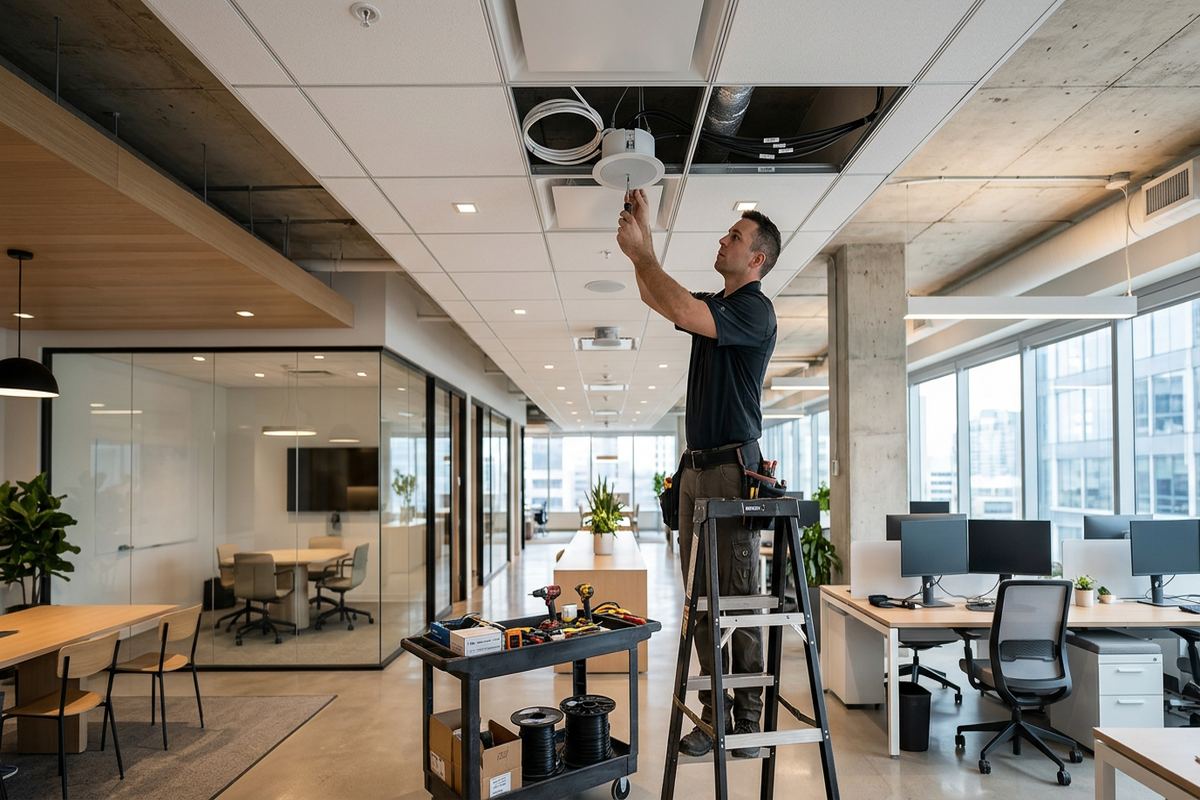
Brampton’s warehouse and logistics base creates recurring transitions between offices, shipping counters, lunchrooms and large industrial floor areas. Conventional in-ceiling speakers may suit enclosed offices with suspended ceilings, but they may not be appropriate for high, open warehouse structures. The design can separate those conditions rather than forcing one speaker format across the entire site. We check ceiling grids, tiles, supports and above-ceiling congestion in office areas. Any work near operational equipment, storage racks or active shipping paths must be planned around site access rules and safe working conditions established by the customer.
Retail plazas and professional units frequently change layout between occupants. Existing speaker cable may be abandoned, unidentified or routed to equipment that has been removed. We test and trace accessible wiring before deciding whether it can be reused. Reuse is not assumed simply because a cable appears above the ceiling. Its route, condition, conductor arrangement and destination must support the proposed system. New runs are labelled consistently, and removed or unused connections are identified where included. At handover, staff receive practical guidance on source selection, zone volume and ordinary shutdown or restart procedures.
- Office and retail background audio
- Separate office and warehouse-area planning
- Existing cable testing and tracing
- Equipment-rack coordination
- Staff control and operation handover
Outdoor-Adjacent Audio and Brampton Weather
In-ceiling speakers installed in covered porches, soffits or other outdoor-adjacent areas need equipment rated for the actual environment. A roof overhead does not eliminate wind-driven rain, humidity, condensation or winter temperature changes. Brampton’s freeze-thaw cycles can stress poorly sealed penetrations and mounting surfaces. We review the ceiling material, exposure, drainage direction and cable entry before proposing a location. Exterior-grade speaker models and appropriate mounting methods are used where required. Indoor speakers are not substituted in exposed locations merely because the opening resembles a typical interior ceiling cut-out.
Penetrations through brick, siding or other exterior finishes require careful routing and sealing. Masonry walls often need a different drilling and fastening method from wood-frame construction, and the cable entry should be positioned to reduce water tracking. Sealants and fittings must be compatible with the surfaces and exposure. Where a route crosses from a warm interior into an unconditioned soffit, air and moisture movement also need consideration. The written scope describes exterior cable routes and visible mounting details so the customer understands how the installation will appear before openings are made.
Audio around a patio or entrance should also be planned with nearby properties and indoor spaces in mind. Speaker orientation and zone control can keep normal listening focused toward the intended area rather than relying on excessive volume. Mount Pleasant and newer Brampton subdivisions may have closely spaced homes, making controlled coverage particularly useful. For a commercial entrance or loading-office area, operating noise and door activity can change audibility throughout the day. We configure practical levels on site, while the customer remains responsible for operating the system appropriately for the property and surrounding area.
- Weather-suitable speaker selection
- Sealed exterior cable penetrations
- Masonry and frame-specific methods
- Freeze-thaw exposure considered
- Coverage directed toward listening areas
Brampton Installation, Testing and Handover
Before pricing, UnifiedLink completes a site assessment appropriate to the service and travel distance. The resulting written scope covers equipment, device placement, cable routes, exclusions, equipment ownership and warranty. It also records customer-supplied items and work assigned to others, such as electrical receptacles, drywall repair or painting. This process gives both parties a common reference before installation begins. If concealed conditions require a material route change, the issue is discussed rather than treated as an assumed addition. The aim is a defined installation that can be tested against the agreed room and zone requirements.
Installation includes mounting the speakers, completing labelled terminations and configuring the specified amplifier or controls on site. Each channel is checked for correct assignment, connection and operation. We listen across the intended area to identify obvious imbalance, unwanted vibration or incorrect zone behaviour, then make available adjustments within the equipment’s capabilities. Grilles are aligned for a consistent finish, and accessible work areas are left orderly. Testing also confirms that customer-provided sources function with the agreed interfaces, although faults or limitations within third-party equipment remain outside the installer’s control unless specifically included.
At handover, the customer receives control of the system through their own credentials, along with an as-built record showing speaker zones and cable destinations. We review normal operation, source selection and relevant volume controls. Requests sent during business hours are answered the same day; after-hours requests are answered the next business day. Site assessment timing depends on the requested service and travel distance. Whether the property is in Downtown Brampton, Bramalea, Springdale or another Peel Region community, the next step is to describe the rooms, ceiling type, desired sources and any renovation schedule.
- Site assessment before pricing
- Written equipment and route scope
- On-site testing and configuration
- Customer-owned login credentials
- As-built zone and cable record
Brampton neighbourhoods we cover
- Downtown Brampton
- Bramalea
- Springdale
- Heart Lake
- Mount Pleasant
- Castlemore
- Fletcher's Meadow
In-ceiling speaker installation in Brampton — common questions
Can speakers be installed in my finished Brampton basement?
Usually, but the available cable route must be assessed first. Finished Brampton basements can contain ducts, plumbing, beams, insulation and closed bulkheads that limit access. We inspect the ceiling and possible routes through utility rooms, closets or adjacent unfinished areas. If access openings or patching may be required, those responsibilities are identified in the written scope before installation begins.
How many in-ceiling speakers does a room need?
The quantity depends on room dimensions, ceiling height, listening positions, surface finishes and the intended volume. A small furnished room may need a different layout from an open kitchen or reflective commercial lobby. We assess the Brampton property and plan spacing for balanced coverage rather than selecting a count from floor area alone. Amplifier capacity and the number of desired zones are considered at the same time.
Can you connect ceiling speakers to my television?
Yes, when the television, amplifier and speaker arrangement provide compatible connections. Many passive in-ceiling speakers require an amplifier or audio-video receiver because they cannot connect directly to a television. We review the television’s available outputs, source devices and desired control method. The Brampton installation scope will identify required equipment, customer-supplied components and any limitations involving third-party remotes, applications or television settings.
Do I need condo or landlord approval?
Approval may be required if you rent, occupy a condominium, or plan work involving concrete, common elements, fire-rated assemblies or shared ceiling spaces. Brampton tenants and condo owners should obtain written authorization before cable routing or ceiling cuts begin. We can provide proposed locations and route details for review, but the customer is responsible for confirming permissions, building procedures and any restoration obligations.
Can existing speaker wiring be reused?
Existing wiring can sometimes be reused after its route, condition, conductor arrangement and destination are checked. In Brampton renovations and commercial tenant spaces, old cables may be unlabelled, joined above ceilings or disconnected at the far end. We test accessible wiring rather than assuming it is serviceable. If it does not suit the proposed amplifier, speaker load or layout, the written scope can provide for new continuous, labelled runs.
What happens after the installation is complete?
We test channel assignment, speaker operation, zone controls and connected sources included in the scope. Configuration is completed on site, and the system is handed over using the customer’s own credentials. You receive an as-built record showing zones and cable destinations, plus an explanation of routine operation. Brampton requests sent during business hours are answered the same day; after-hours requests are answered the next business day.
Coverage in Brampton is confirmed against the address before we quote. See everything we install in Brampton or the province-wide in-ceiling speaker installation page.