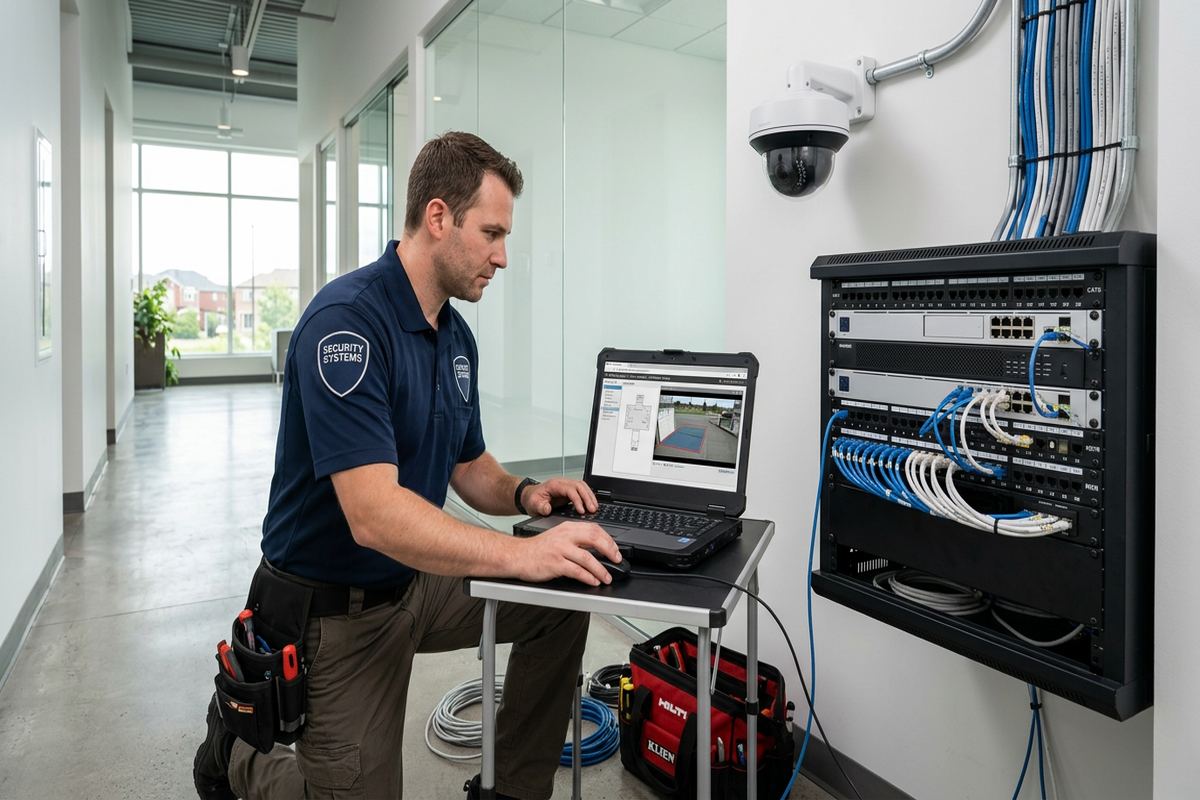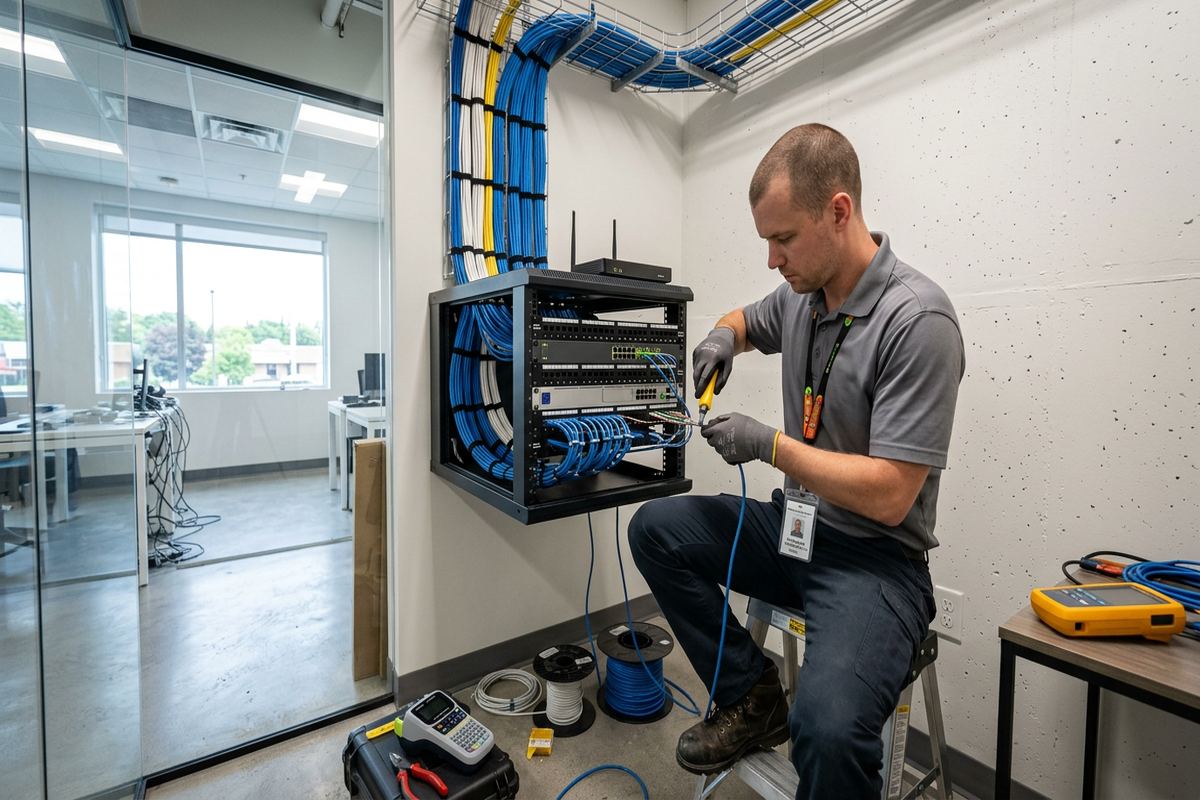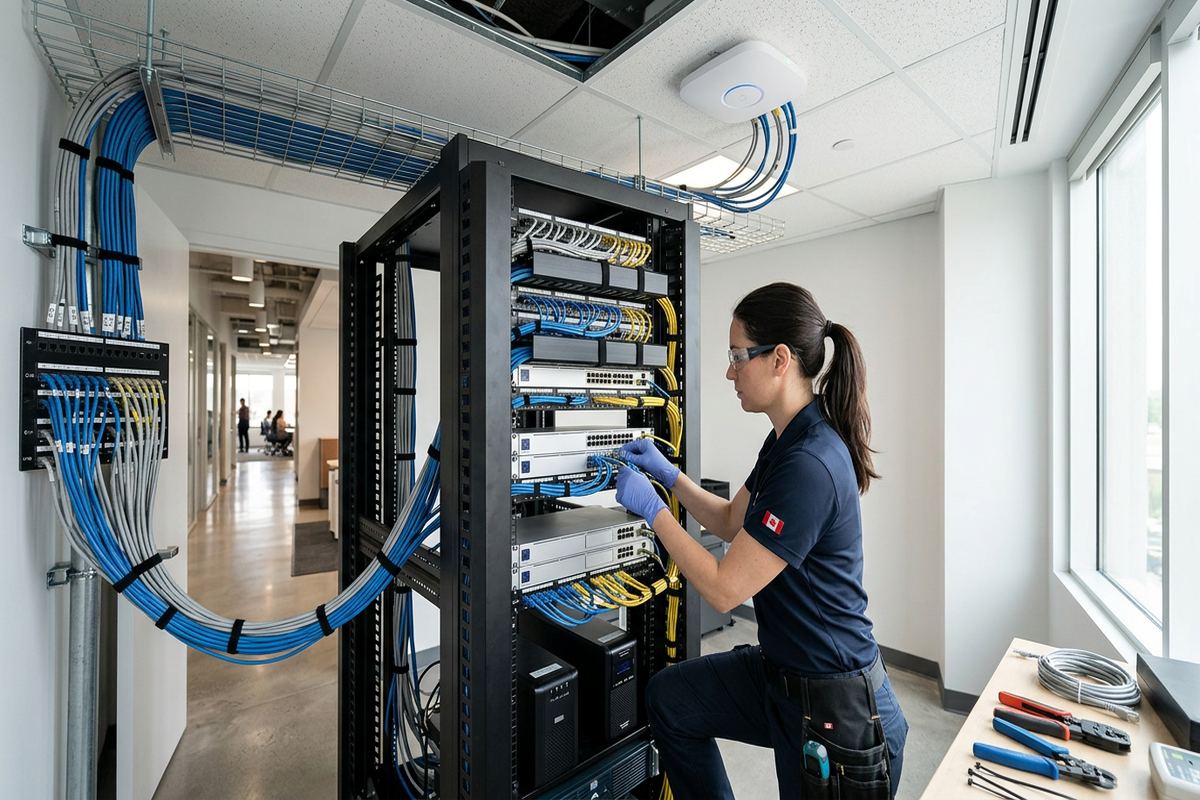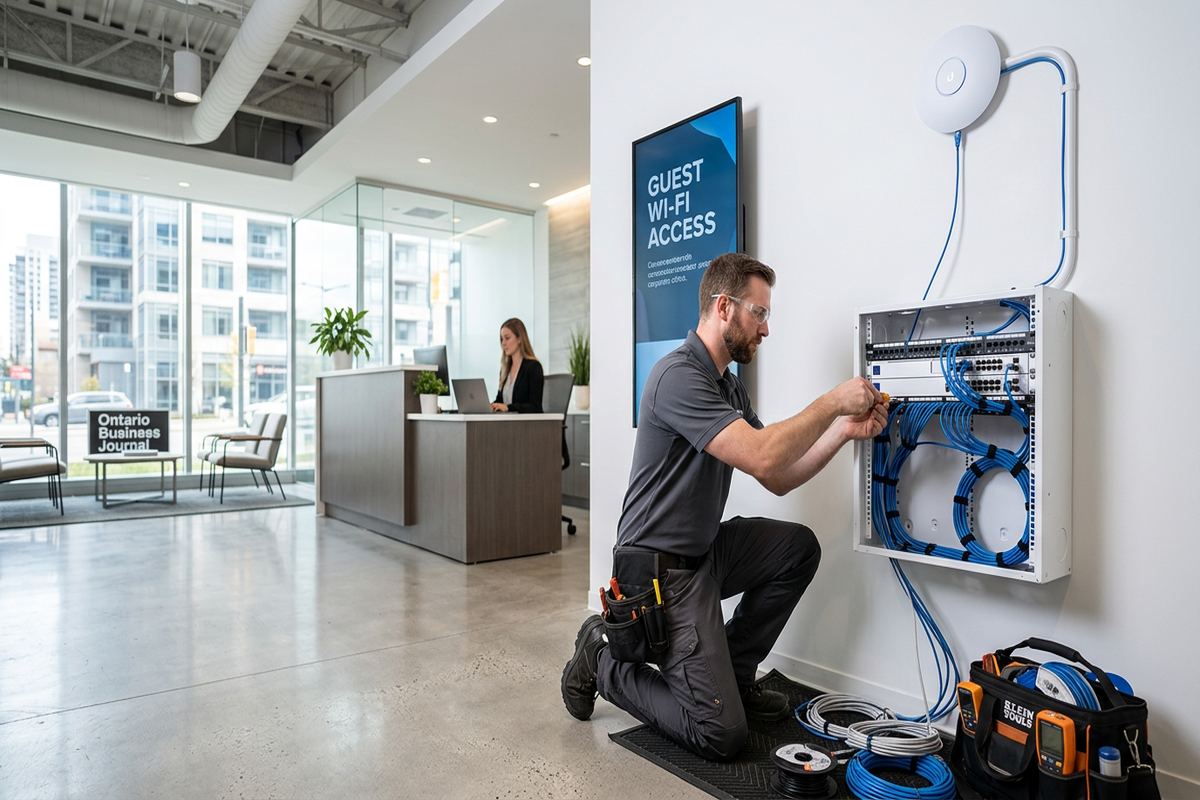
UnifiedLink installs commercial networks for offices, stores, clinics, workshops and multi-unit properties in Barrie and across Simcoe County. We plan cable routes, install structured cabling, organize network racks, mount wireless access points and configure equipment on site. Each project starts with an assessment so the written scope reflects the building, users and operational requirements.
Commercial Network Planning for Barrie Properties
A reliable commercial network starts with understanding how the property is used, rather than placing equipment wherever installation is easiest. During a site assessment, we review work areas, communications rooms, internet service locations, device counts, construction materials and likely future changes. Barrie properties range from older Downtown buildings to newer south-end units, so routing options vary considerably. The assessment also identifies shared spaces, restricted areas, ceiling access and power availability. These details shape a written scope before pricing, reducing uncertainty around equipment, labour, cable pathways, exclusions and responsibilities.
Network design should reflect actual business traffic. A small office using cloud applications has different requirements from a clinic moving large files, a warehouse using handheld scanners or a restaurant supporting point-of-sale terminals and guest Wi-Fi. We separate critical operational devices from public or less secure traffic where appropriate. Switch capacity, uplink speed, wireless coverage and available ports are considered together. This avoids treating cabling, Wi-Fi and network hardware as unrelated purchases. It also provides a practical foundation for adding workstations, cameras, access control or other connected systems later.
Building ownership and occupancy affect planning as much as technical requirements. Tenants may need written landlord approval before drilling, opening ceilings, mounting equipment or using common telecommunications rooms. Condo boards or property managers may also control risers, corridors and exterior walls. UnifiedLink can define proposed routes and mounting points clearly enough for the customer to seek the required approval. The scope states equipment ownership, exclusions and warranty terms, helping owners, tenants and managers understand which components remain with the premises and which belong to the operating business.
- Site assessment before project pricing
- Device, user and traffic requirement review
- Cable route and communications-room planning
- Landlord and condo approval considerations
- Written equipment ownership and warranty terms
Structured Cabling in Barrie Offices and Units
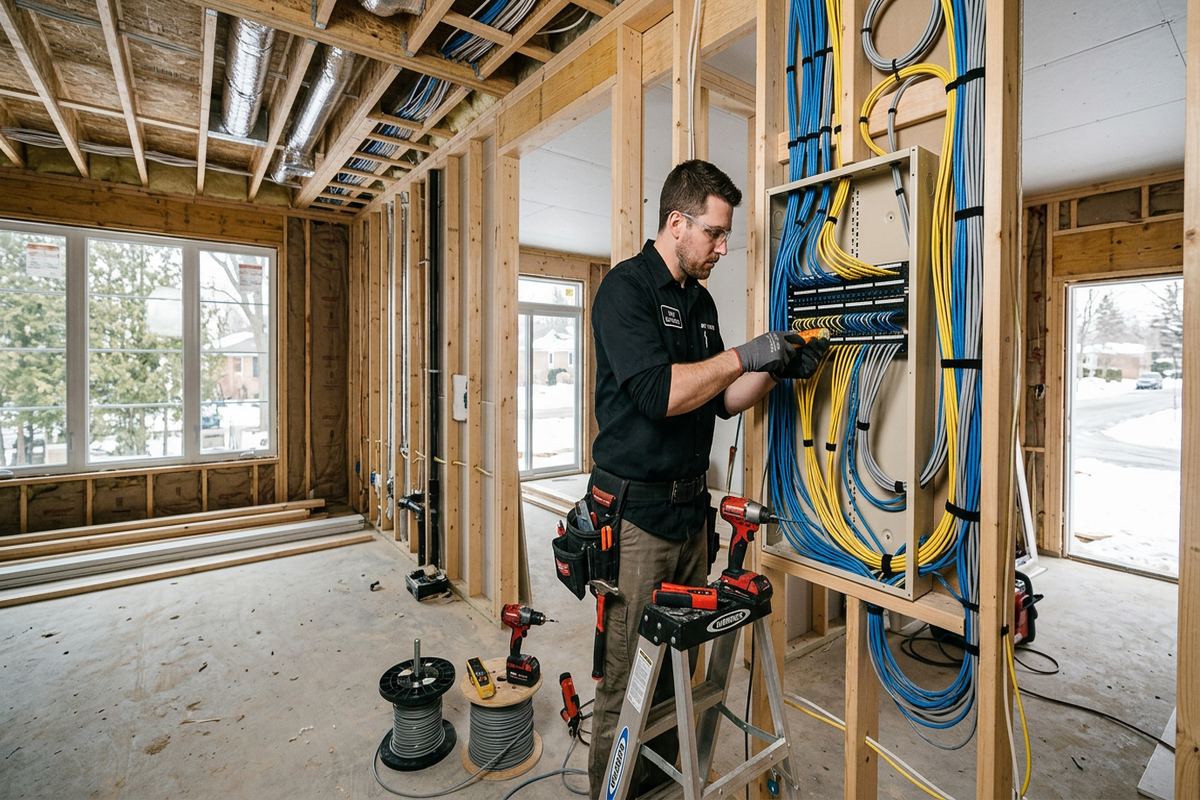
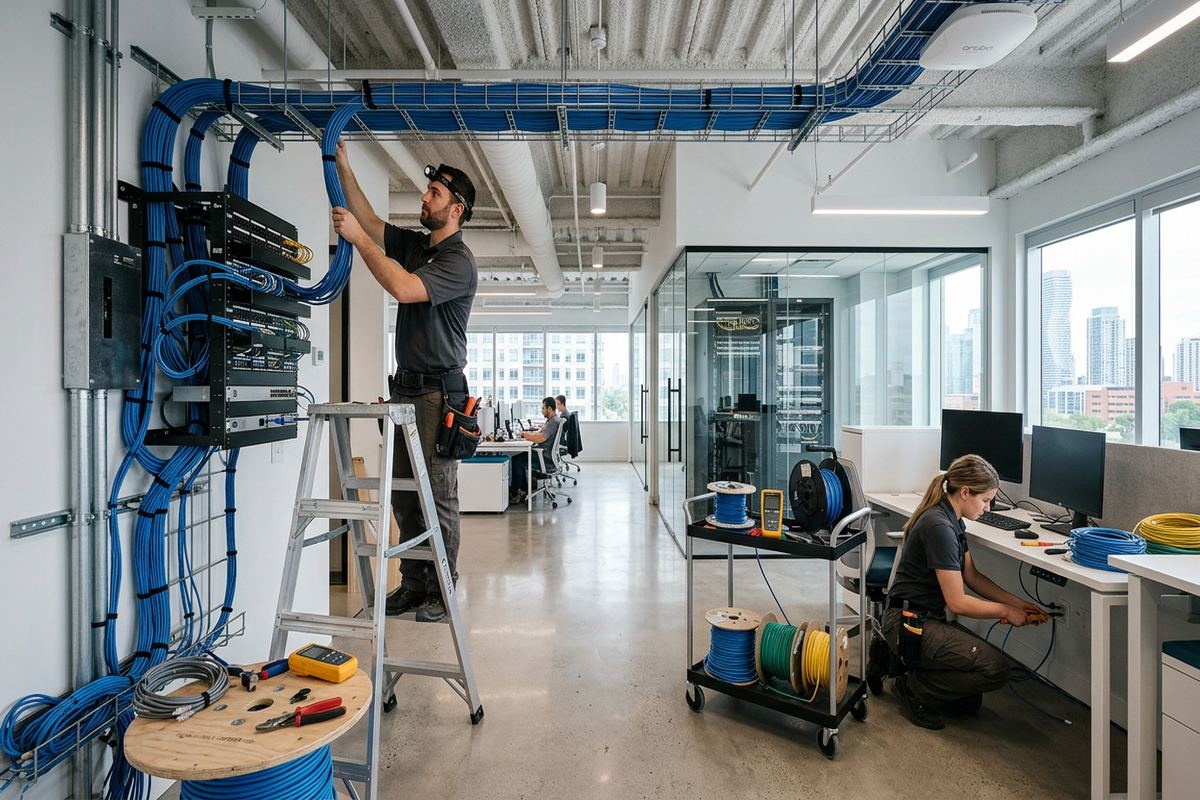
Structured cabling provides the physical path between work areas, wireless access points, printers, phones, cameras and the network rack. We install continuous labelled cable runs rather than joining short sections inside walls or ceilings. Each run is routed back to an agreed termination point and labelled consistently at both ends. Suitable pathways depend on the site: accessible ceilings may support trays or approved supports, while finished offices may require surface raceway or carefully planned wall access. The objective is serviceable cabling that can be traced without opening unnecessary areas later.
Construction type changes how a network installation proceeds. Frame walls in newer Painswick or Innis-Shore commercial spaces may offer straightforward vertical routes, although insulation, fire blocking and finished ceilings can limit access. Older Downtown Barrie properties may include masonry walls, narrow cavities, previous renovations and undocumented wiring. Industrial units can have long open spans, steel structures and higher mounting points. We select routes and fastening methods for the material involved instead of applying one approach everywhere. Fire separations, occupied areas and other building constraints are reviewed before penetrations are made.
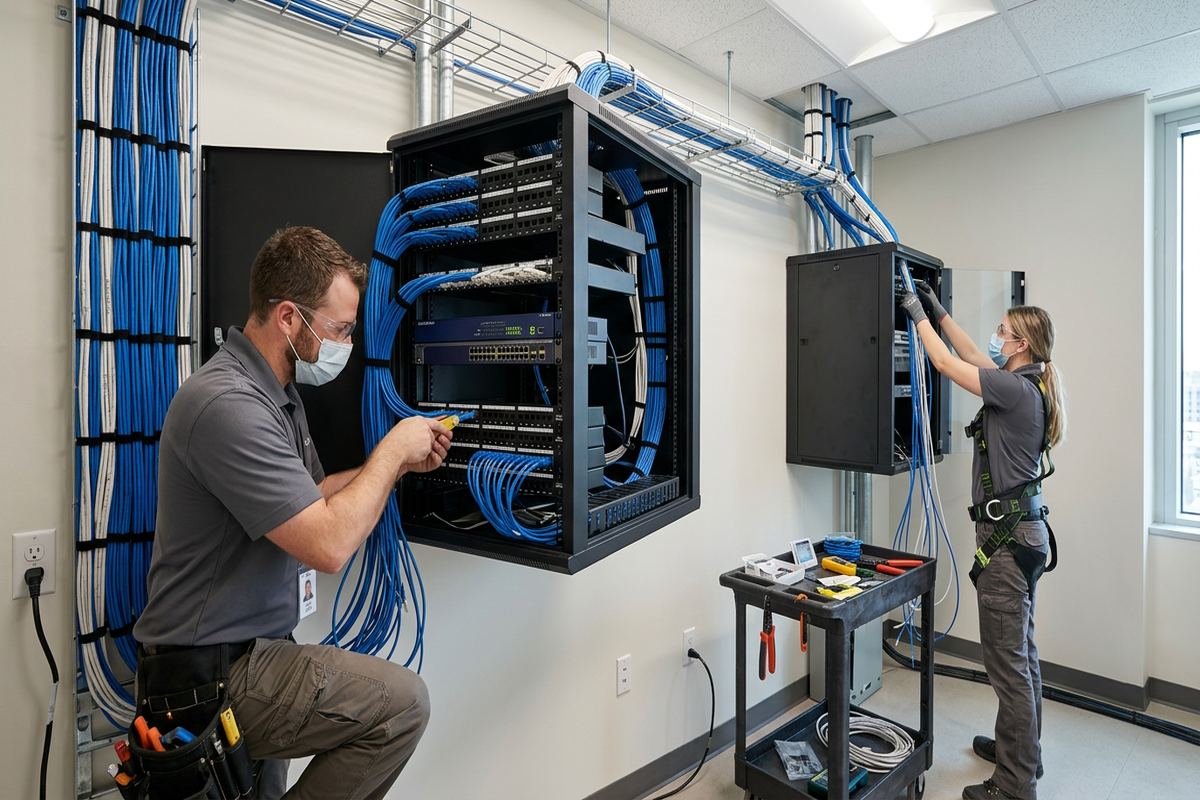
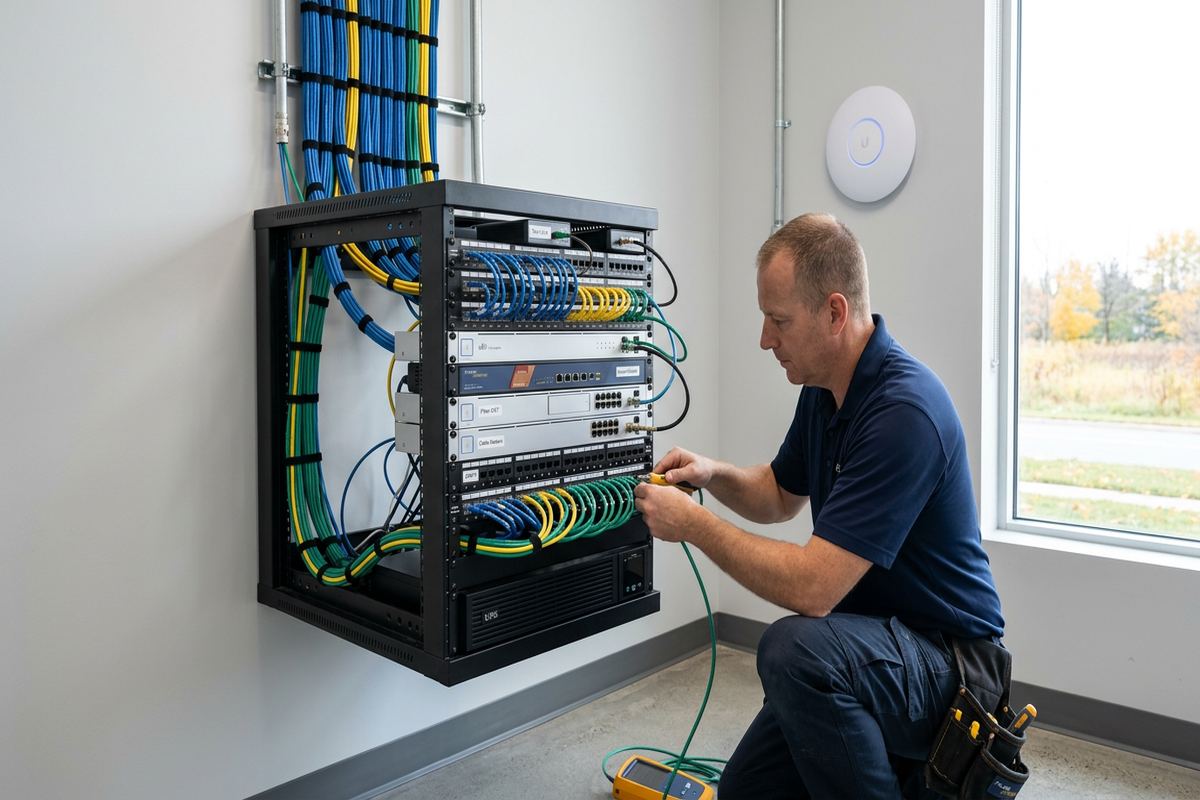
Terminations are organized at patch panels, wall cabinets or floor-standing racks according to the number of cables, available space and equipment weight. Patch leads should be long enough for safe movement without creating tangled bundles that block airflow. Switches, routers, power distribution and other components are positioned so indicators and ports remain accessible. Cable management supports future troubleshooting because technicians can identify a destination without pulling on unrelated wiring. Where existing cabling will remain, we assess its condition and labelling before deciding whether it can be integrated into the new layout.
- Continuous home-run data cables
- Consistent labels at both ends
- Patch-panel and rack termination
- Routes suited to masonry or frame walls
- Assessment of reusable existing cabling
Business Wi-Fi Design Across Barrie
Commercial Wi-Fi requires more than choosing a central location for one powerful access point. Walls, floors, shelving, machinery, glazing and neighbouring networks all influence usable coverage. Barrie’s mix of converted buildings, small commercial plazas and newer subdivisions creates different radio conditions from one property to another. We review where staff and customers actually connect, including meeting rooms, checkout areas, storage spaces and loading zones. Access points are positioned to distribute capacity, not merely to produce a visible signal. Wired connections remain preferable for stationary devices that require consistent performance.
Wireless access points generally perform better when connected by dedicated data cable and mounted in suitable open locations. Hiding a unit above ductwork, inside a metal cabinet or behind dense masonry can reduce coverage and make servicing difficult. In larger Barrie offices, multiple access points may be configured with coordinated settings so devices can move through the premises more predictably. Network names and access policies can be separated for staff, guests and operational equipment. The final arrangement depends on the customer’s router, switch capabilities, internet connection and any centrally managed wireless platform included in the scope.
Exterior Wi-Fi needs additional planning because Barrie winters expose equipment and penetrations to snow, ice, moisture and repeated freeze-thaw cycles. An outdoor-rated device does not eliminate the need for suitable cable, protected routing, drip management and carefully sealed wall entries. Mounting hardware must suit masonry, siding, concrete or structural surfaces without relying on interior-grade fasteners. We also consider whether coverage is genuinely required outside or whether an indoor access point near glazing is adequate. Exterior work remains subject to owner permission, safe access and the physical limitations identified during assessment.
- Access point placement based on building materials
- Separate staff, guest and device networks
- Wired backhaul for commercial access points
- Outdoor-rated equipment where required
- Sealed exterior cable penetrations
Barrie, Ontario
Commercial network installation in Barrie, scoped in writing first
Book a site assessment and get equipment, routes, exclusions, and warranty on paper before anything is installed.
Network Racks, Switches and Equipment
The network rack is the service point for the commercial network, so its location affects reliability and maintenance. A rack placed in a busy storage room may be blocked, bumped or exposed to dust and accidental disconnection. We review wall strength, floor space, ventilation, electrical service, internet provider entry and cable access before selecting a location. Smaller Barrie businesses may use a compact wall cabinet, while larger offices or industrial units may require a floor-standing enclosure. The written scope identifies the intended rack, major equipment and work needed to prepare the area.
Switch selection depends on port count, connected device types, uplink requirements and whether power over Ethernet is needed. Wireless access points, network cameras, phones and access control components may all receive data and power through the same cable, but their combined electrical demand must remain within the switch’s available power budget. Spare ports can support reasonable changes without immediately replacing hardware. Managed switches may also provide network separation and useful diagnostic information. We discuss these factors without assuming that every site needs the most complex equipment or that existing hardware must automatically be discarded.
On-site configuration connects the physical installation to the customer’s operating requirements. Depending on scope, this may include switch settings, wireless networks, guest access, device adoption, firmware updates and basic network segmentation. Internet-provider equipment can impose limitations, particularly where routing controls or administrative access remain with the carrier. We document those boundaries rather than presenting provider-owned hardware as part of our installation. At handover, the customer receives access using their own credentials, along with an as-built record showing installed components, cable identifiers, termination locations and relevant configuration details.
- Wall-mounted or floor-standing rack options
- Switch port and power-budget planning
- Organized patching and cable management
- On-site network equipment configuration
- Customer-controlled administrative credentials
Barrie Building Conditions and Cable Routes
No single cable route works for every Barrie property. Downtown Barrie premises can contain layers of renovation, mixed wall materials and limited ceiling access. Commercial plazas may have demising walls, shared roof spaces and landlord-controlled service areas. Newer units around Holly and the south end often provide more regular framing but may still include insulated exterior walls and finished ceilings. During assessment, we look for practical pathways that limit disruption while keeping cables supported and serviceable. Existing conduits are only used after their route, capacity and condition have been considered.
Masonry presents different mounting and penetration requirements from wood or light-gauge steel framing. Fasteners must suit the substrate, and holes should be positioned to avoid unnecessary damage to brick faces, mortar joints, vapour barriers and concealed services. Frame construction may permit concealed cable runs, but drilling locations still require care around plumbing, electrical wiring and structural members. In occupied offices, route planning also considers dust, noise and access to work areas. Surface raceway can be a sensible alternative where opening walls would create disproportionate repairs or interfere with business operations.
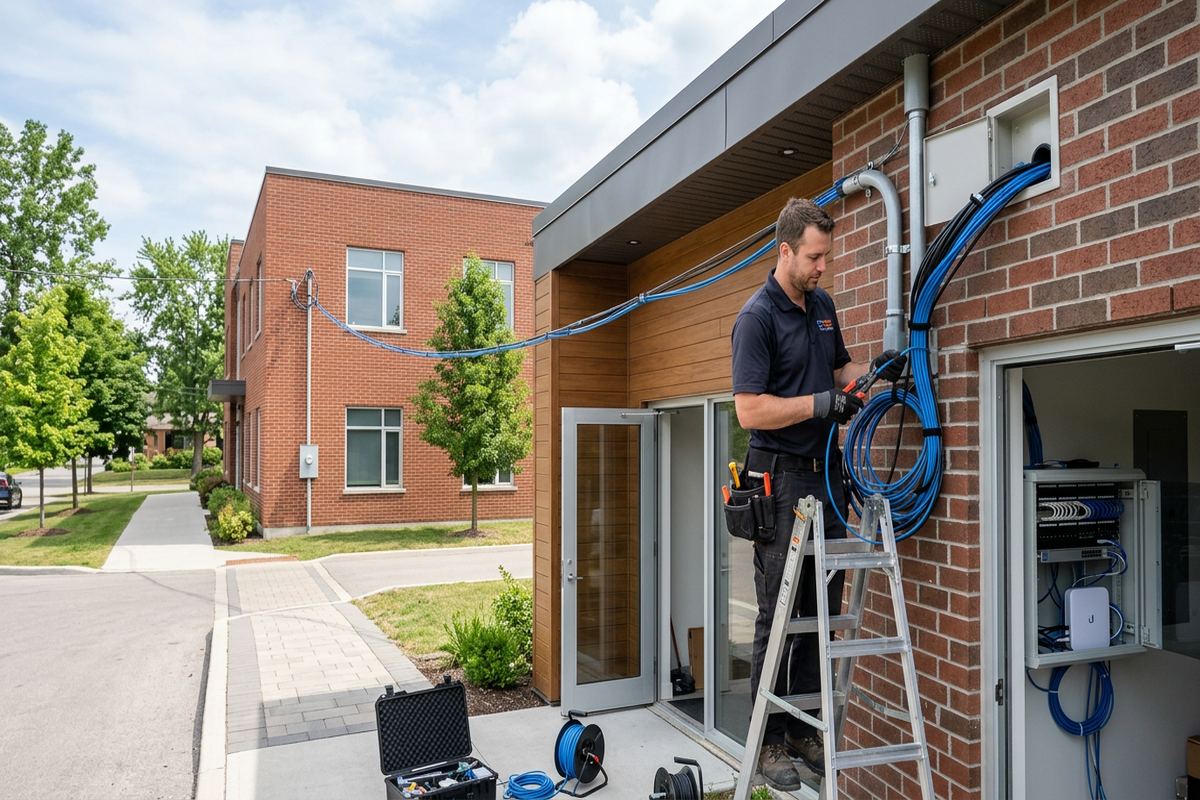
Cable that leaves the conditioned interior requires protection from local weather. Barrie’s winter temperatures and freeze-thaw conditions can stress poorly sealed penetrations, loose clips and exposed cable jackets. Exterior routes should use materials intended for the environment, include appropriate support and avoid locations where snow clearing or ice movement could cause damage. Wall openings are sealed using a method compatible with the surface and route. If a project involves roof areas, common elements or a leased exterior wall, owner or property-manager approval should be obtained before installation begins.
- Routes adapted to existing construction
- Fasteners selected for each substrate
- Surface raceway for finished spaces
- Weather-suitable exterior cable and hardware
- Compatible sealing at wall penetrations
Commercial Network Upgrades and Expansion in Barrie
An upgrade does not always require removing every existing cable and device. We first identify what is present, where it terminates and whether it can support the intended service. Unlabelled cables, improvised extensions and abandoned equipment are common obstacles because they make faults difficult to isolate. Existing runs may be retained when their type, condition, route and termination are suitable. Other runs may need replacement or separation from power sources. The resulting scope distinguishes reusable infrastructure from new work, helping a Barrie business understand what will change and what will remain.
Expansion planning is useful for growing offices, changing retail layouts and industrial units adding connected equipment. A few carefully chosen spare ports, accessible pathways or reserved rack space can make later additions less disruptive. This does not mean installing excessive hardware without a defined need. Instead, we discuss likely workstation moves, additional access points, cameras, phones, printers and operational devices during the assessment. In fast-growing south-end areas such as Painswick and Innis-Shore, tenant improvements may happen in stages, making clear cable records and an organized central rack particularly valuable.
Network replacement can often be staged around operational priorities. Critical workstations, payment systems or production devices may need to remain available while other areas are migrated. The sequence depends on access, existing infrastructure and whether old and new equipment can operate together temporarily. A written scope can identify customer responsibilities, planned interruptions and exclusions before work starts. Where another provider controls the internet circuit, hosted phone system or specialized application, coordination may be required. UnifiedLink acts as one accountable contractor for the network installation covered by the agreed scope.
- Existing cable and equipment assessment
- Removal or identification of abandoned wiring
- Capacity planning for likely additions
- Phased migration where practical
- Defined responsibilities for third-party systems
Installation Process and Documentation
A commercial network project begins with a request and discussion of the property, operating needs and known problems. Requests sent during business hours are answered the same day; after-hours requests are answered the next business day. Site assessment timing depends on the service and travel distance. At the Barrie property, we review equipment locations, routes, access limits and any approvals still required. This information is used to prepare a written scope rather than quoting from assumptions based only on floor area or a rough count of network outlets.
The written scope covers equipment, cable routes, device placement, exclusions, equipment ownership and warranty. It also gives both parties a reference when property conditions require discussion. Before installation, customers should confirm access to telecommunications rooms, ceiling spaces, locked areas and locations controlled by a landlord or condo corporation. Furniture, stored goods and active work areas can affect safe access. For occupied commercial sites, practical scheduling and clear communication help reduce interference, although exact sequencing depends on project size, site rules and coordination with internet or technology providers.
During installation, cables are supported, terminated and labelled according to the agreed layout. Equipment included in the project is mounted and configured on site, then connected for functional checks within the defined scope. Handover uses the customer’s own credentials rather than installer-owned accounts. The as-built record identifies cable runs, port labels, equipment locations and other relevant installation details. This record gives the business a useful starting point for troubleshooting or later changes. Any departures from the original scope should be documented so the finished system reflects what was actually installed.
- Same-day reply during business hours
- Assessment timing based on service and travel
- Detailed written installation scope
- On-site configuration and functional checks
- As-built records provided at handover
Connected Systems for Barrie Commercial Sites
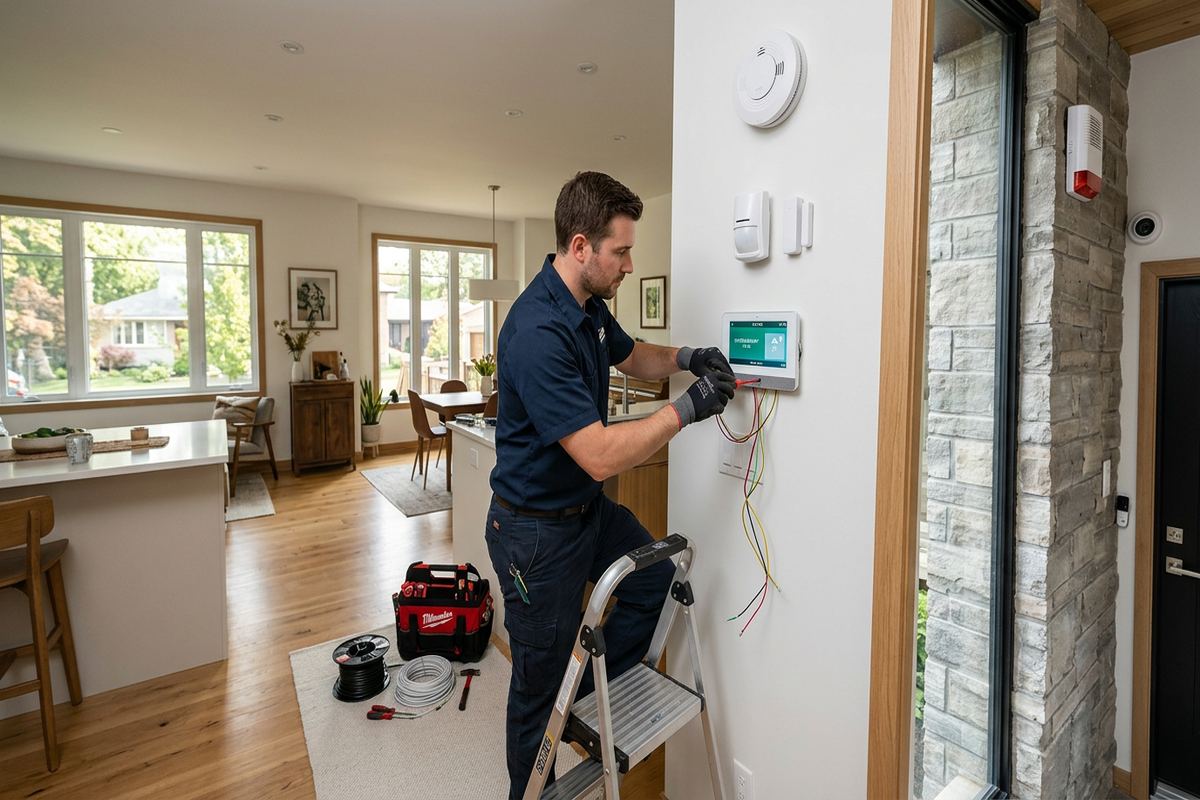
A commercial network often supports more than computers and wireless devices. Security cameras, access control panels, intercoms, displays, audio systems and internet-based phones may all depend on structured cabling and network switches. Planning these systems together helps avoid duplicated routes, crowded racks and switch capacity problems. UnifiedLink’s Internet and Networking work can be coordinated with other low-voltage services under one accountable contractor. Each system still needs a defined scope, because device ownership, credentials, storage, licensing and third-party service requirements can differ even when they share the same network infrastructure.
Segmentation helps keep unlike devices logically separated where the selected network equipment supports it. Guest Wi-Fi should not automatically share unrestricted access with office computers, while cameras or building devices may need their own network rules. The suitable arrangement depends on hardware capabilities, business policies and any outside technology provider managing servers or applications. We can configure included equipment on site and document the implemented settings. More advanced cybersecurity, managed monitoring or application administration should not be assumed unless expressly included. Clear boundaries prevent a cabling project from being mistaken for every aspect of ongoing IT support.
From a small Allandale office to a plaza unit in Ardagh Bluffs, the objective is a network that matches the premises and can be understood after installation. That means labelled continuous cable runs, accessible terminations, appropriately placed wireless access points and records that correspond with the finished work. Barrie’s varied building stock makes an on-site review especially important; drawings and photographs may not reveal concealed masonry, blocked pathways or shared service areas. A site assessment and written scope provide the practical basis for equipment selection, installation planning and final handover.
- Coordination with cameras and access control
- Network support for phones and displays
- Logical separation of different device groups
- Documented limits of included IT work
- One accountable low-voltage contractor
Barrie neighbourhoods we cover
- Downtown Barrie
- Ardagh Bluffs
- Painswick
- Holly
- Allandale
- Innis-Shore
Commercial network installation in Barrie — common questions
How is a Barrie commercial network installation priced?
Pricing follows a site assessment because cable access, construction materials, outlet counts, equipment and approvals vary between Barrie properties. After reviewing the site, UnifiedLink provides a written scope covering equipment, routes, device placement, exclusions, ownership and warranty. This avoids relying on a generic per-outlet estimate that may not reflect masonry, finished ceilings, long industrial runs or landlord-controlled areas.
Can you reuse our existing network cabling?
Existing cabling can sometimes be reused if its type, condition, routing and terminations are suitable for the intended network. In Barrie buildings with several renovations, labels may be missing and routes may be difficult to confirm. We assess the existing infrastructure before including it in the scope. Unsuitable, damaged or improvised runs may need replacement rather than being connected to new equipment.
Do I need landlord or condo approval?
Approval may be required if the work affects common areas, telecommunications rooms, exterior walls, risers or building finishes. This is common in leased Barrie plazas, offices and condo properties. UnifiedLink can identify proposed cable routes and device locations in the written scope, but the customer is responsible for obtaining required owner, landlord or condo approval before restricted work proceeds.
Can you improve Wi-Fi in a masonry building?
Yes, but masonry can significantly reduce wireless signals, so placement should be based on the building layout and actual usage areas. Older Downtown Barrie properties may require multiple wired access points rather than one centrally located unit. We review walls, floors, shelving and available cable routes, then include suitable access point locations and network equipment in the proposed scope.
Can network equipment be installed outdoors?
Some access points and enclosures are designed for exterior use, but Barrie winters require attention to more than the device rating. Cable jackets, connectors, supports, mounting hardware and wall seals must suit snow, moisture and freeze-thaw exposure. Exterior installation also depends on safe access, an appropriate mounting surface and any landlord, condo or property-manager approval required for the location.
What do we receive when installation is complete?
At handover, the included equipment is configured on site and administrative access is provided using the customer’s own credentials. You also receive an as-built record identifying installed equipment, cable labels, termination points and relevant configuration details. This documentation is particularly useful when a Barrie business later moves workstations, adds devices or needs another provider to troubleshoot a connected system.
Coverage in Barrie is confirmed against the address before we quote. See everything we install in Barrie or the province-wide commercial network installation page.