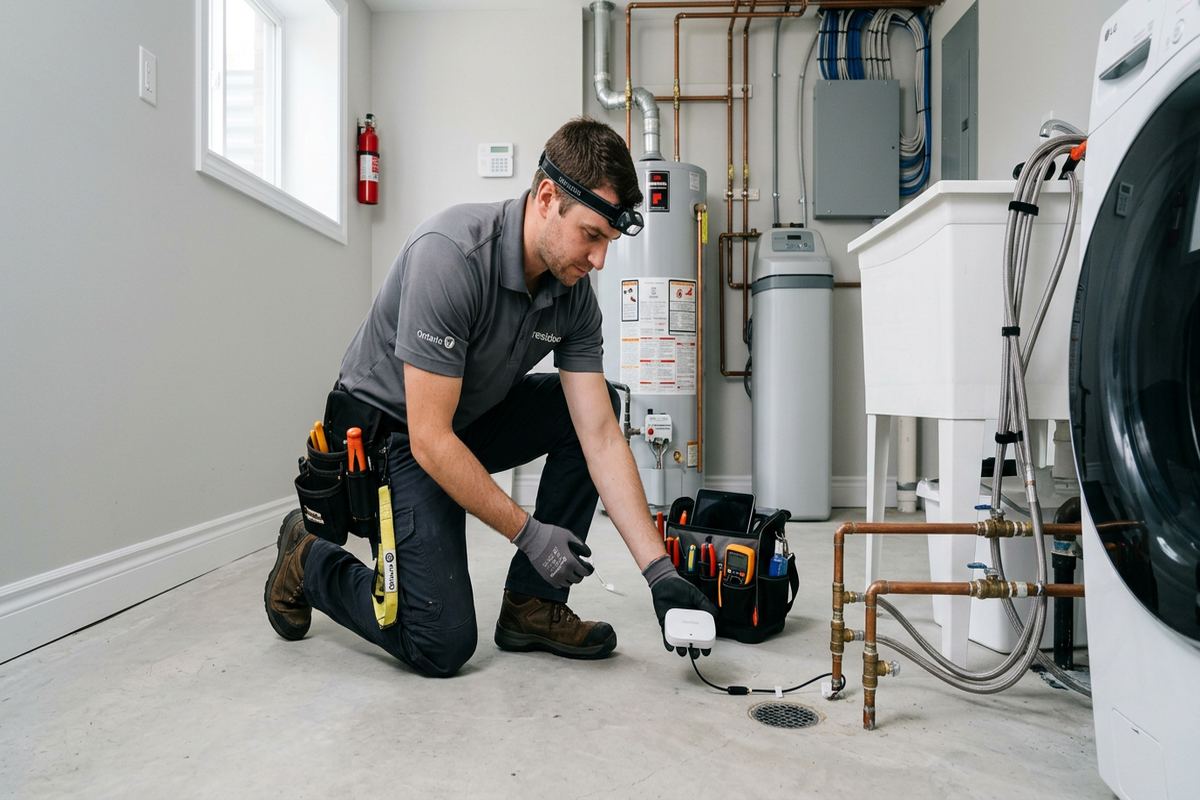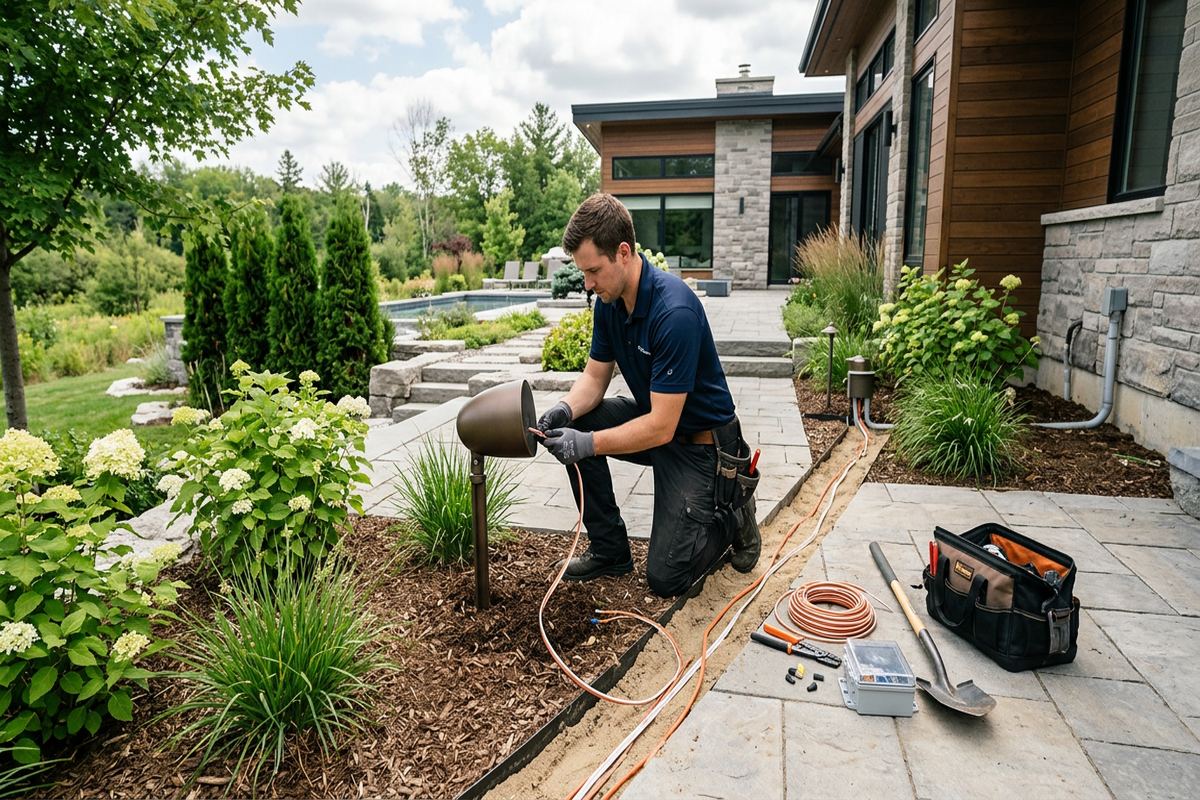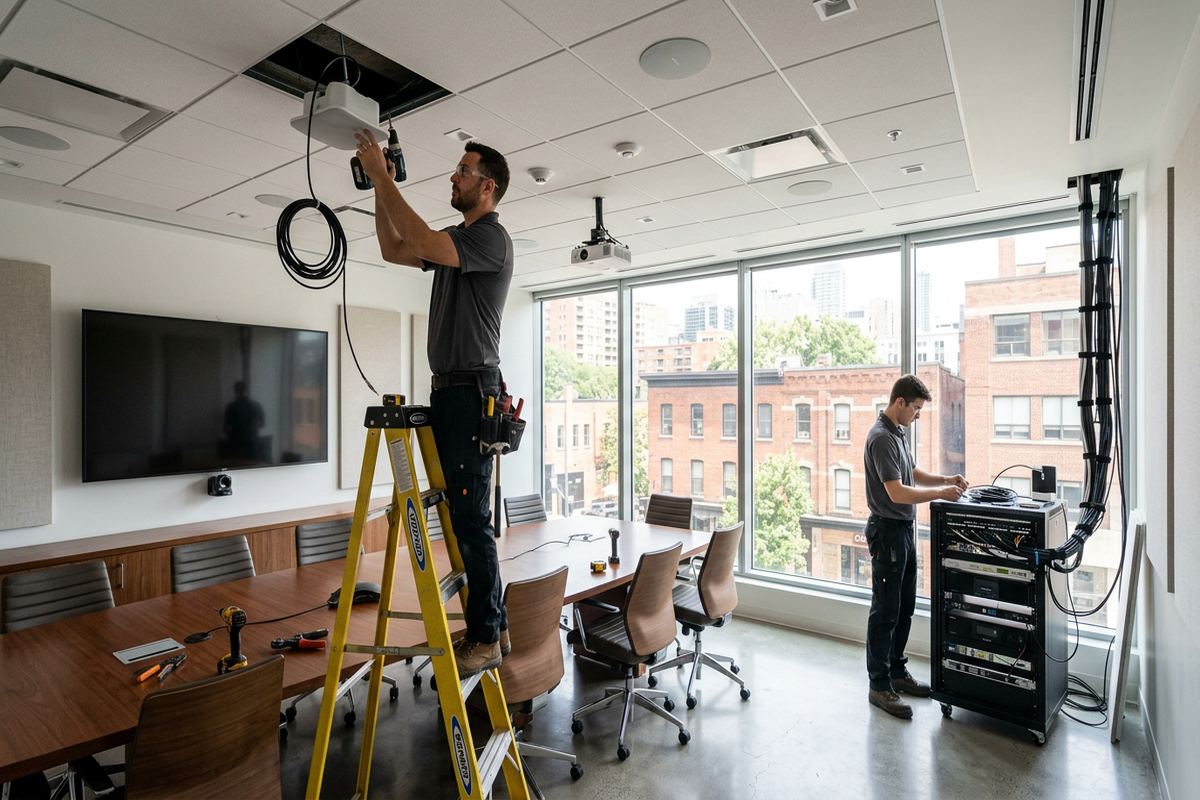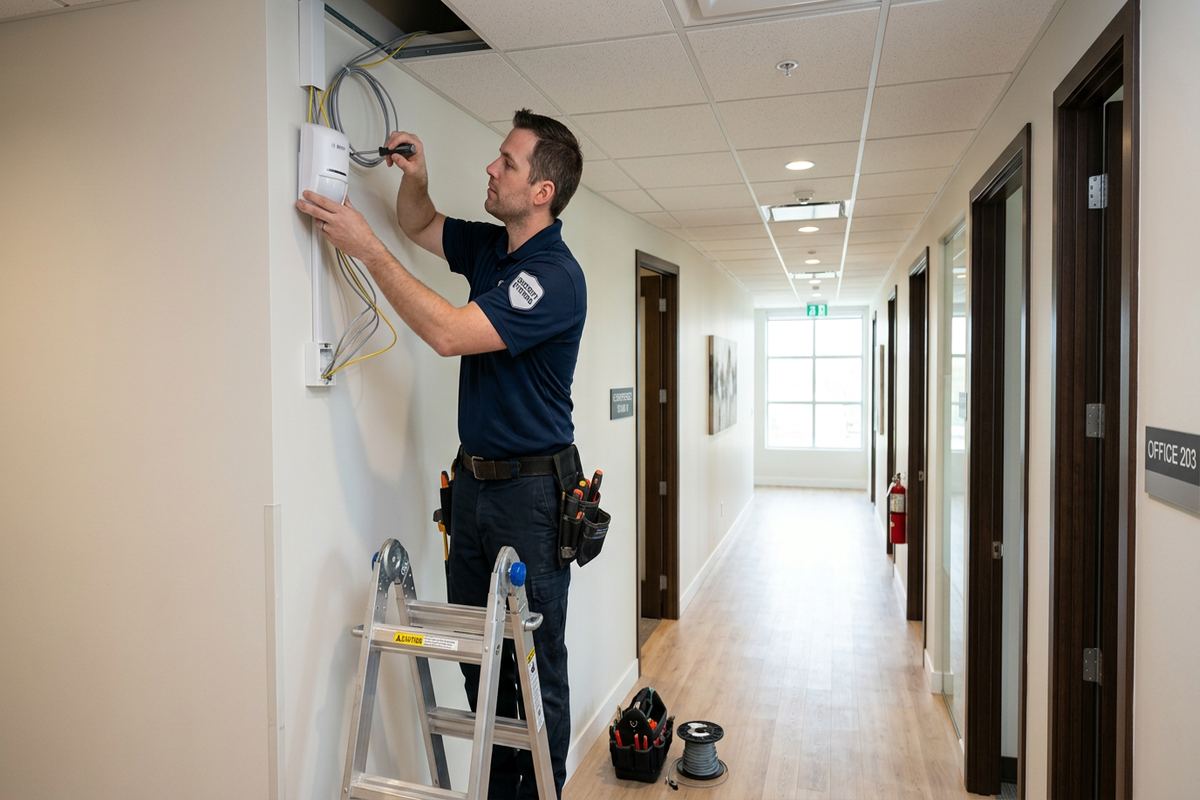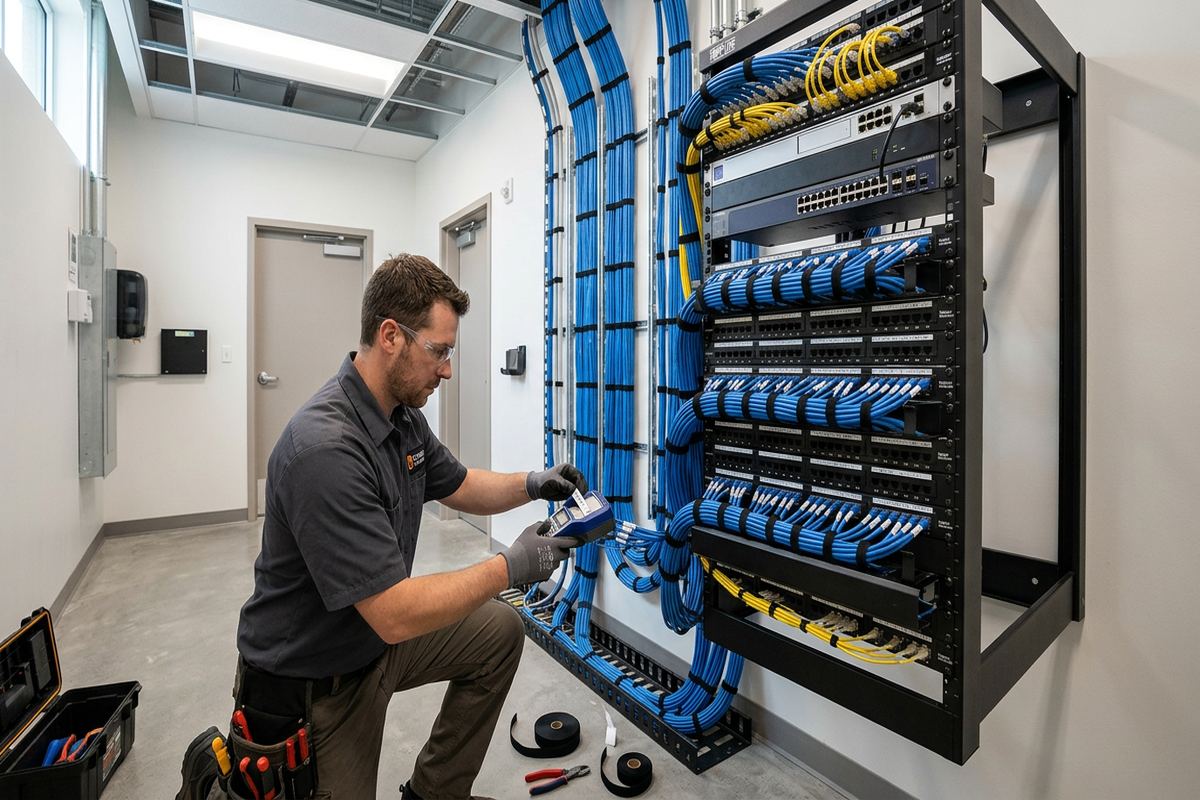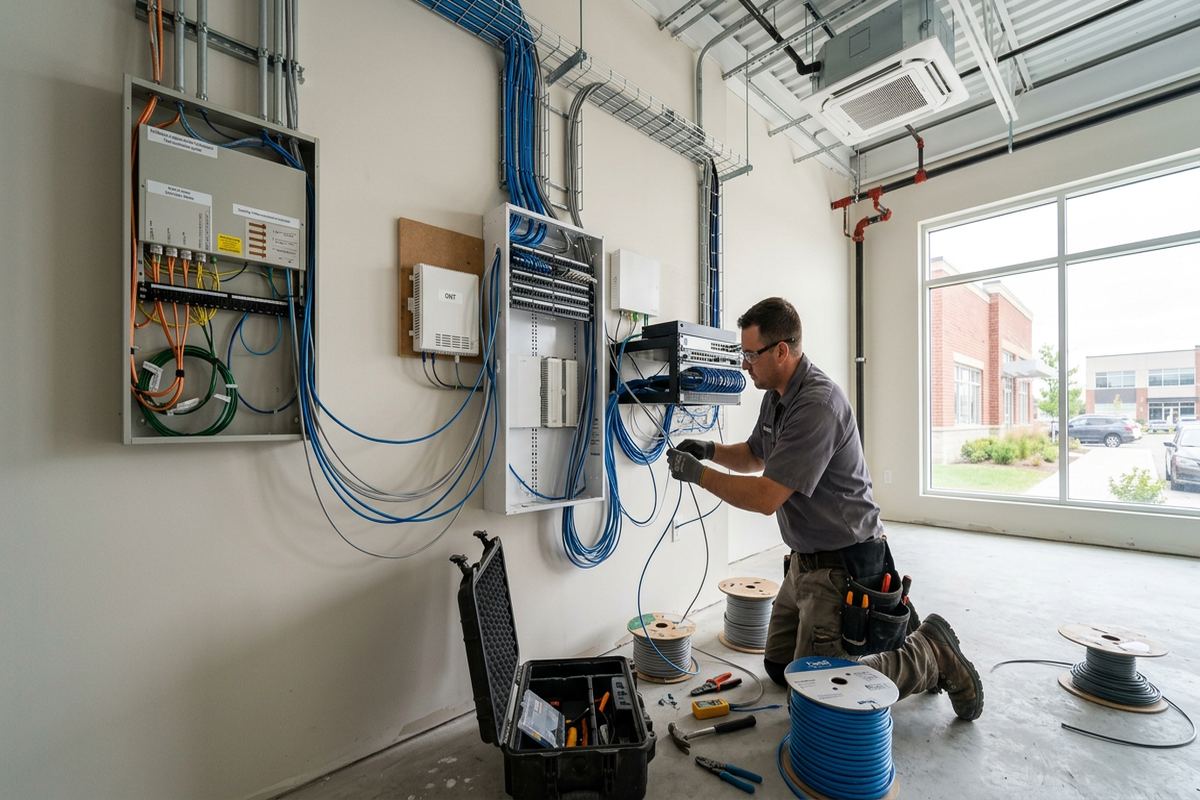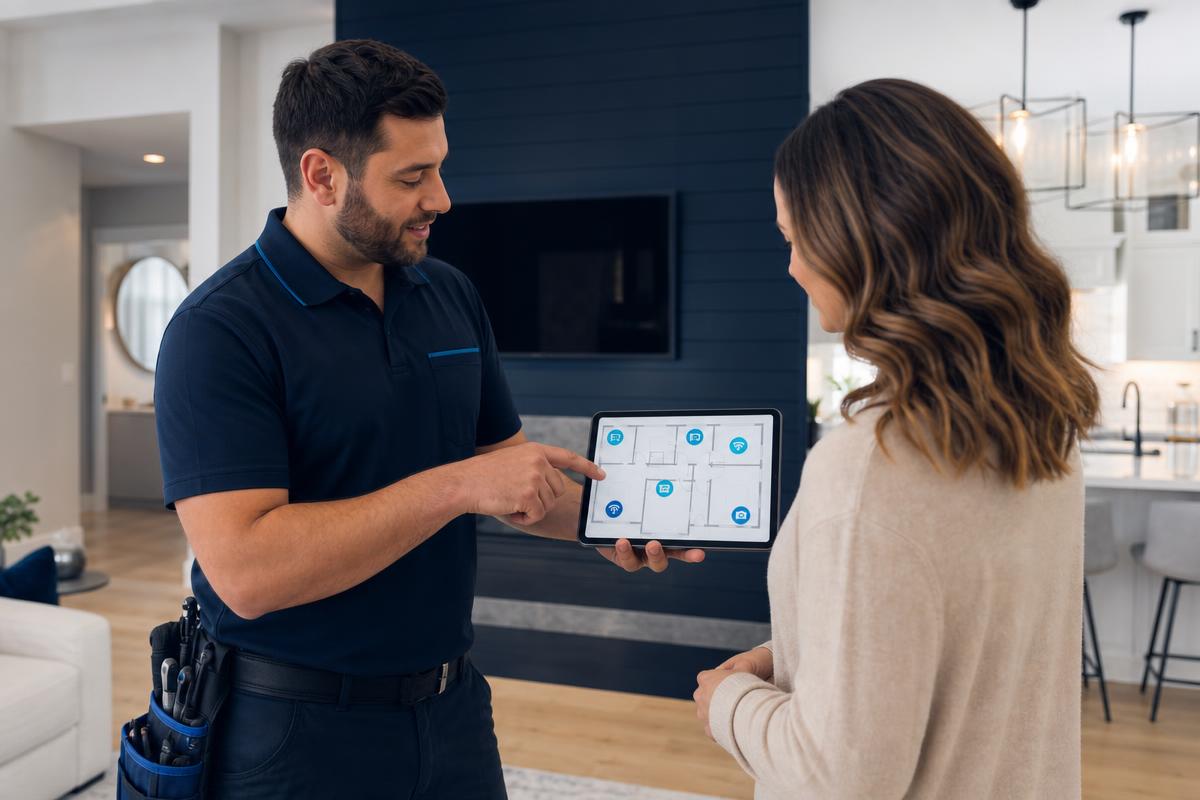
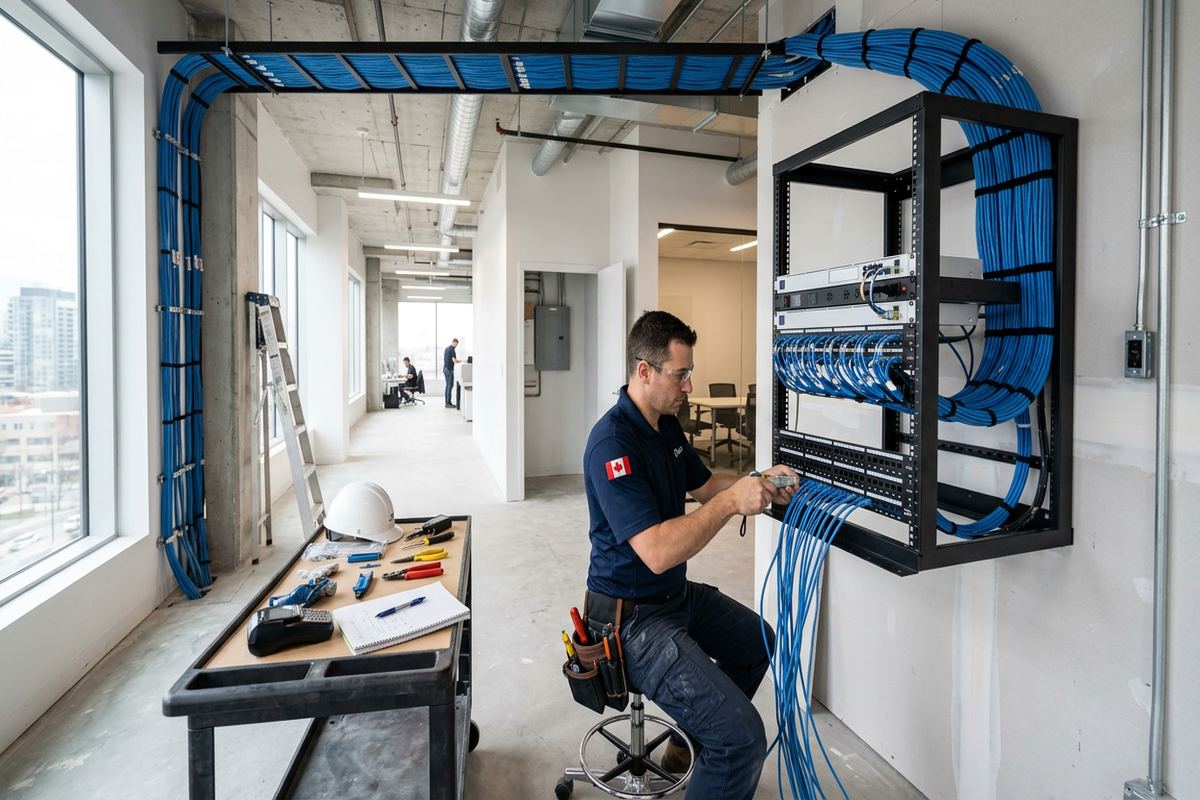
UnifiedLink installs low-voltage cabling for homes, commercial spaces and industrial units across Ajax and Durham Region. We plan routes for network, camera, alarm, access control, Wi-Fi, audio and display systems, then install, label, test and document the cabling. Each project begins with a site assessment before pricing and a written scope suited to the property.
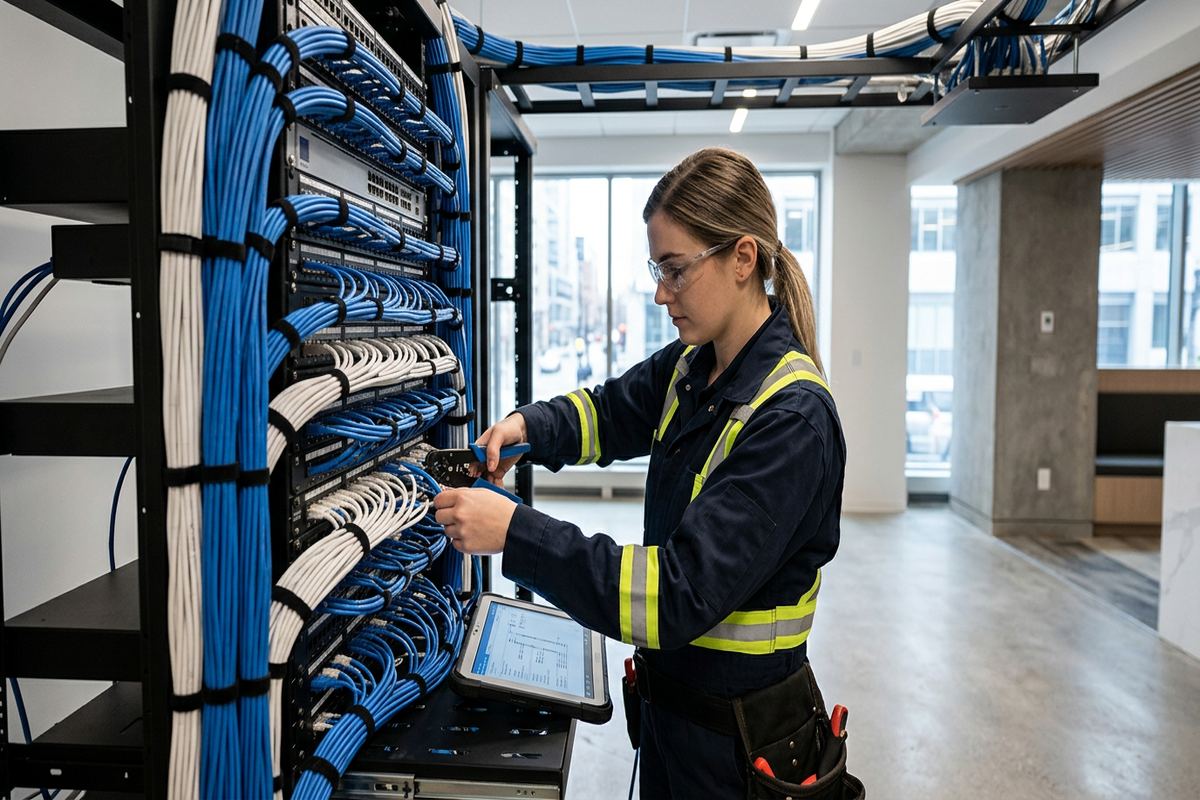
Low-Voltage Cabling Planned for Ajax Properties
Low-voltage work starts with understanding what each cable must support, where connected equipment will sit and how the property can be accessed without unnecessary disruption. In Ajax, newer subdivisions and lakefront homes often have finished basements, insulated garages and completed landscaping. These features can make likely pathways easy to identify, but the work remains detail-heavy. Finished ceilings, vapour barriers, cabinetry and mechanical systems must be considered before drilling. We assess the site, confirm device locations and develop practical routes before providing pricing or beginning installation.
A proper plan separates current needs from reasonable future capacity. Camera locations may need network cabling and local mounting support, while wireless access points require ceiling positions that provide useful coverage rather than simply convenient wiring. Displays, speakers, alarm contacts and controlled doors have different cable and termination requirements. We identify these differences in a written scope covering equipment, cable routes, device placement, exclusions, equipment ownership and warranty. That document gives Ajax homeowners, landlords and businesses a clear basis for reviewing the work before cables are installed.
One accountable contractor can coordinate the cabling with the systems using it. This is useful when a project combines data outlets, surveillance cameras, access control, audio or Wi-Fi because cable performance cannot be separated from device placement and configuration. UnifiedLink installs continuous labelled runs, completes on-site configuration where applicable and hands over systems using the customer’s own credentials. An as-built record identifies installed routes, outlet labels and relevant equipment. The result is a serviceable installation that another technician can understand without tracing every concealed cable again.
- Site assessment completed before pricing
- Cable routes reviewed before drilling begins
- Written scope identifies inclusions and exclusions
- Device locations coordinated with cable requirements
- As-built record supplied at handover
Choosing Cable Routes in Finished Ajax Homes
Finished basements common in Ajax change how retrofit cabling should be approached. An open utility area may provide access to floor joists, but finished recreation rooms, bulkheads and enclosed stairways can interrupt an otherwise direct path. We look for routes through mechanical spaces, closets, attached garages and accessible ceiling areas before proposing openings. In communities such as Nottingham and Applecroft, planning around completed interiors can reduce visible surface cabling while keeping bends, pulling tension and separation from electrical wiring within appropriate limits. Any expected access points are discussed before work starts.
Frame construction usually offers concealed pathways through stud and joist spaces, although insulation, fire blocking and structural members can limit access. Masonry requires a different method because brick veneer, concrete foundation walls and block demising walls cannot be treated like hollow interior partitions. Drill locations, sleeve requirements and cable protection are selected for the material encountered. Where a concealed route is not practical, neatly installed raceway may be preferable to multiple exploratory openings. The written scope distinguishes concealed, exposed and raceway sections so the expected finish is clear to the Ajax property owner.
A retrofit should also account for furniture, future renovations and access to terminations. A network outlet hidden behind fixed cabinetry is difficult to service, while a camera cable ending too close to an eavestrough can complicate mounting and maintenance. We confirm endpoint height, orientation and clearance before pulling cable. If drywall access is likely, the customer can arrange finishing directly or have responsibilities identified in the scope. This prevents assumptions about patching, painting or carpentry and keeps the low-voltage installation focused on planned, testable and maintainable pathways throughout the home.
- Routes through accessible utility spaces
- Options for concealed cable or raceway
- Drilling suited to frame or masonry walls
- Endpoint positions checked for service access
- Expected openings identified in writing
Cabling for Networks, Wi-Fi and Connected Devices
Network cabling provides the fixed backbone for internet access, wireless access points, cameras, controllers, televisions and other connected equipment. Rather than placing every cable beside the service provider’s modem, we consider where the router, switches, patch panels and backup power can be housed securely with ventilation and service clearance. Runs are selected according to distance, bandwidth needs, equipment interfaces and installation conditions. Each cable is kept continuous between intended termination points, labelled at both ends and tested after termination. This makes faults easier to isolate and later changes easier to plan.
Wi-Fi performance depends on access-point placement as much as the cable feeding it. Finished multi-level homes in Southwood or Central Ajax may benefit from wired ceiling or wall locations that serve occupied areas without forcing signals through masonry, ductwork or several insulated floors. Commercial suites may require separate coverage for staff, point-of-sale equipment, building devices and visitors. We do not treat additional access points as a substitute for planning. The assessment considers layout, construction and likely interference, followed by on-site configuration using customer-owned credentials when configuration forms part of the agreed scope.
Low-voltage pathways can support future devices without filling every wall with unused cable. During a renovation or before a basement ceiling is closed, it may be sensible to add selected runs or conduit to locations that would later be difficult to reach. In a completed property, speculative cabling must be balanced against access work and actual use. We document spare cables and leave them labelled and safely terminated or coiled at agreed points. Customers then know what capacity exists, where it ends and whether additional equipment or configuration is required before that pathway can be used.
- Data runs labelled at both ends
- Access-point locations planned for usable coverage
- Central equipment areas arranged for serviceability
- Installed network cables tested after termination
- Spare pathways recorded for future use
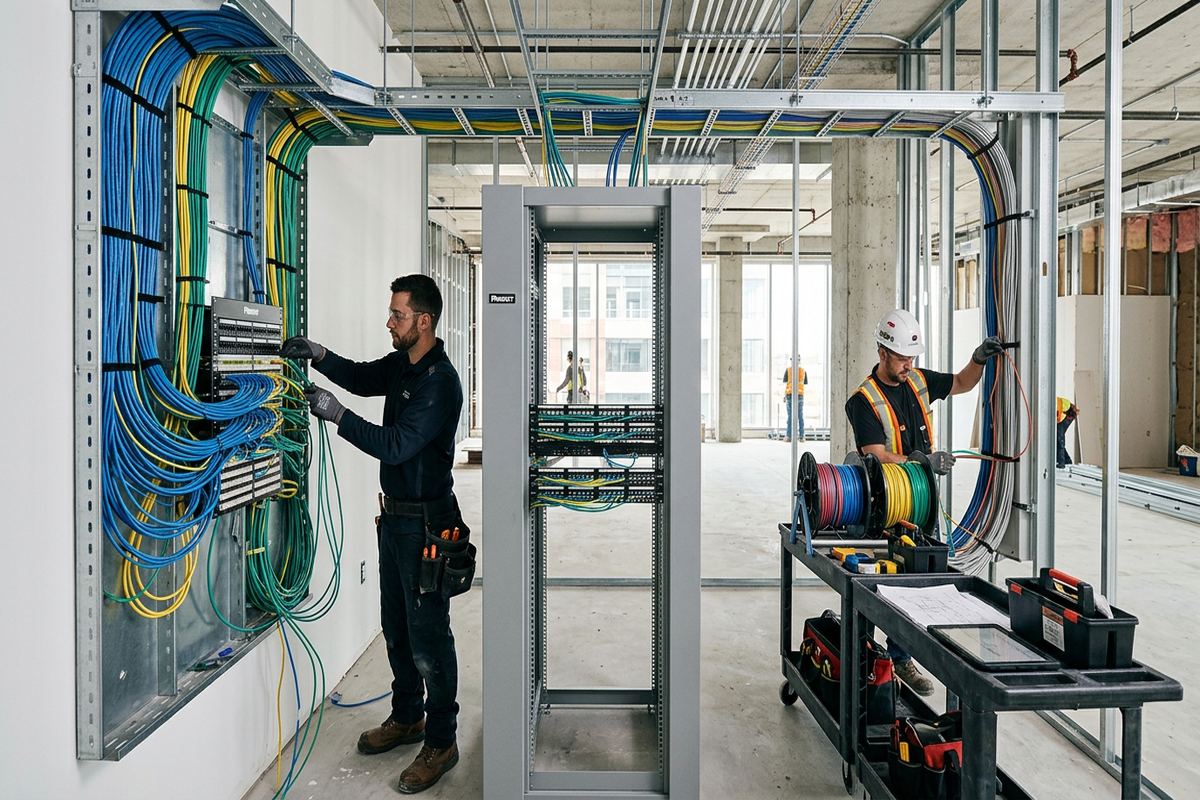
Ajax, Ontario
Low-voltage cabling installation in Ajax, scoped in writing first
Book a site assessment and get equipment, routes, exclusions, and warranty on paper before anything is installed.
Exterior Low-Voltage Cabling in Ajax Weather
Exterior cabling in Ajax must be selected and installed for seasonal temperature changes, moisture, sunlight and repeated freeze-thaw cycles. Indoor cable should not be routed outdoors merely because the exposed section is short. We assess whether the application calls for outdoor-rated cable, conduit, protected transitions or other suitable materials. Entry points are positioned to reduce water exposure and are sealed using methods compatible with the surrounding surface. A downward approach or drip loop may be used where appropriate so water is not directed toward the wall penetration or connected device.
Camera, antenna and outdoor access-point locations require more than a clear viewing direction. Mounting surfaces must support the device, permit proper fasteners and leave enough room for weather-resistant cable handling. Brick veneer, concrete, siding and soffit materials each require a suitable approach; masonry joints and cladding systems should not be penetrated indiscriminately. Around lakefront homes near Duffin's Bay or Pickering Beach, exposed elevations may receive more wind-driven precipitation. We plan cable protection, mounting and sealing as one assembly rather than treating the penetration as a separate finishing step.
Exterior routes should remain inspectable and avoid predictable damage. Cables are kept away from sharp edges, moving doors, eavestrough discharge and locations where snow clearing, ladders or landscaping tools could strike them. Conduit placement also needs to account for expansion, drainage and transitions into conditioned spaces. If underground work is proposed, route conditions and responsibilities for excavation or restoration are defined before installation. The as-built record notes relevant entry points and cable destinations, helping an Ajax owner inspect seals, plan future exterior work and avoid damaging concealed low-voltage pathways.
- Outdoor-rated materials where conditions require them
- Penetrations sealed for the surrounding surface
- Mounts selected for masonry, siding or soffits
- Routes protected from snow and maintenance activity
- Exterior entry points recorded at handover
Ajax Commercial and Industrial Cabling
Commercial strips and industrial units in Ajax often need cabling installed around active operations, existing ceilings, tenant improvements and shared building systems. A retail suite may combine point-of-sale data, cameras, Wi-Fi and audio, while a warehouse may need long runs to doors, offices or loading areas. We review ceiling height, pathway access, equipment locations and operational restrictions during the assessment. Routes are coordinated to avoid unsupported cable, electrical interference, heat sources and areas where stock handling or lift equipment could damage exposed infrastructure. Work boundaries are then documented in the scope.
Tenant projects require confirmation of who can approve drilling, pathway use and equipment mounting. A landlord or property manager may control risers, common areas, roof access, exterior walls and electrical rooms even when the customer occupies the suite. We ask customers to obtain applicable approvals before affected work proceeds, and the proposed route can be documented for review. Similar considerations apply to condominiums, where unit boundaries and common elements may restrict cable pathways. Approval requirements are not assumed away simply because the installation uses low voltage rather than line-voltage electrical wiring.
Serviceability matters in busy premises because undocumented cables quickly become difficult to manage. We group and support runs appropriately, label both ends and organize termination points so individual services can be identified without disturbing unrelated equipment. Patch panels, cabinets or other termination hardware are selected according to the agreed system rather than added without context. At handover, the customer receives an as-built record and their own system credentials where configuration is included. Equipment ownership and warranty details are recorded in the written scope, reducing uncertainty when a tenant moves, expands or requests later changes.
- Routes coordinated with operating work areas
- Landlord and property approvals identified early
- Cabling supported and separated appropriately
- Termination points labelled for easier service
- Ownership and warranty terms documented
Cable Installation, Termination and Testing
Installation follows the agreed pathway rather than shifting routes without discussion whenever an obstacle appears. Before pulling, we verify endpoints and inspect accessible sections for hazards, obstructions and competing services. Cable is handled within suitable bend and pulling limits, supported using appropriate hardware and protected where it passes through vulnerable locations. Continuous runs avoid hidden splices that complicate troubleshooting. If concealed conditions require a meaningful change, we explain the issue and revise the approach before proceeding. This discipline is particularly important in finished Ajax properties, where an unplanned opening or penetration can affect completed surfaces.
Termination must match the cable, connector and connected equipment. Data outlets, patch panels, camera leads, speaker cabling and control wiring are not interchangeable simply because they are all low voltage. We use the termination method specified for the application, provide strain relief where needed and label each end using a consistent identifier. Installed data cabling is tested to confirm continuity and wire mapping, with other system wiring checked according to its function and accessible equipment. Test findings that indicate damage or an incorrect termination are addressed before the installation is handed over.
On-site configuration connects physical cabling to practical system operation when that work is included. This may involve assigning network-connected devices, checking camera views, confirming access-control inputs or verifying that audio and display endpoints receive their intended signals. Configuration is completed with the customer’s own credentials, not an installer-controlled account that limits later access. Handover also identifies any customer-supplied equipment, service-provider dependencies or unfinished third-party work. The aim is to leave Ajax customers with a documented system they can operate, maintain and expand without relying on undocumented passwords or unexplained cable labels.
- Continuous runs without concealed splices
- Appropriate support and cable protection
- Consistent labels at every termination
- Testing matched to cable function
- Customer-owned credentials used at handover
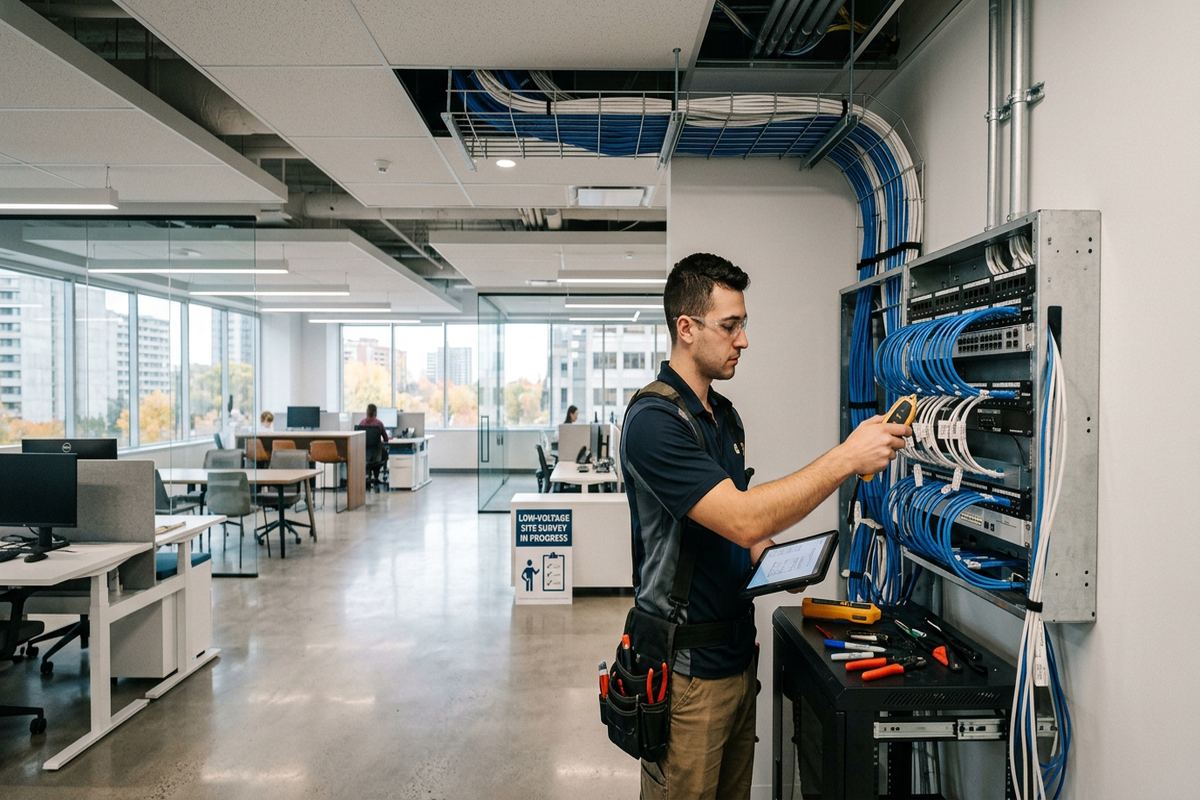
Approvals, Scope and Project Coordination in Ajax
A clear scope prevents low-voltage work from overlapping ambiguously with electrical, drywall, millwork or internet-provider responsibilities. Following the assessment, we document equipment, routes, placement, exclusions, ownership and warranty. The scope can also identify whether pathways are existing, newly installed or dependent on access by another trade. For renovations, cable work is best coordinated before insulation and drywall conceal framing, but after device locations are sufficiently settled. In completed Ajax homes, sequencing may instead depend on furniture moves, ceiling access and any separately arranged surface repairs needed after the installation.
Condo boards, landlords and commercial property managers can impose requirements beyond the customer’s unit or leased space. Written approval may be needed before drilling exterior walls, entering common telecommunications rooms, attaching devices to shared structures or using ceiling space outside the premises. Customers remain responsible for obtaining permissions applicable to their property, while we can describe the proposed low-voltage work for review. In multi-tenant locations, access scheduling and escort requirements should also be confirmed. These steps help prevent an otherwise workable route from being stopped after equipment and cable have already been prepared.
Coordination also includes deciding what happens to existing cabling. Some legacy runs can be tested, identified and retained, while damaged, inaccessible or unsuitable cable may need replacement. Abandoned cable should not automatically be treated as a ready-made pulling line or assumed to reach the label shown on an old panel. We trace what can be accessed and state any limitations. Where removal is requested, the scope identifies the intended extent because concealed sections may be impractical to extract without opening finishes. Ajax customers can then compare reuse, replacement and new-route options on a documented basis.
- Written scope issued before installation
- Trade responsibilities and exclusions clarified
- Property approvals confirmed by the customer
- Renovation sequencing planned around access
- Existing cabling assessed before reuse
Handover and Future Changes for Ajax Systems
Handover is where labels, test results and configuration are connected to the customer’s day-to-day use. We review the installed endpoints, central termination area and relevant equipment, then provide an as-built record showing the completed arrangement. The record is intended to be practical rather than decorative: identifiers should correspond to labels visible at outlets, patch locations or device ends. Any spare runs, inaccessible sections or agreed deviations from the original route are noted. For Ajax properties with finished basements, documenting concealed pathways is especially useful before later renovations or wall-mounted fixtures are planned.
Future changes are easier when the original system has capacity, clear ownership and accessible termination points. A customer may later add cameras, move an office, install another wireless access point or reorganize a commercial floor. The as-built information provides a starting point, but each change still needs review for cable type, pathway capacity and connected equipment. We do not assume that an unused outlet supports every application. Where equipment was customer-supplied or depends on subscriptions and service providers, those boundaries remain identified so responsibilities are clear during troubleshooting or expansion.
Ajax customers can request an assessment for a single new run, a retrofit across several rooms or coordinated cabling for multiple systems. Requests sent during business hours are answered the same day, while after-hours requests are answered the next business day. Site assessment timing depends on the service and travel distance. Pricing follows the assessment because access, materials, route length, construction and device requirements cannot be established reliably from an address alone. The resulting written scope provides the basis for installation, testing and handover by one accountable low-voltage contractor serving Durham Region.
- Installed routes captured in an as-built record
- Spare and concealed runs clearly identified
- Credentials transferred to the customer
- Future additions reviewed against existing capacity
- Assessment completed before project pricing
Ajax neighbourhoods we cover
- Southwood
- Nottingham
- Duffin's Bay
- Applecroft
- Pickering Beach
- Central Ajax
Low-voltage cabling installation in Ajax — common questions
Can you run cable through my finished Ajax basement?
Often, yes, but the route depends on joist direction, bulkheads, insulation, utility spaces and access above the ceiling. Finished basements in Ajax can offer useful pathways while still requiring careful drilling and endpoint planning. We assess the property before pricing, discuss any expected openings or visible raceway and document the agreed route and exclusions in writing.
Do exterior camera cables need special protection?
Exterior cable routes in Ajax must account for moisture, sunlight, winter temperatures and freeze-thaw cycles. Depending on the route, the work may require outdoor-rated cable, conduit, protected transitions and compatible sealing at wall penetrations. Mounting methods also vary between brick, concrete, siding and soffit surfaces. We assess the complete route rather than selecting protection based only on the camera location.
Can existing low-voltage cable be reused?
Existing cable may be reusable if its type, condition, route, terminations and performance suit the intended system. Labels alone are not enough, particularly in renovated Ajax homes or commercial units where previous changes may be undocumented. We inspect and test accessible cabling, explain any limitations and include agreed reuse or replacement in the written scope. Concealed sections may limit what can be verified.
Do I need condo or landlord approval?
Approval may be required if cabling crosses common areas, enters shared telecommunications rooms or involves exterior walls, ceilings, risers or other controlled property. Ajax tenants and condominium owners should confirm applicable rules before installation. UnifiedLink can document the proposed route and device locations for review, but the customer is responsible for obtaining permissions from the landlord, condominium corporation or property manager.
Will I receive labels and cable documentation?
Yes. New continuous cable runs are labelled, and handover includes an as-built record describing installed routes, endpoints and relevant equipment. Where on-site configuration is included, the system is handed over using the customer’s own credentials. This documentation is useful in Ajax homes with concealed basement pathways and in commercial spaces where future technicians need to identify services without tracing every cable again.
How quickly can an Ajax assessment be arranged?
Requests sent during business hours are answered the same day, and after-hours requests are answered the next business day. The timing of an Ajax site assessment depends on the service and travel distance. Pricing is provided after the assessment so the proposed cable routes, construction materials, device locations, access requirements and project exclusions can be captured in a written scope.
Coverage in Ajax is confirmed against the address before we quote. See everything we install in Ajax or the province-wide low-voltage cabling installation page.