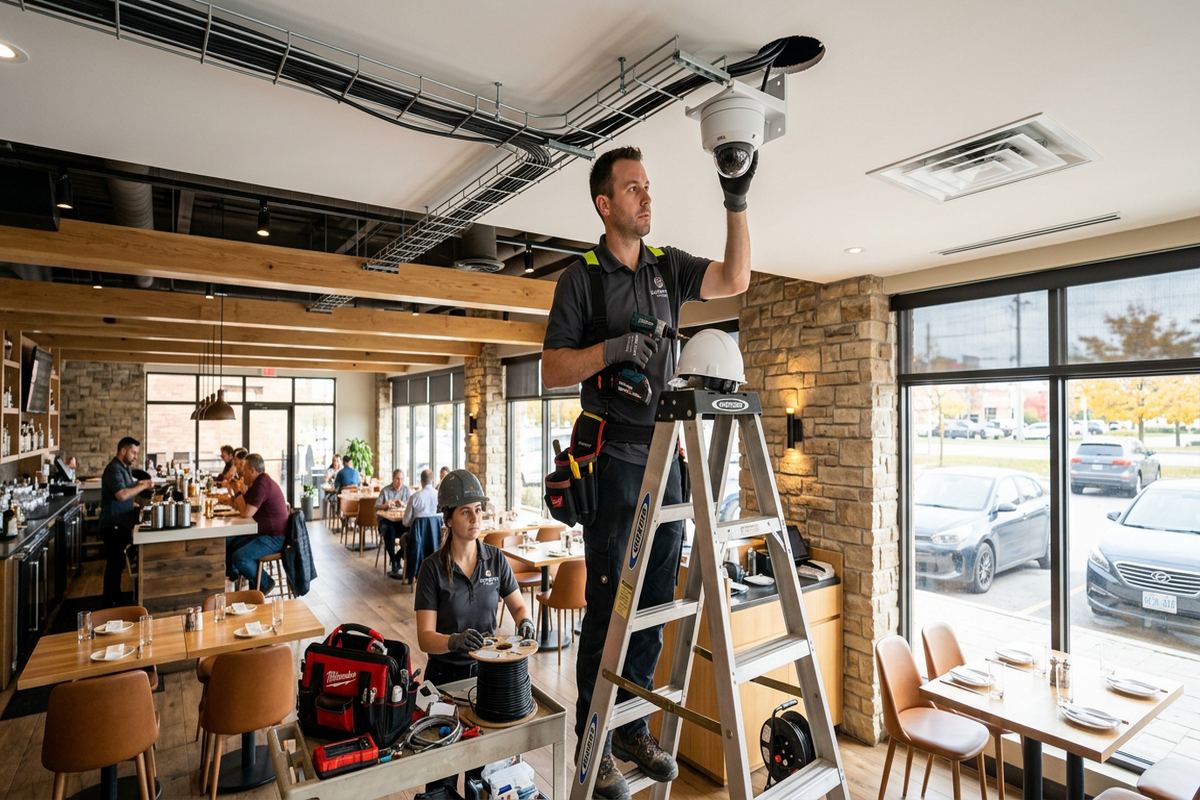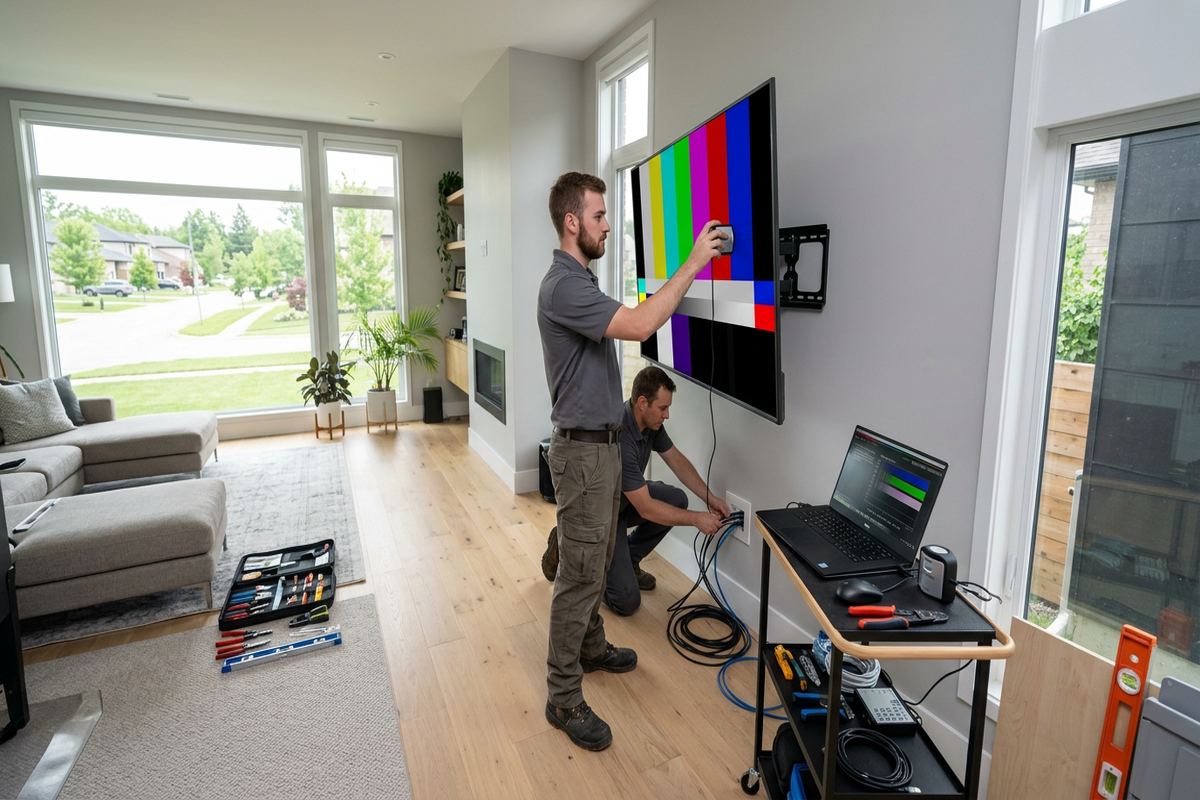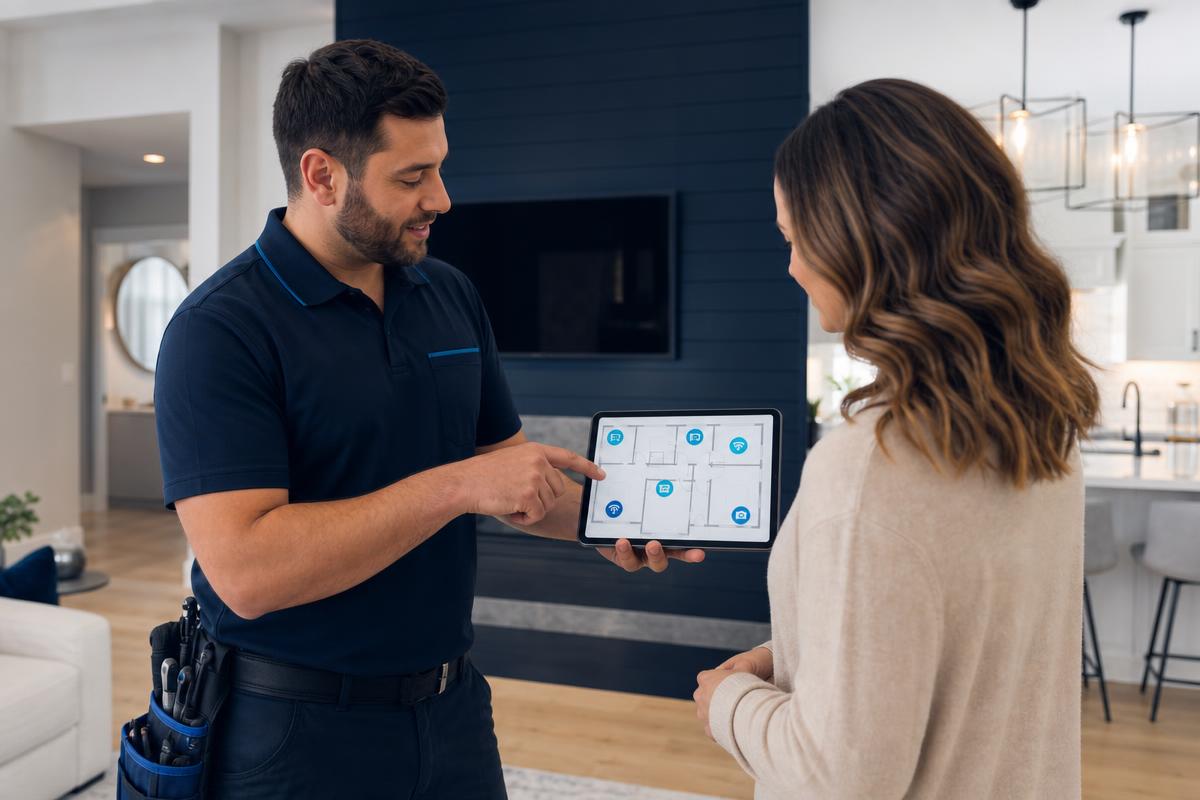
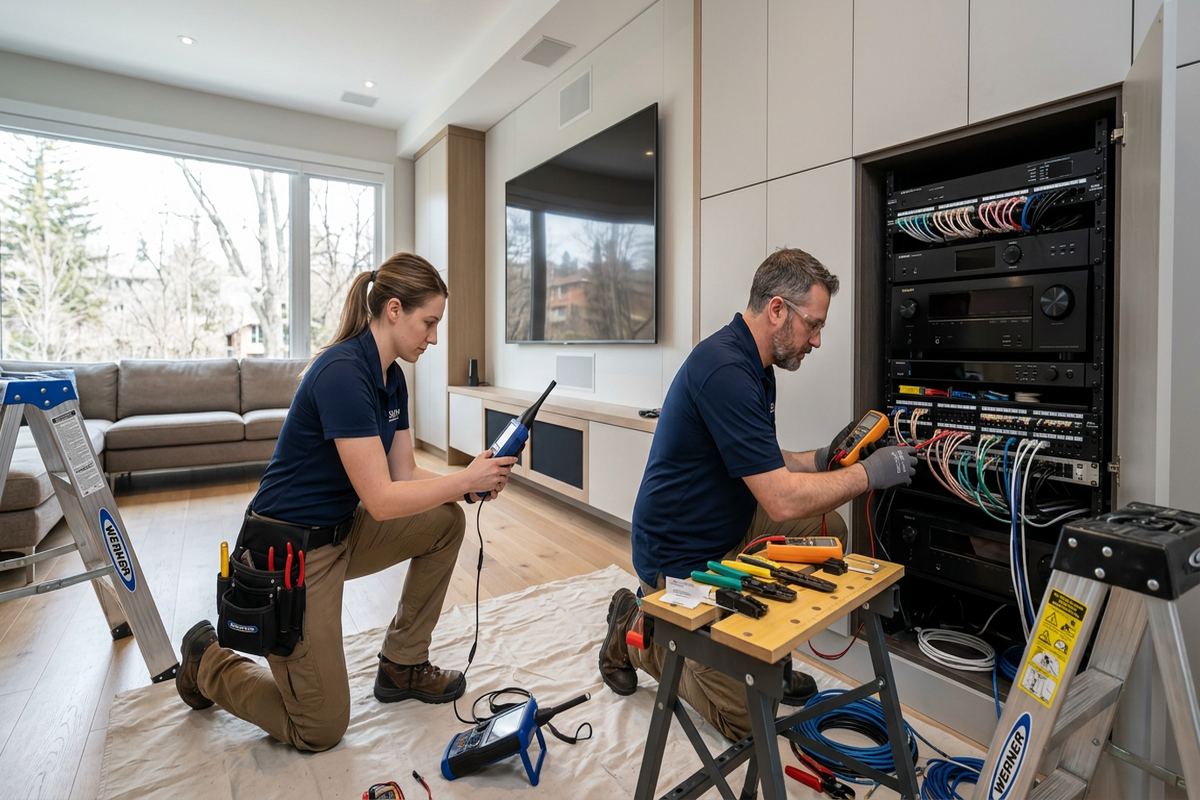
UnifiedLink installs in-ceiling speakers for homes and businesses across Aurora and York Region. We plan speaker placement, amplifier requirements and cable routes before cutting the ceiling. Each installation includes continuous labelled cable runs, secure mounting, on-site configuration and a clear handover using the customer’s own system credentials.
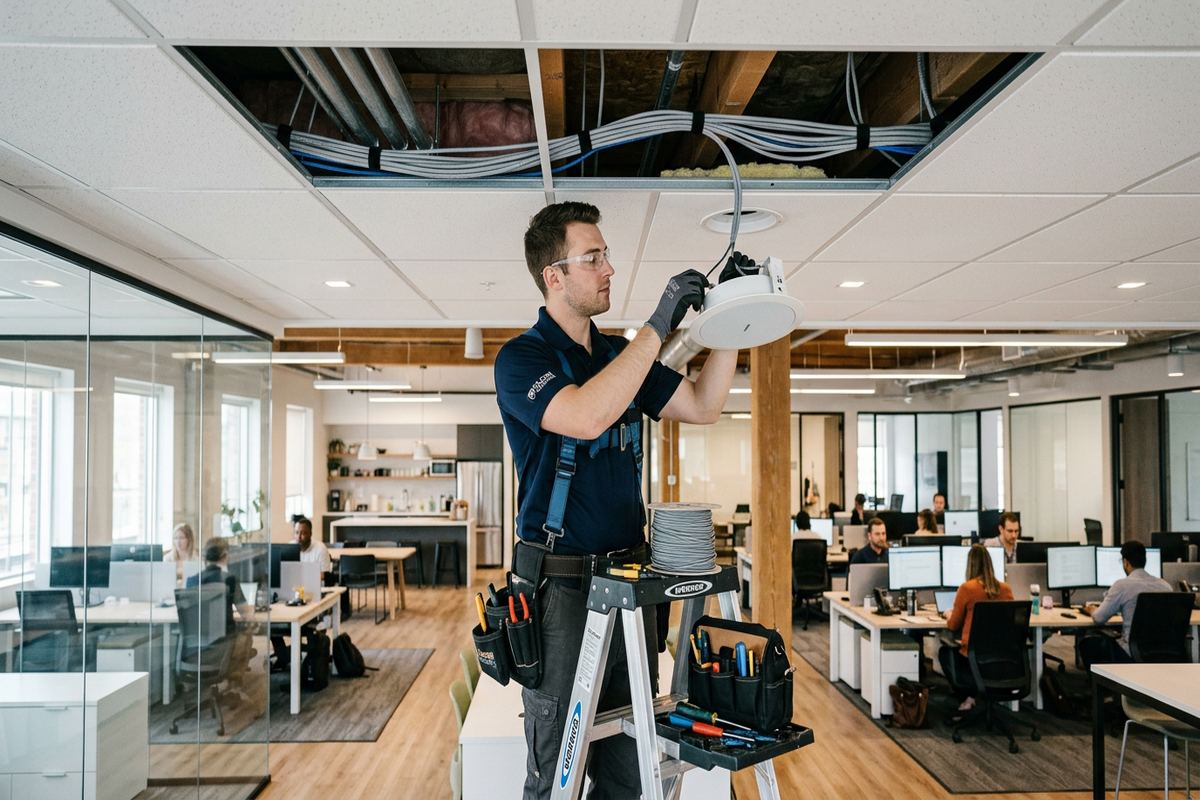
In-Ceiling Speaker Installation for Aurora Properties
An in-ceiling audio system should provide even, intelligible sound without dominating the room. UnifiedLink plans systems around listening areas, ceiling height, furniture, room finishes and expected volume. Speaker quantity is based on coverage rather than simply filling every available ceiling bay. Before pricing, we complete a site assessment and identify practical cable routes, amplifier locations and access limitations. The resulting written scope covers equipment, speaker placement, cable routes, exclusions, equipment ownership and warranty, so the work is defined before installation begins.
Aurora’s mix of housing affects how an audio installation is approached. Heritage homes near Yonge Street can contain plaster, lath, shallow cavities, additions and framing that does not follow modern spacing. Larger estate properties east of town may have high ceilings, broad open rooms and long cable distances back to a central rack. In either setting, exploratory work and careful measurements help avoid unnecessary openings. We confirm what can be reached from attics, basements, mechanical spaces or existing low-voltage pathways before proposing speaker locations.
The goal is a serviceable system, not just speakers that produce sound on installation day. Continuous labelled cable runs make future troubleshooting and equipment changes easier. Connections are terminated consistently, amplifier channels are documented and each zone is tested from source to speaker. On-site configuration can include zone names, input selection, basic level balancing and connection to compatible control applications. At handover, the customer receives access through their own credentials, operating guidance and an as-built record showing installed devices and relevant cable routes.
- Whole-home and single-room audio systems
- Stereo pairs and distributed audio zones
- Retrofit and pre-construction installations
- Residential and commercial speaker layouts
- Written scope before installation
Planning Speaker Coverage Across Aurora Rooms
Good coverage starts with deciding how the room will actually be used. A kitchen or open living area usually benefits from broad, consistent background audio, while a television room may require more deliberate left, right and surround positioning. Bedrooms, offices and treatment rooms often need lower listening levels with clear speech. We consider ceiling dimensions, seating, ambient noise and adjoining spaces before selecting locations. This prevents common results such as one loud spot beneath a speaker, weak sound at the room edge or excessive audio spilling into another zone.
Speaker type also changes the layout. Standard mono speakers are commonly installed in balanced pairs, while a dual-tweeter model can reproduce both channels in a small room where two cut-ins are impractical. Angled or aimable models can direct sound toward a seating area, but they still need suitable ceiling depth and clear space around the back can. Moisture-resistant equipment may be appropriate for bathrooms or sheltered exterior areas. Product selection remains tied to the amplifier, room conditions and required coverage rather than appearance alone.
Properties in Aurora Village and Aurora Highlands frequently combine original rooms with later renovations. A ceiling that looks continuous from below may conceal bulkheads, doubled joists, plumbing or separate framing from an addition. We use available drawings, accessible cavities and non-destructive checks to refine the layout before openings are made. Final cut-in points are confirmed against lighting, smoke alarms, sprinklers, HVAC grilles and ceiling fans. Where the preferred position is blocked, we explain the practical alternatives before changing the agreed speaker arrangement.
- Coverage planned around occupied areas
- Speaker spacing coordinated with ceiling fixtures
- Stereo and mono options for small rooms
- Aimable models considered where useful
- Obstructions checked before final cut-ins
Cabling and Amplification for Aurora Audio Systems
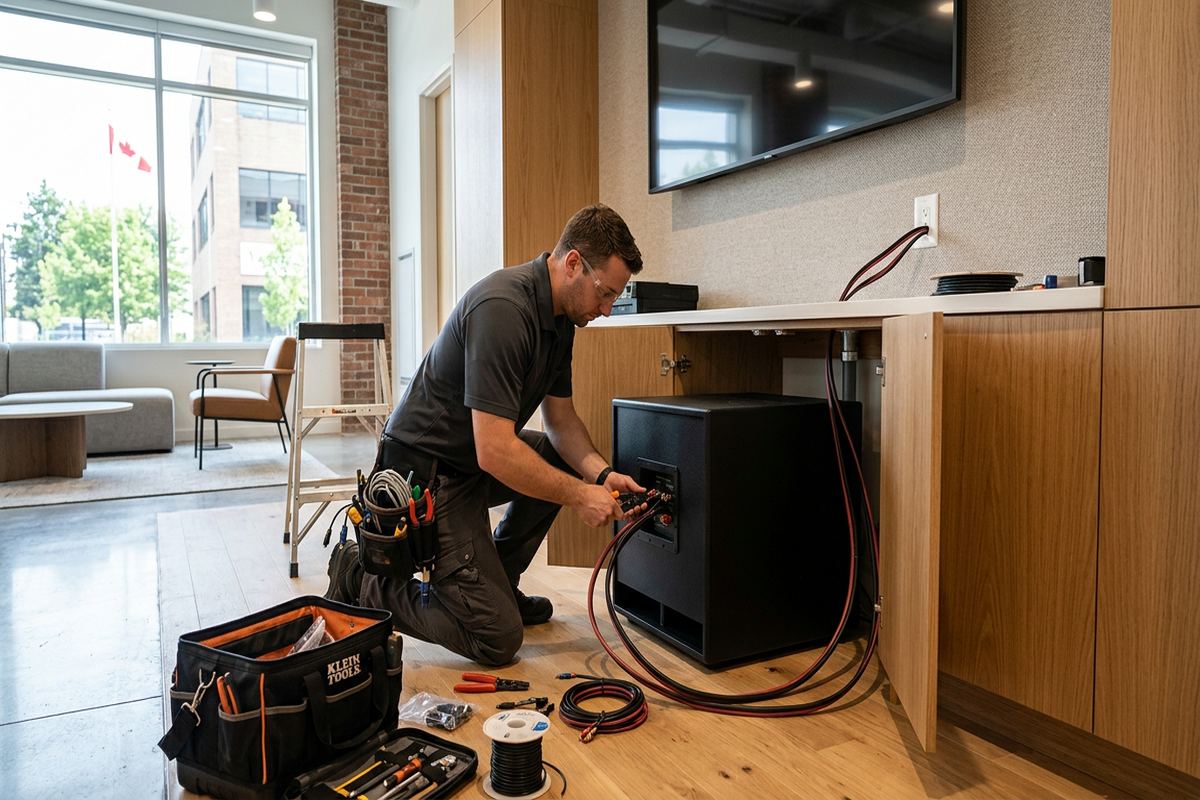
The speakers are only one part of a reliable audio system. Cable gauge, distance, impedance and amplifier capacity must work together. Long runs in larger Aurora properties may require heavier speaker cable to reduce loss, while multiple speakers on one channel need an approved series, parallel or impedance-matched design. We do not join short cable pieces inside inaccessible cavities. Each speaker receives a continuous labelled run from the agreed head-end or local amplifier, subject to the documented system design. Labels identify zones clearly at both ends.
Amplifier placement deserves the same attention as speaker placement. Equipment needs power, ventilation, network access where applicable and enough working space for terminations. Hiding an amplifier in a sealed cabinet can cause heat problems and make routine resets difficult. In estate properties east of town, a central rack may support many rooms efficiently, although cable distances and zone requirements must be evaluated. For a smaller installation, a local cabinet or utility space may be more practical. The written scope identifies the planned location and customer-provided requirements.
Modern audio platforms can combine streaming, television sound and local inputs, but compatibility must be established before installation. We confirm whether the customer wants independent rooms, grouped playback, fixed wall controls or application-based control. Existing receivers and speakers are assessed by model and available connections rather than assumed to be reusable. On-site configuration includes applicable firmware checks, source setup, zone naming and functional testing. Customers receive their own administrator credentials where accounts are required, avoiding systems that remain dependent on an installer’s personal login after handover.
- Continuous cable from amplifier to speaker
- Labels applied at both cable ends
- Amplifier load checked before connection
- Ventilation and service access considered
- Customer-owned system credentials at handover
Aurora, Ontario
In-ceiling speaker installation in Aurora, scoped in writing first
Book a site assessment and get equipment, routes, exclusions, and warranty on paper before anything is installed.
Retrofit Work in Aurora’s Finished Homes
Retrofitting speakers into a finished ceiling requires a different plan from new construction. Access may come from an unfinished basement, attic, closet or nearby utility room, but some routes require limited openings for drilling and cable retrieval. We discuss those openings before work starts and distinguish installation work from painting, plaster repair or decorative finishing where those tasks are excluded. In occupied Aurora homes, floors and nearby furnishings are protected, dust is managed at cut-in points and removed ceiling material is kept clear of the speaker mechanism.
Heritage homes near Yonge Street can require particular care. Plaster and lath may crack beyond a standard saw line if it is handled like drywall, and decorative ceiling details can limit acceptable locations. Masonry dividing walls, brick chimneys and old framing can also interrupt otherwise direct cable routes. We assess whether a ceiling cut-in is suitable or whether surface-mounted speakers, discreet raceway or another route would reduce risk. No installation method should compromise a feature simply to preserve an initially preferred speaker position.
Newer frame construction usually offers more predictable cavities, but it is not obstruction-free. Engineered joists have drilling restrictions, insulated ceilings can be difficult to fish, and fire-rated assemblies must retain their intended performance. Vapour barriers beneath attic spaces should not be casually punctured or left unsealed. Aurora’s cold winters make air leakage and condensation control important wherever work approaches the building envelope. Cable penetrations are sealed appropriately, and speakers are not placed where insulation, moisture or temperature conditions exceed the equipment’s intended installation requirements.
- Finished-ceiling routes assessed before cutting
- Plaster and lath handled carefully
- Limited access openings identified in scope
- Vapour barriers and insulation considered
- Work areas protected during installation
Audio Zones for Homes and Businesses
A well-defined zone lets occupants control the areas that matter without creating unnecessary complexity. Common residential zones include kitchens, dining rooms, patios, primary bedrooms, basements and exercise rooms. Some owners want every area synchronized, while others need separate sources and volume control. We document those expectations before selecting amplification. In Hills of St. Andrew or Rural Aurora, larger floor plans may call for several independently controlled areas. Zone boundaries should follow everyday use, not simply the number of rooms shown on a floor plan.
Commercial installations have different priorities. Offices, clinics, studios, restaurants and customer-facing units may require low-level background music, paging compatibility or separate staff and public zones. Speaker spacing must account for ceiling height and equipment noise so speech remains understandable without making nearby areas uncomfortable. Commercial strips and industrial units around Aurora can include open decks, demising walls, suspended ceilings and warehouse sections. We inspect accessible pathways and coordinate speaker placement with lighting, HVAC, sprinklers and other base-building systems before establishing the installation scope.
Tenants and condominium owners may need written approval before ceilings, common walls or shared service spaces are accessed. A landlord, condominium corporation or property manager may also set working-hour, insurance, access and restoration requirements. UnifiedLink does not assume that a tenant’s permission covers building-owned assemblies. Customers should obtain the required approvals before installation, and any approved routing conditions are added to the scope. In leased commercial units, we can also distinguish customer-owned audio equipment from cabling or infrastructure that the landlord requires to remain with the premises.
- Independent or grouped audio zones
- Background music for customer-facing spaces
- Layouts for suspended or open ceilings
- Landlord conditions added to the scope
- Equipment ownership documented clearly
Outdoor and Sheltered Ceiling Speakers in Aurora
Covered patios, porches and outdoor kitchens can often use ceiling-mounted speakers, but indoor products are not automatically suitable. We verify the equipment’s environmental rating, mounting depth and exposure to wind-driven moisture. A roof may shelter the speaker face while leaving the rear enclosure exposed to humid air or large temperature changes. Cable routes from inside to outside must also be planned as envelope penetrations. Exterior-rated cable, suitable fittings and careful sealing help protect the route rather than relying on caulking applied only around the visible grille.
Aurora’s winters and repeated freeze-thaw cycles can affect exterior materials, seals and mounting surfaces. Water entering a poorly sealed penetration may freeze, expand and damage the surrounding finish. Masonry walls require appropriate drilling and anchors, while frame walls need penetrations located and sealed without compromising flashing or drainage planes. Speaker openings in soffits must avoid vents, wiring and structural members. We select routing and mounting methods after inspecting the actual construction, since brick veneer, solid masonry and framed additions each present different conditions.
Outdoor audio should be designed for the listening area, not to project sound beyond the property. Several speakers operated at moderate levels often provide more even patio coverage than one loud unit. Placement considers seating, neighbouring properties, doors and windows, as well as the direction in which an aimable speaker radiates. In Rural Aurora and estate settings, greater distances do not remove the need for controlled coverage. The system is tested at practical levels, and zone controls are configured so outdoor audio can be adjusted independently from indoor rooms.
- Weather-suitable speakers for sheltered locations
- Exterior penetrations sealed for local conditions
- Masonry and frame construction assessed
- Coverage directed toward occupied areas
- Outdoor zones controlled independently
Pre-Wiring Aurora Renovations and New Spaces
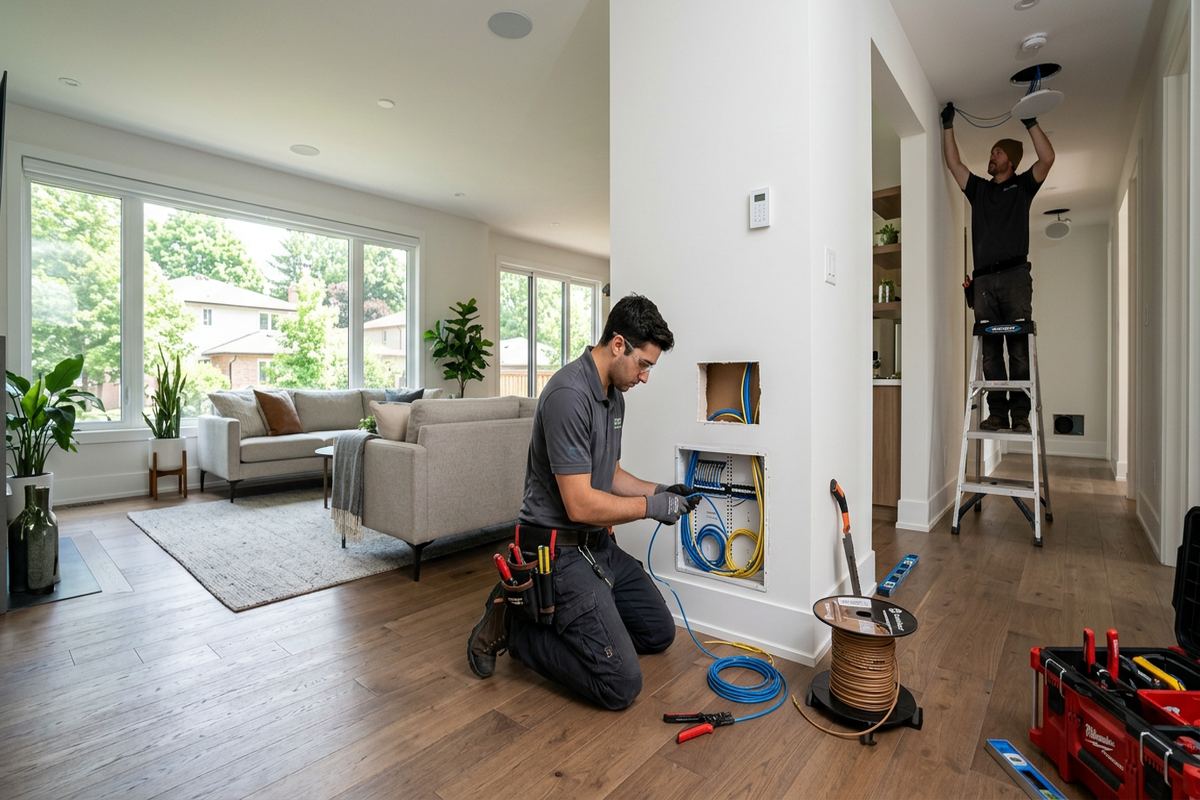
Open framing provides the cleanest opportunity to install speaker cable, but pre-wiring still needs a finished-system plan. We establish likely speaker models, cut-out sizes, amplifier locations and zone requirements before cables are placed. Runs are kept away from likely sources of electrical interference and secured without crushing the jacket. Service loops are left where appropriate, and cable ends are protected and labelled until trim-out. Photographs and route notes help locate wiring after drywall, reducing guesswork when speaker openings are cut later in the project.
Coordination with the general contractor and other trades prevents avoidable conflicts. Speaker locations can be displaced by pot lights, ceiling framing, ductwork, plumbing, sprinkler heads or access panels added after the audio plan. We mark proposed positions and update them when site conditions change. If vapour barriers, fire separations or acoustic assemblies are involved, penetrations and backing requirements must be agreed before closure. Aurora renovations that connect older construction to new additions often require separate routing approaches on each side, even when the finished ceiling will appear continuous.
Pre-wire completion is not the same as system completion. Before walls and ceilings close, cable continuity and identification should be checked, but final performance cannot be confirmed until speakers, amplifiers and sources are installed. During trim-out, we verify openings against the latest room layout, terminate the labelled runs and test every zone. If equipment will be purchased later, the scope states which items are installed now, what remains outstanding and who owns supplied materials. This keeps staged projects understandable for homeowners, builders and future service technicians.
- Speaker cable installed before drywall
- Routes photographed before wall closure
- Locations coordinated with other trades
- Pre-wire and trim-out scopes separated
- Every completed zone functionally tested
Aurora Site Assessment, Installation and Handover
Every project begins with enough information to define the work responsibly. The site assessment reviews room dimensions, ceiling construction, available access, preferred control method, existing equipment and the intended listening areas. For retrofits, we identify likely routes and explain where conditions remain concealed. For commercial sites, access rules and operating constraints are also recorded. Site assessment timing depends on the service and travel distance. Requests sent during business hours are answered the same day, while after-hours requests are answered the next business day.
Following the assessment, UnifiedLink provides a written scope covering equipment, cable routes, device placement, exclusions, equipment ownership and warranty. This is the point to confirm whether patching, painting, electrical work, network changes or third-party approvals fall outside the audio installation. Once accepted, one accountable contractor coordinates the low-voltage work rather than leaving the customer to reconcile separate cable, speaker and configuration tasks. Any material site condition that changes the planned route or placement is discussed before the affected portion of work proceeds.
At completion, each Aurora audio zone is checked for correct channel assignment, clean output, practical volume control and source operation. Grilles are seated, labels are verified and installed equipment is configured on site. The customer receives the system through their own credentials, along with basic operating guidance and an as-built record. That record identifies speaker zones, amplifier connections and relevant cable information available from the installation. A structured handover makes later expansion, troubleshooting or equipment replacement more straightforward for the owner and any technician working on the system.
- Assessment completed before pricing
- Written equipment and routing scope
- One contractor for low-voltage work
- On-site setup and zone testing
- As-built record provided at handover
Aurora neighbourhoods we cover
- Aurora Village
- Bayview Wellington
- Aurora Highlands
- Hills of St. Andrew
- Rural Aurora
In-ceiling speaker installation in Aurora — common questions
Can you install speakers in an older Aurora home?
Yes, subject to a site assessment. Older Aurora homes, particularly near Yonge Street, may have plaster and lath, irregular framing, masonry obstructions or additions built at different times. We inspect available access and propose routes that limit unnecessary openings. If a ceiling is unsuitable for a conventional cut-in, we explain practical surface-mounted or alternate-routing options before pricing the work.
How many in-ceiling speakers does my room need?
The quantity depends on room size, ceiling height, seating, finishes, background noise and the type of listening expected. A small room may use one dual-tweeter speaker, while a broad open area may need several speakers for even coverage. During an Aurora site assessment, we plan spacing around occupied areas and coordinate locations with lights, HVAC grilles, fans and other ceiling devices.
Can you use my existing receiver or amplifier?
Often, but compatibility must be confirmed by model and connection type. We check channel capacity, supported speaker impedance, available zones and the intended control method. An existing receiver may work for one room but be unsuitable for several independently controlled Aurora audio zones. Reusable equipment and any limitations are identified in the written scope before installation, rather than assumed during speaker cut-in work.
Will you need to cut access holes?
Some finished Aurora homes allow cable routing from an attic, basement or accessible ceiling without extra openings. Others require limited access holes to drill framing or retrieve cable. We identify foreseeable openings during assessment and include them in the scope. Painting, plaster repair or decorative finishing is listed as included or excluded, so responsibility for restoration is clear before the installation starts.
Can ceiling speakers be installed on a covered patio?
Yes, when the speaker, cable and mounting method are suitable for the location. Aurora’s winters, moisture and freeze-thaw conditions require attention to environmental ratings and sealed envelope penetrations. We inspect whether the ceiling is a soffit, framed assembly or masonry-supported structure, avoid vents and drainage paths, and direct coverage toward the patio rather than surrounding properties.
Do I need condo or landlord approval?
Possibly. Aurora condominium corporations, landlords and property managers may regulate ceiling penetrations, common spaces, work hours, insurance documentation and restoration. Approval is particularly important when cable routes cross shared assemblies or base-building areas. The customer is responsible for obtaining required permission before installation. We can reflect approved routing conditions, equipment ownership and access requirements in the written project scope.
Coverage in Aurora is confirmed against the address before we quote. See everything we install in Aurora or the province-wide in-ceiling speaker installation page.