UnifiedLink installs commercial security camera systems for businesses, farms, managed properties and industrial sites in Chatham. Each project starts with a site assessment to determine coverage, cable routes, recording needs and exterior mounting requirements. We provide a written scope, complete on-site configuration and hand over the finished system using credentials controlled by the customer.
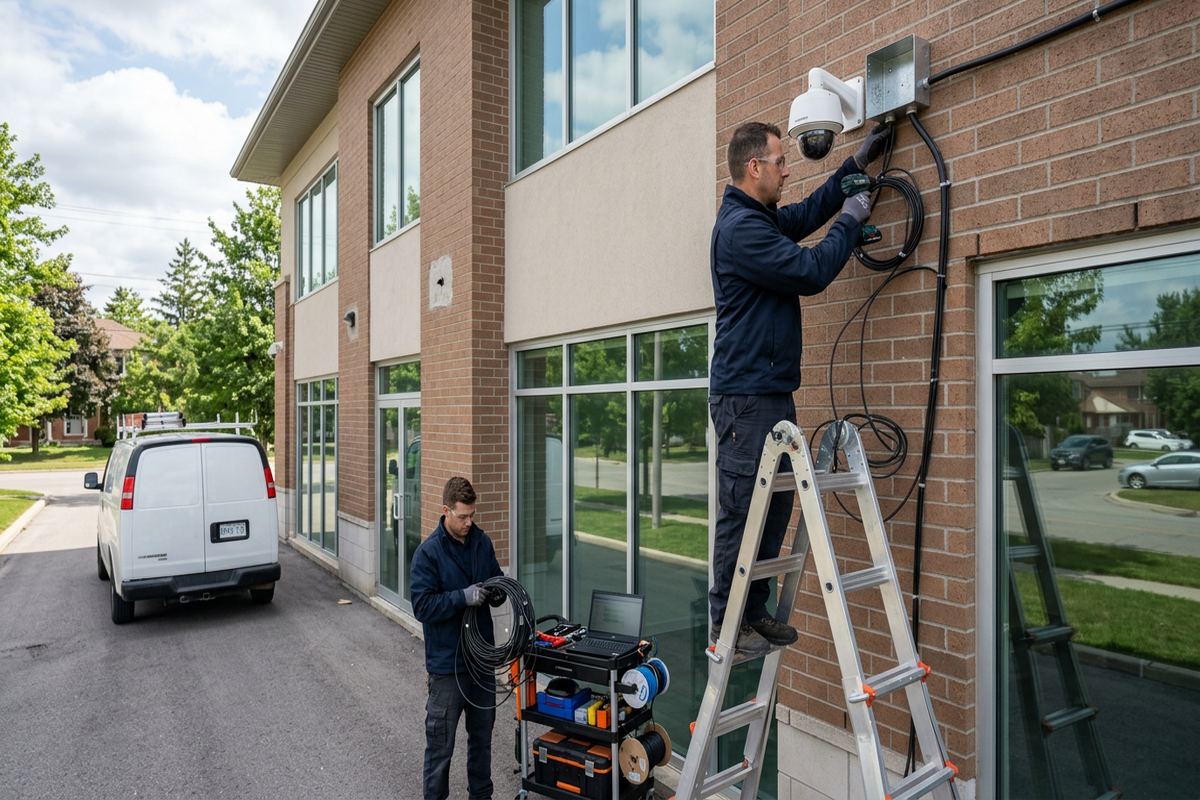
Commercial Camera Planning for Chatham Properties
Commercial camera work begins with understanding the property rather than selecting equipment from a catalogue. In Chatham, the required coverage often reflects a mixture of older town buildings, commercial strips, farm properties, workshops and grain or food facilities. We assess entrances, loading areas, parking, cash-handling points, storage spaces and property boundaries before recommending camera positions. The plan also considers where recording equipment can be secured, how staff will review footage and whether existing network infrastructure can support the expected video traffic without affecting other business systems.
A site assessment identifies practical limits that are easy to miss on a floor plan. Glare from storefront glass, vehicle headlights, deep overhangs, tall exterior walls and changing seasonal light can all reduce useful image quality. We review likely subject distance and direction so cameras are selected for identification, general observation or vehicle coverage as appropriate. The assessment also establishes workable cable paths, lift or ladder access, available power and the condition of mounting surfaces. Pricing follows this review because equipment quantities and installation effort depend on the actual building.
The written scope sets out the proposed equipment, camera locations, cable routes, recording approach and work exclusions. It also states equipment ownership and applicable warranty information, reducing uncertainty between the property owner, tenant, manager and installer. Chatham projects involving leased units, condominiums or shared buildings may require written approval before drilling, exterior mounting or using common pathways. Confirming those permissions early avoids unsuitable placements and helps preserve fire separations, exterior finishes and access for other building services throughout the installation process.
- Entrance, loading and parking coverage review
- Camera purpose defined by viewing distance
- Recorder and network location planning
- Landlord or condominium approval requirements
- Written equipment and installation scope
Camera Placement Across Chatham Worksites
Useful coverage depends on what the operator needs to see after an incident. A wide view may show activity across a yard while providing too little detail to identify a person at a doorway. For commercial sites in Chatham, we separate overview, identification and vehicle-monitoring tasks instead of expecting one camera to perform every role. Entrances are generally approached differently from open parking areas, production spaces or long fence lines. Placement accounts for mounting height, lens angle, backlighting, obstructions and the routes people or vehicles are most likely to use.
Downtown Chatham properties can present narrow storefronts, shared walls, upper-level occupancies and limited rear-lane access. These conditions may favour compact camera positions and internal cable routes that avoid neighbouring premises. Around the Thames Campus area or commercial strips, broader parking and pedestrian approaches can require overlapping views rather than a single distant camera. Prestancia properties may have architectural controls or shared ownership considerations. In every setting, cameras should cover the intended business area without unnecessarily viewing private neighbouring spaces, residential windows or unrelated public activity.
Warehouses and industrial units need placement that reflects how the building operates. Racking, moving doors, parked trailers, changing stock and high ceilings can create blind areas after an apparently clear installation. We review daily movement and likely future obstructions before fixing positions. Interior cameras may need to monitor receiving, controlled stock or a specific transaction point, while exterior devices address approaches and after-hours activity. Camera views are checked on-site during configuration, allowing useful adjustments before final tightening, sealing, recording setup and documented handover to the customer.
- Separate overview and identification views
- Overlapping coverage for larger approaches
- Doorway views protected from strong backlight
- Placement checked against normal operations
- Privacy-conscious viewing boundaries
Exterior Security Cameras in Chatham Weather
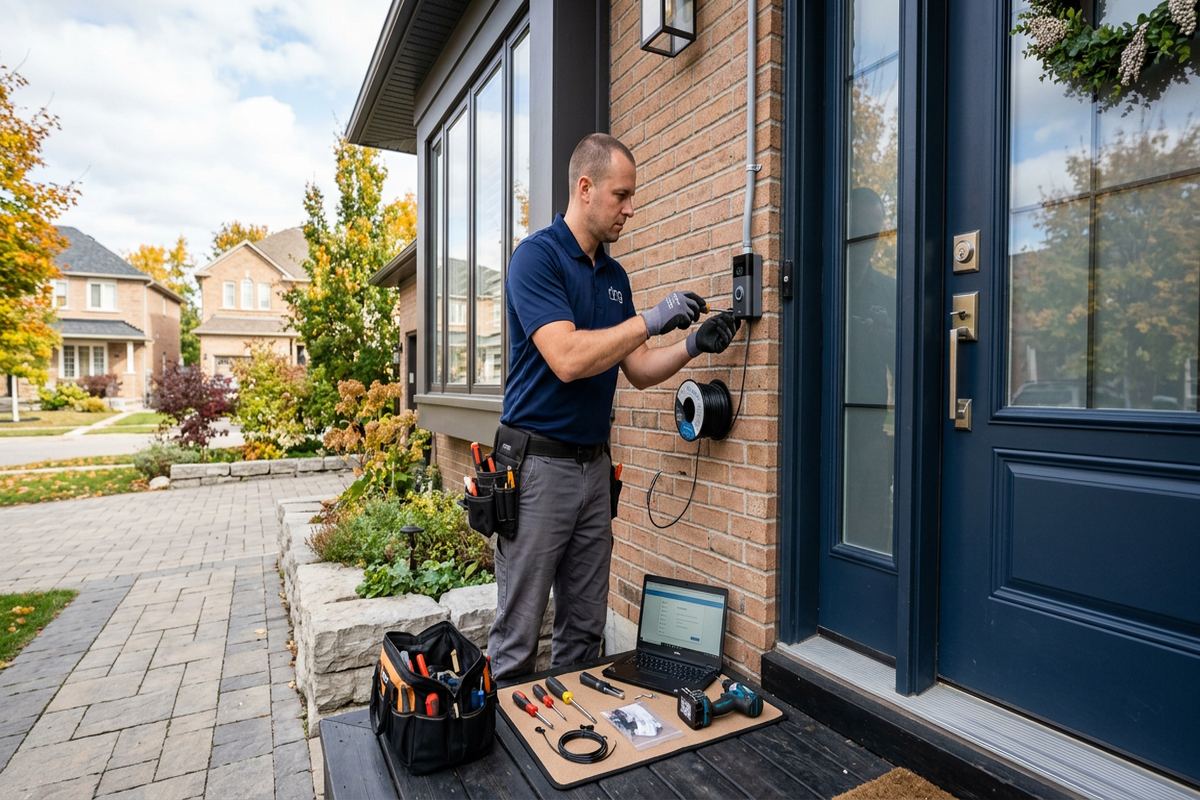
Exterior installation in Chatham must account for winter moisture, wind, ice and repeated freeze-thaw cycles. A camera rated for outdoor use still depends on a sound mounting method and properly protected cable entry. Water can follow poorly dressed cable, collect behind a base or enter through an unsealed penetration. We use suitable mounting surfaces, weather-conscious cable routing and sealed entries so the building envelope is not left exposed. Drip loops, junction arrangements and connector protection are considered according to the device, wall assembly and location rather than treated as optional finishing details.
Masonry and frame construction require different fastening and penetration methods. Older Chatham buildings may have brick that should not be treated like modern concrete, while sided frame walls require attention to sheathing, cavities and suitable backing. Mounting only to a weak finish can lead to movement, failed seals or damaged cladding. Before drilling, we consider the wall material, interior route and nearby utilities. Exterior penetrations are positioned and sealed to limit moisture entry, and visible cable is mechanically protected where concealment is not practical or where exposure creates a damage risk.
Agricultural and food-related properties add dust, washdown, vibration, insects and large temperature changes to the environmental assessment. A camera suitable for a sheltered office entrance may be inappropriate near grain handling, loading or processing activity. We discuss the operating environment before equipment is specified and avoid placing devices where routine work will repeatedly block or contaminate the lens. At farm properties outside central Chatham, long distances between buildings may also change the network design. Trenching, aerial pathways or wireless links require separate assessment rather than assumptions based on urban buildings.
- Weather-rated cameras for exposed locations
- Sealed exterior wall penetrations
- Fasteners matched to wall construction
- Protected connectors and cable entries
- Environmental review for dust and washdown
Chatham, Ontario
Commercial security camera installation in Chatham, scoped in writing first
Book a site assessment and get equipment, routes, exclusions, and warranty on paper before anything is installed.
Structured Cabling for Chatham Camera Systems
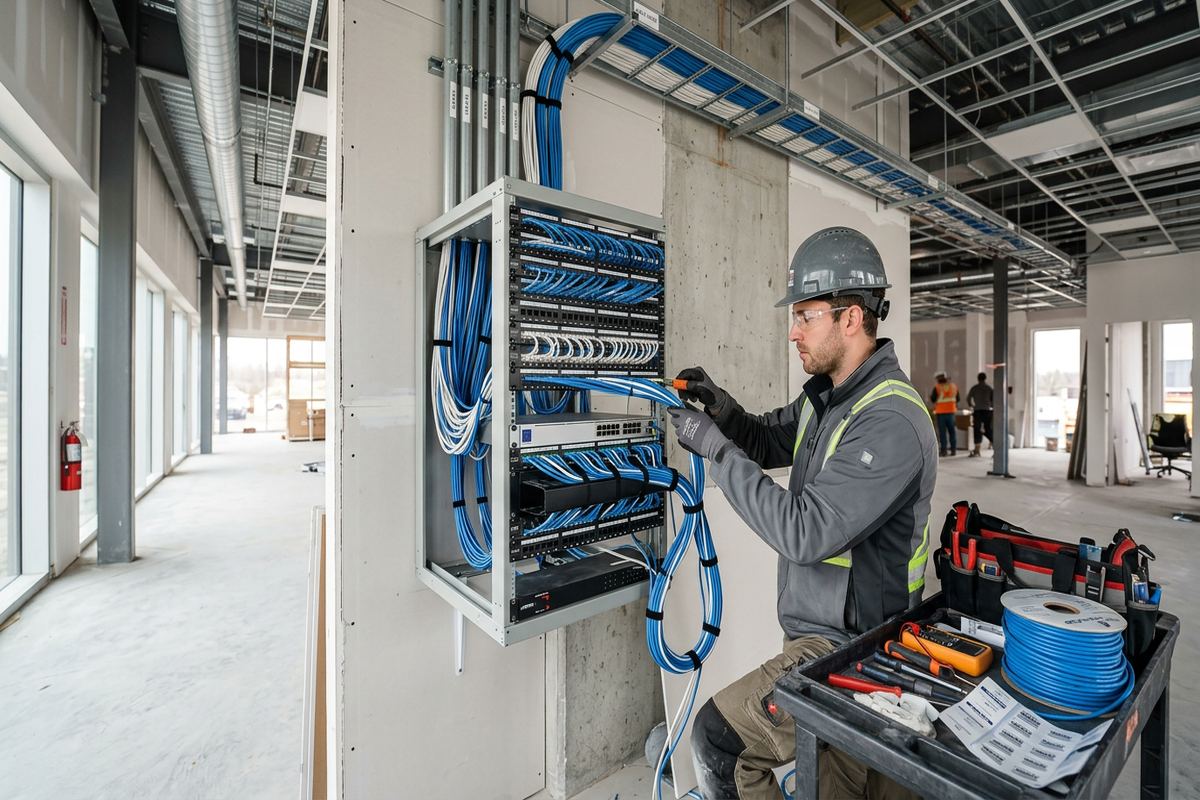
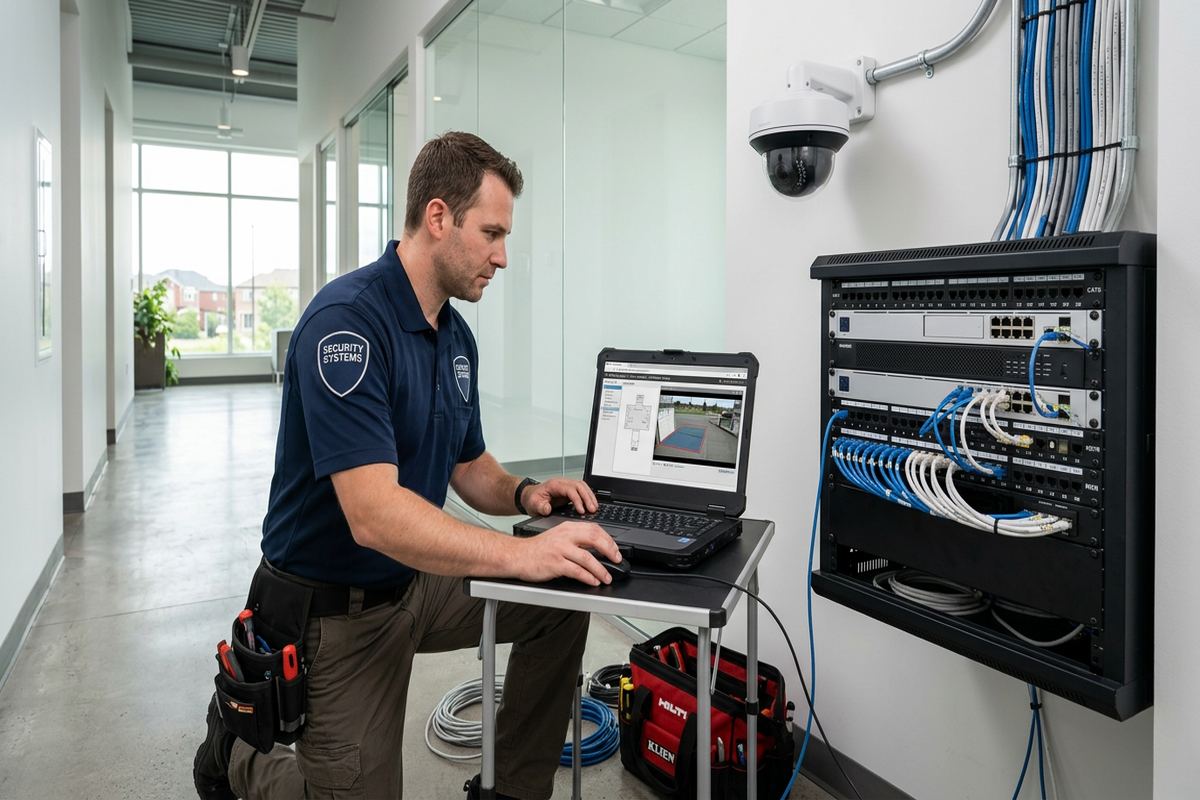
A camera system is only as dependable as the cabling and network behind it. UnifiedLink installs continuous labelled cable runs between each camera and the designated equipment location, avoiding unnecessary hidden joins. Routes are planned around electrical interference, heat, moving equipment, wet areas and points where cable could be crushed or cut. In finished Chatham offices or older buildings, concealed routes may be limited by plaster, masonry, inaccessible ceilings or previous renovations. The written scope explains whether cabling will be concealed, surface-mounted, placed in conduit or routed through an approved service pathway.
Power over Ethernet can carry data and power to compatible cameras over one network cable, but switch capacity and distance still need to be checked. We review port availability, power budget, recorder connections and the separation between the camera network and ordinary business traffic. Reusing existing cabling is considered only after its route, condition, termination and suitability are assessed. An existing cable that produces a link is not automatically appropriate for sustained video. Where replacement is required, the reason and affected route are included in the proposed scope before installation begins.
Labelling supports maintenance long after installation day. Each run is identified so a camera, switch port and termination can be traced without guessing or disconnecting unrelated devices. Equipment is arranged to allow practical access while remaining protected from casual interference. At handover, the customer receives an as-built record showing installed camera locations and relevant system details. This is especially useful for Chatham properties with several buildings, changing tenants or multiple service contractors, where undocumented cabling can otherwise make future repairs, additions and network changes slower or more disruptive.
- Continuous cable runs without hidden splices
- Labels at device and equipment ends
- Power and network capacity review
- Conduit or protected surface routing where required
- As-built record supplied at handover
Recording, Remote Viewing and Data Control
Recording design starts with operational needs: which cameras require continuous recording, when motion-based events are useful and who should be permitted to review video. Retention depends on camera count, resolution, frame rate, recording mode and available storage, so it should be calculated rather than promised as a generic duration. We discuss the business purpose for footage and configure the recorder on-site within the agreed system capabilities. Search and playback functions are checked with the customer, including how to export an incident clip without changing or exposing the original recording.
Remote viewing may be useful for an owner overseeing a Chatham storefront, farm property or several managed units, but access should not rely on installer-owned accounts. The finished system is handed over using the customer’s own credentials, with authorized users established according to the agreed arrangement. We do not leave routine ownership tied to a technician’s personal login. Network settings, application access and notification options are configured on-site where included in scope. Any dependence on internet service, third-party applications or subscriptions is identified before the customer accepts the proposed equipment.
Video access also requires internal policies. A technically secure system can still create problems if shared passwords are used broadly, former staff retain accounts or exported clips are stored carelessly. We explain the available user roles and help designated administrators understand ordinary account management. The customer remains responsible for deciding who may view, export or disclose recordings and for meeting workplace, tenancy and privacy obligations. For mixed-use or multi-tenant Chatham properties, these decisions should be settled before broad remote access is enabled, particularly where cameras cover shared corridors, entrances or parking areas.
- Storage calculated from recording requirements
- Customer-controlled administrator credentials
- Playback and export demonstrated on-site
- User permissions configured by role
- Third-party dependencies identified in scope
Commercial Camera Upgrades in Chatham
An existing camera system does not always need complete replacement, but its condition must be evaluated as a whole. We inspect camera views, cabling, connectors, power supplies, recording hardware, storage health and network connections before proposing an upgrade. Common issues include obsolete recording formats, failed night illumination, poor image angles, intermittent cabling and systems that cannot be accessed because credentials were never transferred. In Chatham’s older commercial and residential building stock, previous installations may also use improvised pathways that should not be extended without reviewing physical protection and building penetrations.
Compatibility determines whether old and new components can operate together. Analogue cameras, network cameras, proprietary recorders and third-party applications do not automatically integrate, even when connectors appear similar. We identify model information where available and test practical functions rather than relying on assumptions. A phased upgrade may retain serviceable cabling or selected cameras while replacing the recorder and critical views. Where mixed equipment would limit resolution, playback, remote access or support, the written scope explains those limitations so the owner can compare partial replacement with a consistent new platform.
Relocating cameras can sometimes solve more than adding devices. Changes to counters, doors, racking, lighting or parking flow may have made original views ineffective. Wallaceburg facilities and properties elsewhere in Chatham-Kent can also involve travel between sites, so assessment timing depends on the service and distance involved. During the review, we identify cameras that are redundant, obstructed or aimed too broadly and determine whether they can be repositioned safely. Any reused device is still checked for image quality, mounting condition and compatibility with the proposed recording system.
- Existing recorder and camera assessment
- Credential and remote-access review
- Compatibility testing before reuse
- Phased replacement options where practical
- Camera relocation for changed layouts
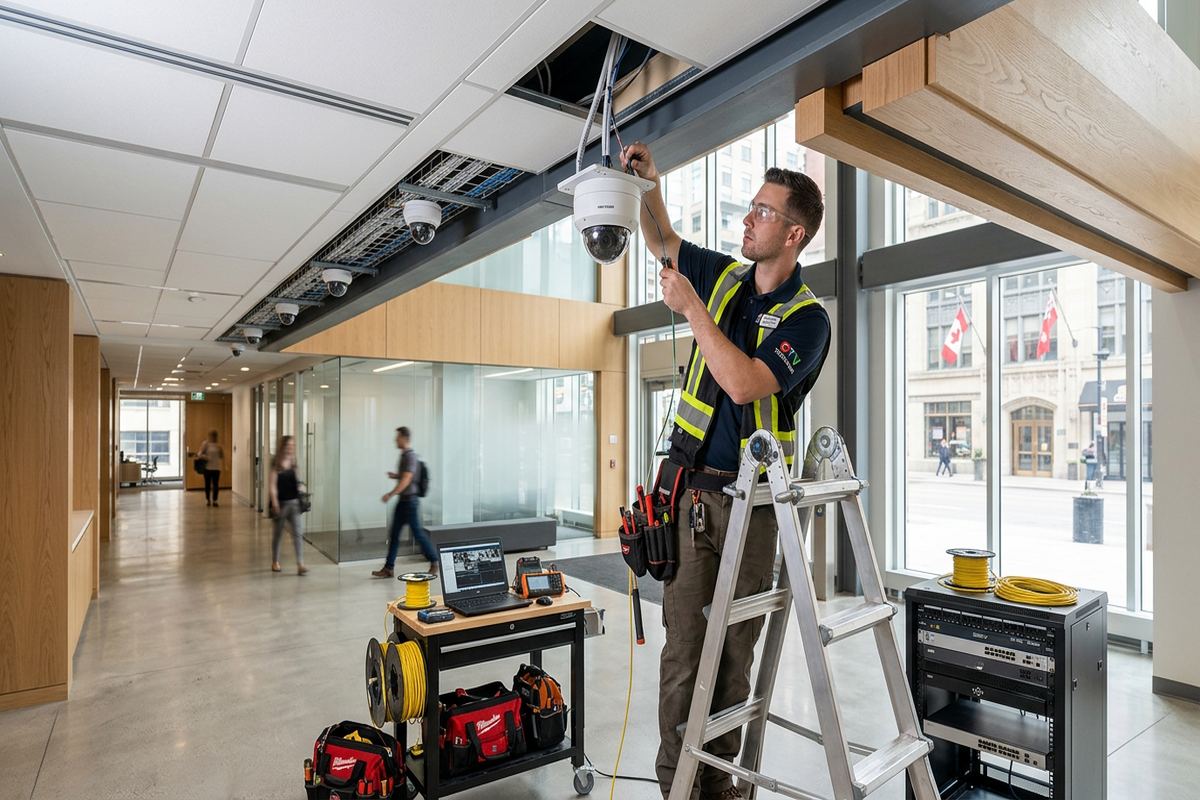
Installation and Handover in Chatham
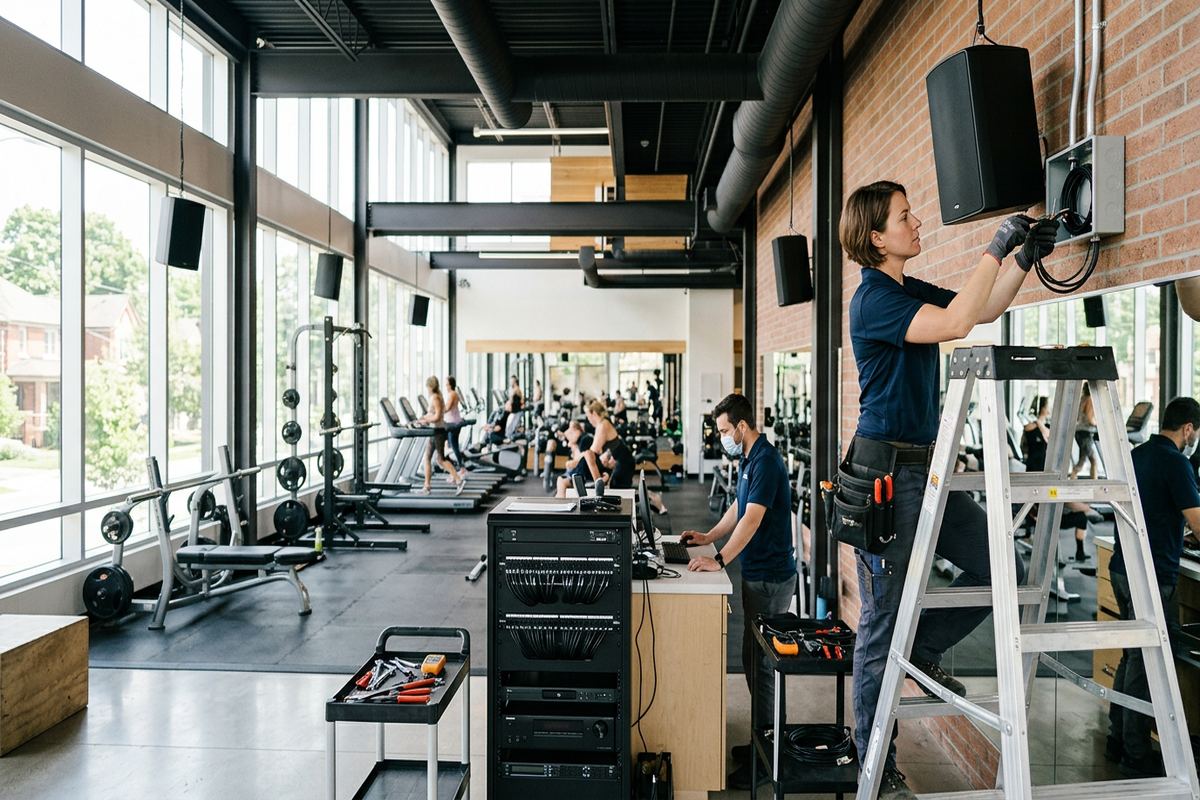
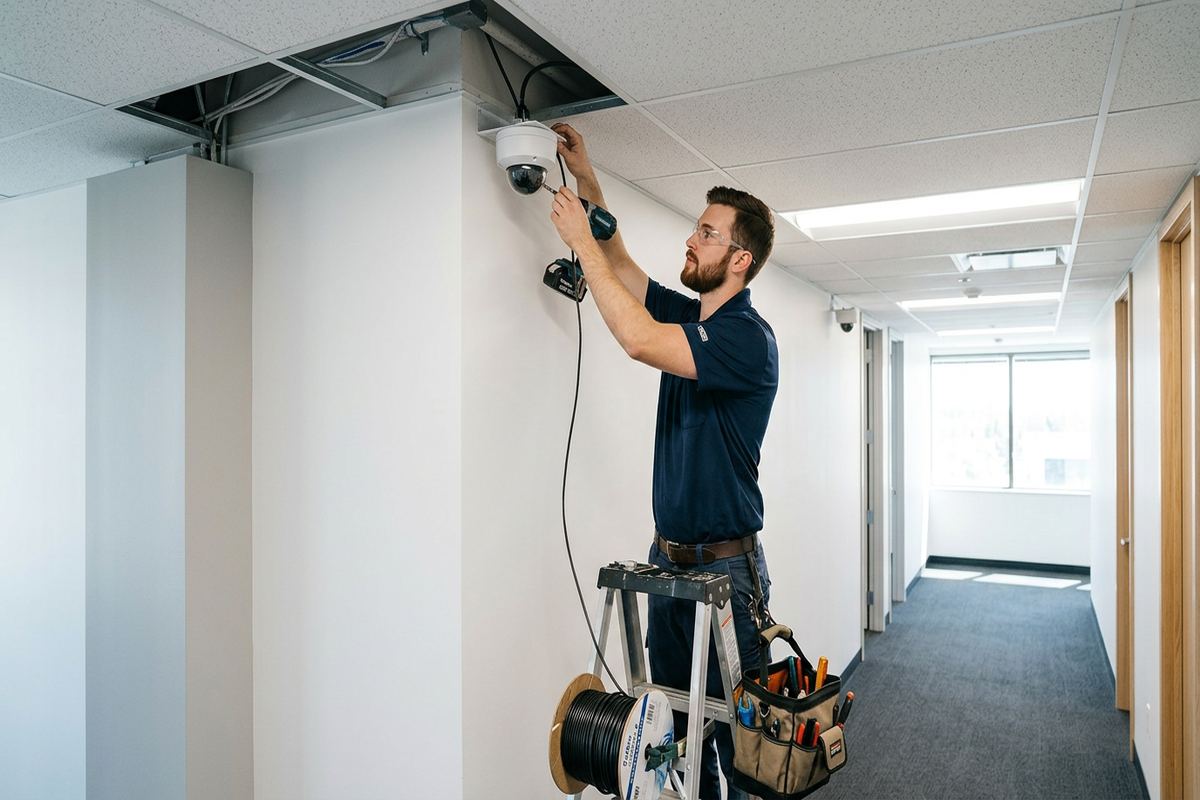
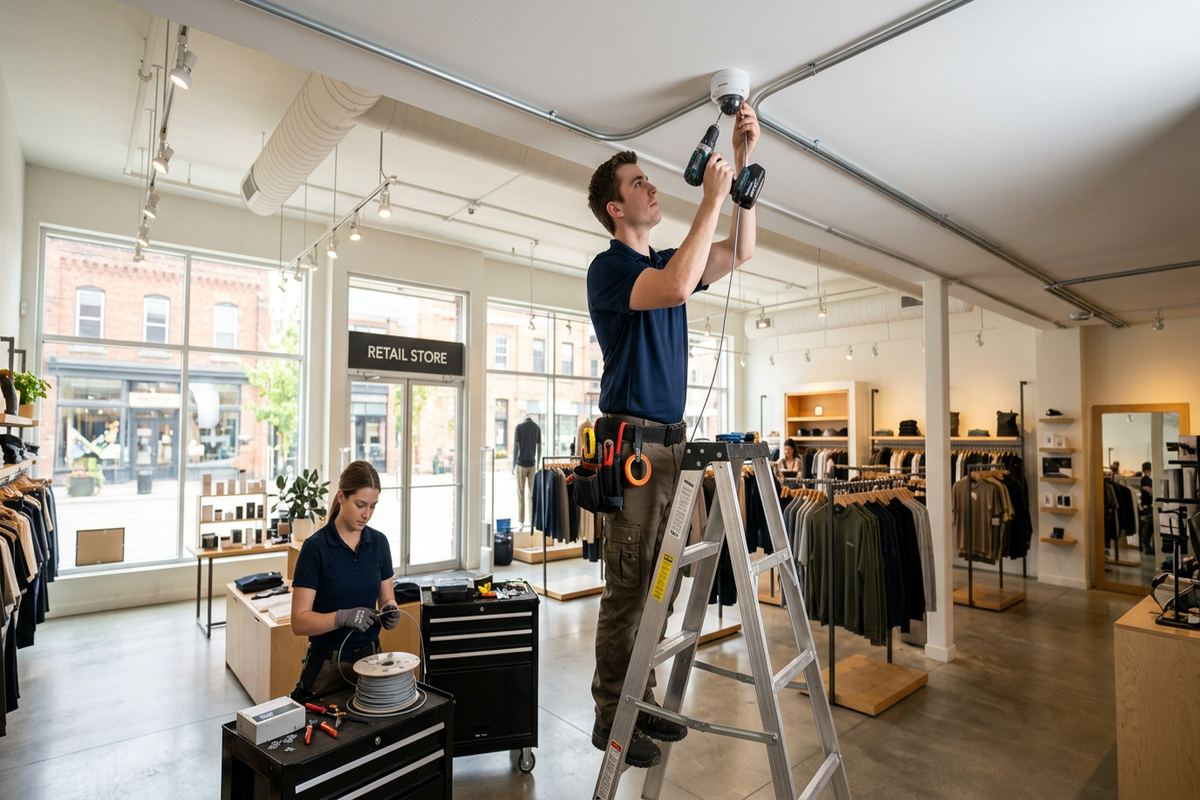
Once the scope is approved, installation follows the documented locations and cable routes unless site conditions require a discussed change. Work includes mounting devices, installing and labelling cable, making terminations, connecting recording and network equipment, and configuring agreed functions on-site. We coordinate access to occupied spaces and identify activities that may affect normal operations, such as work near entrances, ceilings or loading areas. One accountable contractor manages the camera installation, reducing gaps between cabling, device mounting, system configuration and final testing while keeping responsibility for the agreed work clear.
Testing is performed from the recorder and viewing interfaces, not only at the camera. We check live images, recorded playback, time settings, camera names, intended fields of view and user access included in the scope. Exterior positions are reviewed for secure mounting and finished cable entries. Night performance is influenced by site lighting, reflective surfaces, weather and nearby objects, so likely low-light conditions are considered during placement and configuration. Where a return check after dark is outside the agreed work, that exclusion is stated rather than implying conditions were tested when they were not.
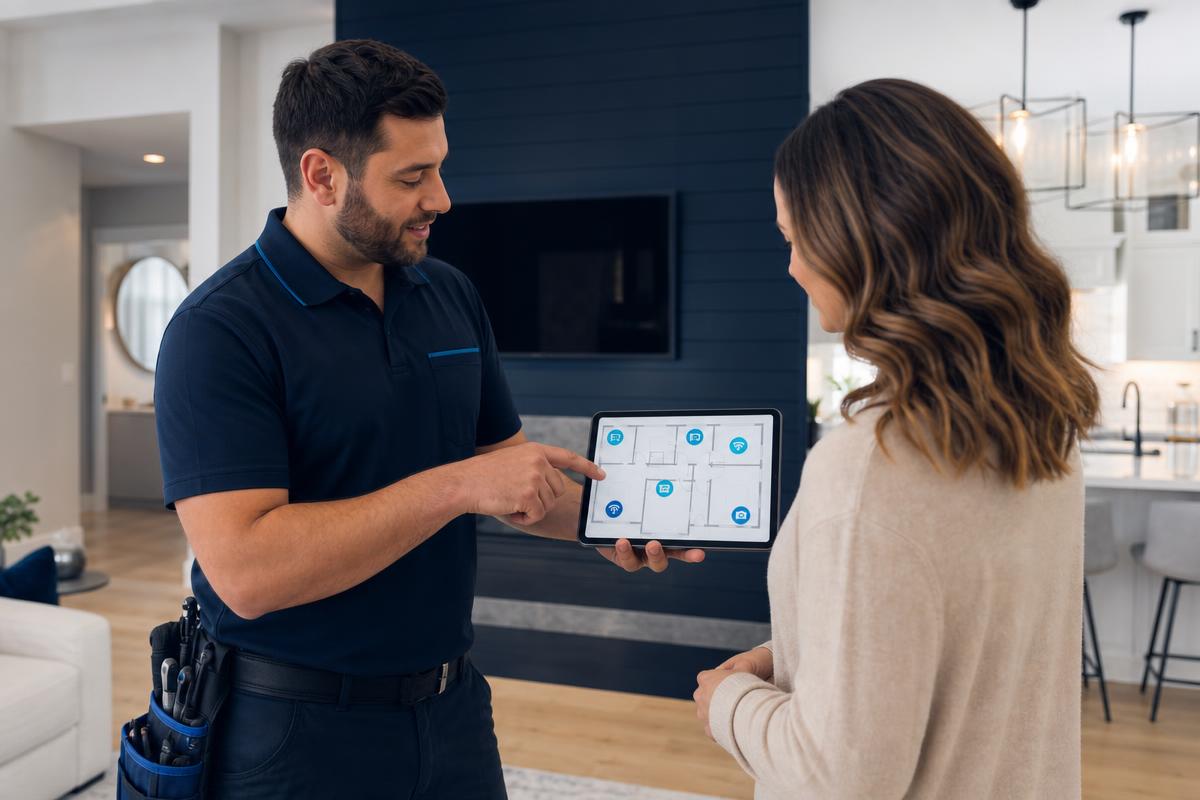
Handover gives the Chatham customer practical control of the completed system. Administrator access uses the customer’s own credentials, and designated users are shown how to view cameras, search recordings and export footage using the installed platform. The as-built record documents camera locations and relevant equipment details, while the written scope records ownership, exclusions and warranty information. Requests received during business hours are answered the same day; after-hours requests are answered the next business day. Timing for a site assessment depends on the required service and travel distance.
- Installation follows the written scope
- On-site camera and recorder configuration
- Playback and user access testing
- Customer-owned credentials at completion
- System demonstration and as-built record
Choosing Coverage for Chatham-Kent Operations
The right system size follows risk, workflow and property layout rather than a fixed camera package. A small Downtown Chatham office may need clear entrance and rear-access views, while a grain facility could require multiple zones covering gates, loading, equipment approaches and storage. Maple City properties may combine newer construction with landscaped sightline obstructions, and older town housing used for commercial purposes can have limited pathways between floors. We match the proposed coverage to the activities that matter, then explain what each camera is expected to show and where limitations remain.
Budget control is best handled by defining priorities before equipment is selected. Critical entrances, transaction points and controlled stock may receive identification-focused views first, while general perimeter observation can be added in a later phase. The assessment separates essential coverage from optional expansion, allowing the owner to decide without relying on an unexplained bundle. No price is issued before the site has been assessed because mounting access, cable routes, building materials and network readiness affect the work. The resulting written scope provides a direct basis for comparing the proposed outcome and exclusions.
Planning for expansion can prevent unnecessary replacement, but unused capacity should still serve a realistic purpose. We discuss likely additions such as another building, loading bay, tenant area or parking section and determine whether recorder channels, storage, switch capacity and cable pathways should accommodate them. For Chatham-Kent businesses with dispersed operations, a consistent platform may simplify authorized viewing, provided each location has suitable connectivity and access controls. The goal is a maintainable installation with documented ownership, clear administration and coverage tied to actual operating needs rather than an arbitrary device count.
- Coverage prioritized by operational risk
- Essential and optional cameras separated
- Expansion capacity planned where justified
- Building materials included in route planning
- One documented scope for the complete project
Chatham neighbourhoods we cover
- Downtown Chatham
- Thames Campus area
- Maple City
- Prestancia
- Wallaceburg
Commercial security camera installation in Chatham — common questions
Do you assess my Chatham property before pricing?
Yes. A site assessment is completed before pricing because camera quantity, mounting height, cable routes, recorder location and network readiness vary between Chatham properties. We also review exterior materials, access equipment needs and the intended purpose of each view. Assessment timing depends on the required service and travel distance. The resulting written scope identifies equipment, placement, routes, exclusions, ownership and warranty information.
Can cameras be installed on older brick buildings?
They can, subject to an assessment of the brick, mortar, interior route and mounting location. Older Chatham masonry should not be treated like modern concrete or frame construction. The fixing method and seal must suit the actual wall assembly. We also consider whether surface conduit is more appropriate than concealed routing and whether landlord, condominium or heritage-related approvals must be obtained by the customer.
Will exterior cameras handle Chatham winters?
Equipment is selected for the expected exposure, but weather resistance also depends on installation. Chatham freeze-thaw cycles, wind-driven moisture and ice make secure mounting, protected connectors and sealed penetrations important. We assess overhangs, wall materials and cable entry points before installation. No outdoor camera is treated as weather-ready merely because its product description says exterior; the complete mounting and connection arrangement must also be suitable.
Can you reuse our existing camera cabling?
Possibly. Existing cabling must be inspected for type, condition, route, termination and compatibility with the proposed equipment. Chatham buildings with previous renovations may contain hidden joins, damaged cable or pathways that are unsuitable for sustained network video. If a run can be reused responsibly, it can be included in the scope. If replacement is recommended, we explain the reason and proposed route before work begins.
Who controls the camera system passwords?
The customer does. At handover, the Chatham business or property owner receives the system using credentials under its own control. Authorized users can be configured according to agreed roles, and ordinary viewing, playback and export functions are demonstrated. We do not leave routine ownership dependent on an installer’s personal account. Customers should also maintain an internal process for removing former users and protecting exported footage.
Can one system cover multiple farm buildings?
Sometimes, although the design depends on distance, power, pathways, internet connectivity and line of sight. Farm properties around Chatham-Kent may require underground cable, protected aerial routes, local recording equipment or assessed wireless links between buildings. Dust, vibration, insects and temperature variation also influence equipment placement. We review each building and connection path before proposing a system rather than assuming an urban office design will work across the site.
Coverage in Chatham is confirmed against the address before we quote. See everything we install in Chatham or the province-wide commercial security camera installation page.