UnifiedLink installs commercial security camera systems for Brantford offices, shops, warehouses, industrial units and mixed-use properties. We assess the site before pricing, plan camera positions and cable routes, configure recording and remote access on site, and provide a documented handover. The installation is adapted to the building, operating risks and approval requirements.
Commercial Camera Planning in Brantford
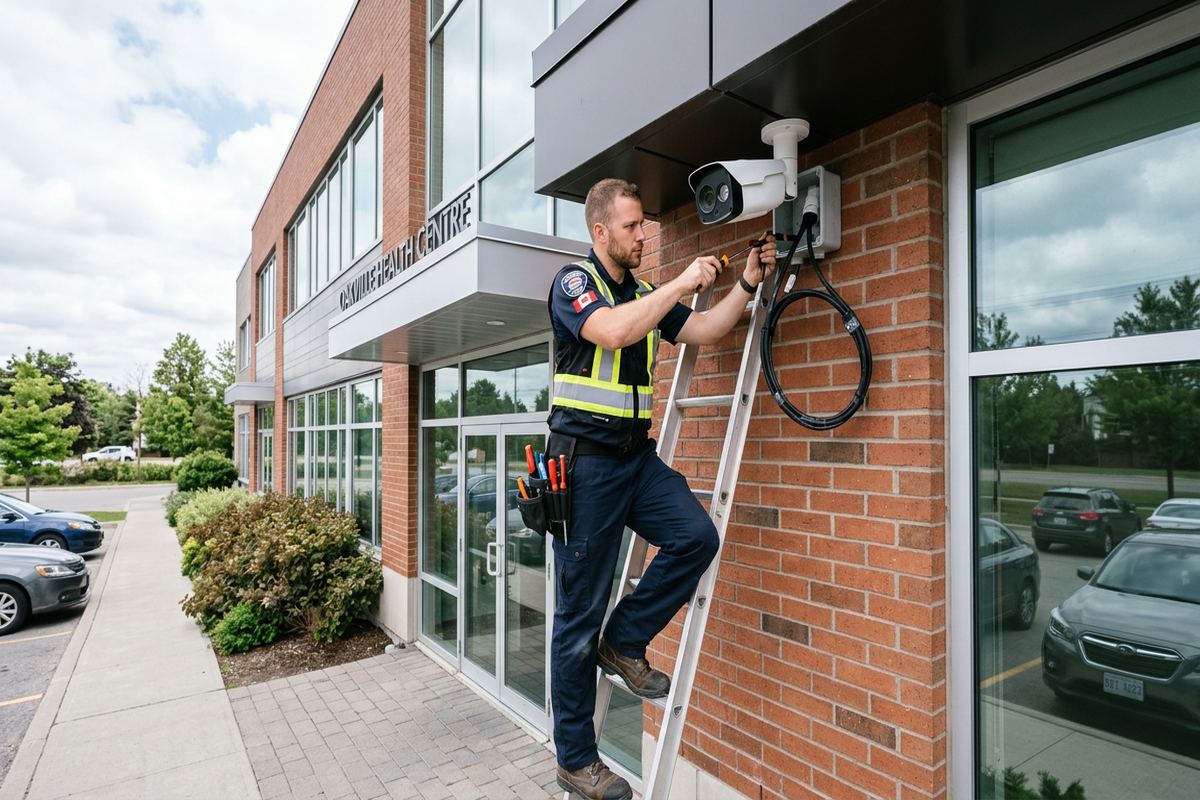
A useful camera system begins with the areas that need evidence, not with an arbitrary camera count. During a Brantford site assessment, we review entrances, exits, loading areas, sales floors, corridors, cash points, parking spaces and restricted rooms. The objective is to identify what each view must show, such as a face at a doorway, activity around inventory or vehicle movement through a yard. Camera height, lens selection, lighting and likely obstructions are considered together so that broad situational views are not mistaken for detailed identification views.
Brantford properties do not share one standard installation method. Converted industrial buildings may have high ceilings, thick masonry walls, exposed steel and long cable distances. Commercial spaces in newer west-end developments often use frame construction, suspended ceilings and shared utility areas. Downtown Brantford locations can include older brick, finished interiors and neighbouring occupancies that limit drilling or exterior access. We plan practical pathways for the actual structure, keeping serviceability, fire separations, landlord conditions and the appearance of customer-facing areas in view before installation begins.
The written scope records the agreed equipment, device placement, cable routes and relevant exclusions. It also states equipment ownership and warranty information, helping property owners, tenants and managers understand what is included before work proceeds. Where a landlord, condominium corporation or property manager controls exterior walls, common hallways or telecommunications rooms, approval should be obtained before installation. One accountable contractor handles the defined camera work, cabling, configuration and handover, reducing uncertainty when a system includes several cameras, network connections and a recorder.
- Entrance, exit and loading-area coverage review
- Identification and overview views planned separately
- Building construction considered before routing cables
- Written equipment, placement and exclusion details
- Landlord or condominium approvals identified early
Camera Coverage for Brantford Businesses
Retail stores and service counters usually need a combination of close and wide views. A camera aimed at the entrance can support facial identification, while separate cameras cover transaction points, display areas and movement through the premises. In Brantford commercial strips, window glare, vehicle headlights and changing daylight can affect image quality throughout the day. We assess these conditions rather than relying only on a daytime preview. Camera placement must also avoid shelves, signs and seasonal displays that can later block an otherwise useful field of view.
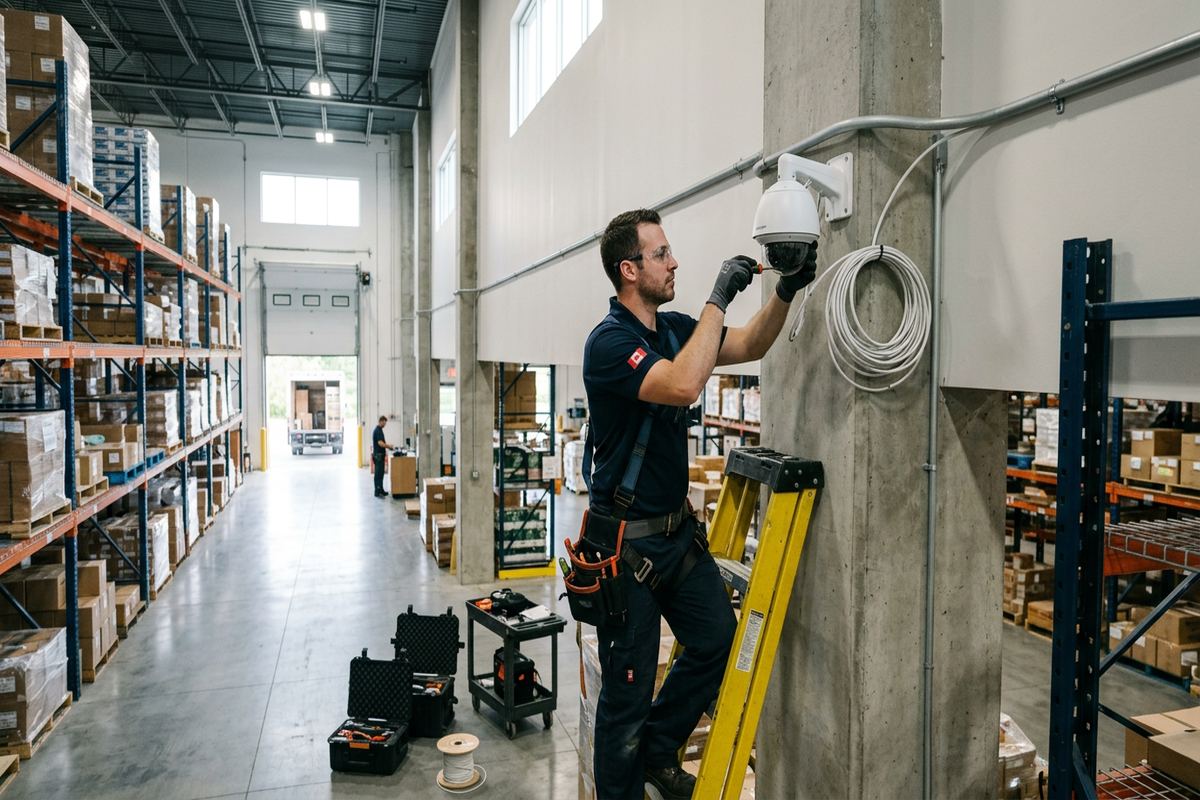
Industrial units and warehouses require different decisions. Long aisles, loading doors, racking and elevated work areas create blind spots that cannot be solved by placing one camera in each corner. Converted industrial buildings in Brantford may provide strong mounting surfaces but present difficult transitions between brick, steel, offices and open production space. We map the intended view and cable pathway together, accounting for lift access, future rack changes and protected routing around operational equipment. Yard cameras may also require dedicated network links, suitable supports and carefully planned night coverage.
Offices, clinics and multi-tenant buildings often need focused coverage without recording every occupied area. Entrances, reception desks, delivery points, server rooms and shared corridors may be appropriate, while private or sensitive spaces require careful consideration. The customer remains responsible for deciding lawful monitoring policies, notices, access permissions and retention practices. We can configure user roles so authorized staff receive suitable access without sharing a single administrator login. Final placement should balance operational needs, image usefulness, privacy obligations and the building rules applying to the Brantford property.
- Retail entrance and transaction-point views
- Warehouse aisle and loading-door coverage
- Office reception and restricted-room monitoring
- User roles for authorized staff
- Lighting and glare checked during planning
Brantford Building Pathways and Cabling
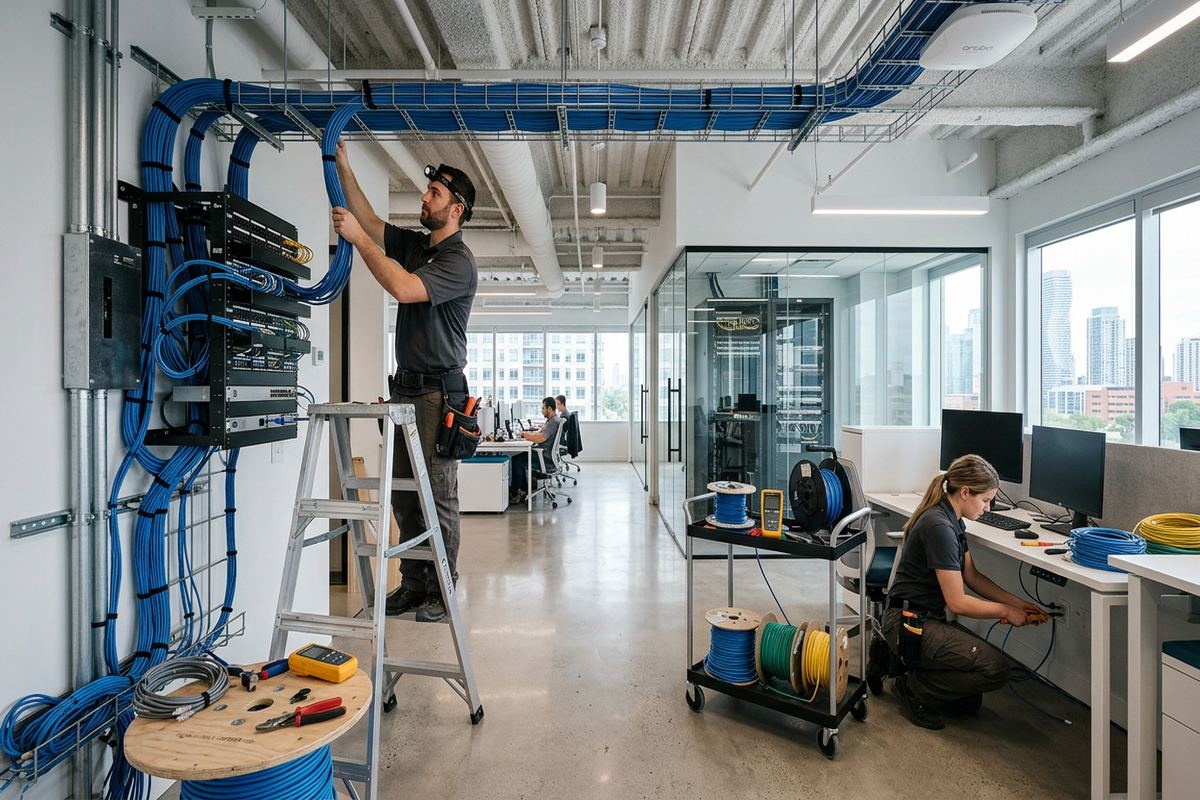
Cable routing has a direct effect on system reliability and future maintenance. UnifiedLink installs continuous labelled cable runs between cameras and the designated network or recording location, avoiding unnecessary joints hidden above ceilings or inside walls. Each pathway is selected for the building rather than forced into a standard layout. In older Brantford properties, this may involve surface raceway, accessible basement routes or careful masonry penetrations. Newer commercial units may allow concealed pathways above suspended ceilings, provided shared spaces and fire-rated assemblies are handled appropriately.
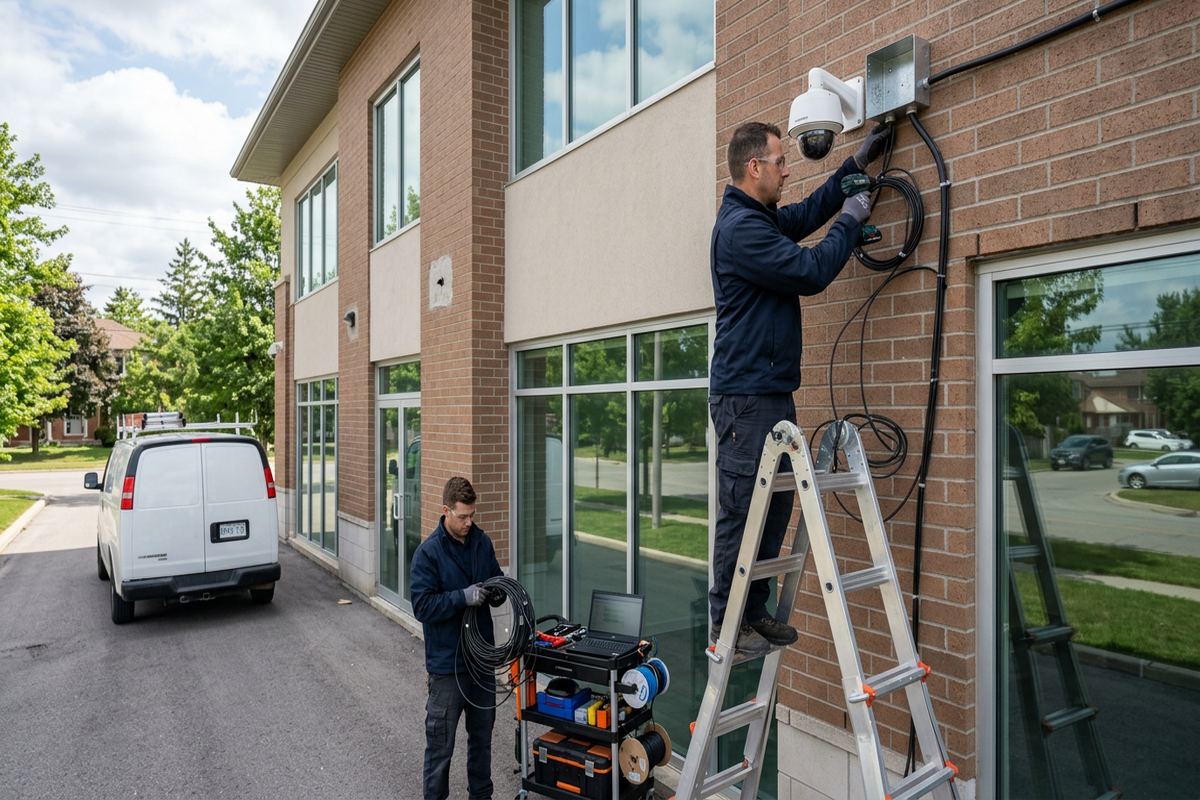
Masonry and frame construction require different fastening and sealing methods. Brick should be drilled and anchored with attention to mortar condition, interior finishes and water entry. Frame walls require suitable backing or secure attachment points so that cameras remain stable. Exterior cable entries need a planned drip path and effective sealing, especially where wind-driven rain or melting snow reaches the wall. We avoid treating sealant as a substitute for correct mounting. Junction boxes, glands and supports are chosen to protect terminations and keep service access practical after the original installation.
Recording and network equipment also need an appropriate location. A recorder placed on an open shelf near public traffic is easier to interfere with than equipment kept in a controlled room or cabinet. The location should have power, ventilation, network access and enough working space for maintenance. Cable lengths and bandwidth are checked before the route is finalized, particularly in larger Brantford industrial units. Where a remote building, yard pole or detached structure exceeds normal copper limitations, the design may require fibre or a purpose-built wireless link instead of an improvised extension.
- Continuous point-to-point cable runs
- Labels at cameras and equipment ends
- Masonry and frame-specific fastening
- Sealed exterior penetrations and junctions
- Recorder locations planned for controlled access
Brantford, Ontario
Commercial security camera installation in Brantford, scoped in writing first
Book a site assessment and get equipment, routes, exclusions, and warranty on paper before anything is installed.
Exterior Cameras for Brantford Winters
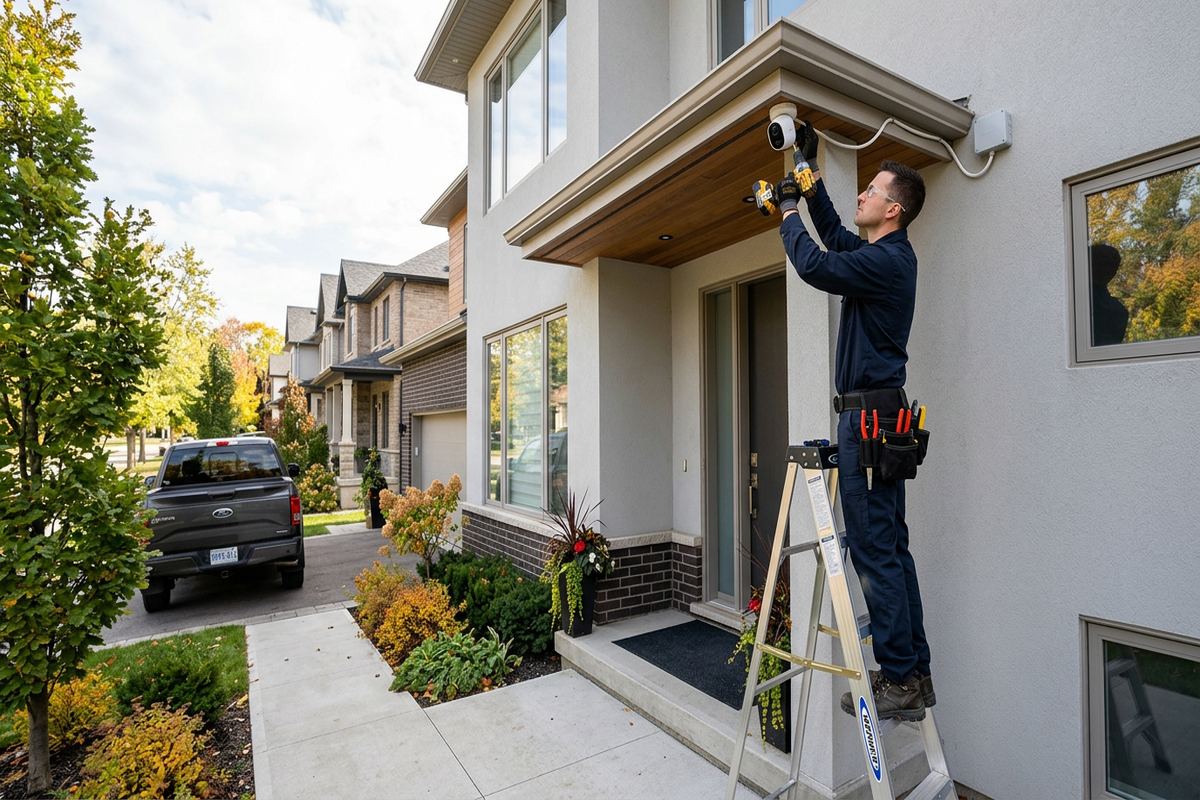
Exterior installations in Brantford must account for winter temperatures, snow, ice and repeated freeze-thaw cycles. Water that enters a poorly sealed penetration can expand as it freezes, damaging masonry or loosening a mounting point over time. Equipment is positioned and mounted to reduce direct exposure where practical, while preserving the required view. Cable entries are sealed using appropriate exterior methods, and connectors are kept inside protected junctions. The mounting surface is checked before drilling because weathered brick, deteriorated mortar and lightweight cladding do not provide equivalent support.
Cold weather also changes what a camera sees. Snow can reflect infrared illumination, wet pavement can produce glare, and blowing flakes may trigger motion-based alerts. A low-mounted camera can be blocked by snowbanks or exposed to road spray, while a camera aimed through an exterior window may capture reflections instead of the scene. During configuration, we adjust image settings, detection areas and alert rules around the intended use. No alert setup can eliminate every weather event, but thoughtful positioning helps reduce avoidable notifications and unusable night footage.
Parking lots, rear delivery lanes and fenced yards need more than a wide image. The planned viewing distance must match the detail the business expects to recover. Lighting, camera angle and vehicle direction affect whether footage shows useful characteristics or only general movement. In areas such as West Brant or Lynden Hills, open approaches can differ substantially from constrained Downtown Brantford lanes. We assess mounting height, nearby lights, property boundaries and available cable pathways before specifying exterior cameras, supports or supplementary illumination.
- Freeze-thaw conditions considered at penetrations
- Protected exterior connectors and junction boxes
- Snow, glare and infrared reflection reviewed
- Detection areas adjusted on site
- Mounting height matched to expected detail
Recording, Networks and Remote Access
Commercial camera performance depends on the recorder and network as much as the cameras themselves. We estimate storage requirements from camera resolution, frame rate, compression, recording schedule and the requested retention period. Actual retention can vary with scene activity and configuration, so it should not be represented as a fixed result without testing. The design also considers whether recording continues locally if internet service is interrupted. For many Brantford businesses, local recording with controlled remote access provides a practical separation between evidence storage and day-to-day viewing.
Network planning starts with available switching, power and internet connectivity. Power over Ethernet can carry data and power on one cable, but switch capacity, port availability and power budget still need verification. Camera traffic may be separated from ordinary business devices where the equipment supports it and the network design calls for it. Existing customer networks are assessed before connection because an unmanaged collection of switches can make faults difficult to trace. Any required network changes, customer responsibilities or dependencies are documented in the scope rather than assumed during installation.
Remote viewing is configured on site using the customer’s own credentials. Authorized users can be assigned individual accounts or roles where supported, reducing reliance on shared passwords. We confirm basic live view, playback and export functions during handover and explain dependencies such as internet access, application updates and notification permissions. Credentials are not intended to remain under an installer-controlled account. Brantford owners and managers should retain administrative control of their system, including the ability to change passwords, remove former users and provide access to designated staff.
- Storage planned around recording requirements
- Recorder operation checked during internet loss
- Switch capacity and power budgets reviewed
- Customer-controlled remote access credentials
- Playback and export demonstrated at handover
Installation in Occupied Brantford Properties
Camera work often takes place while a business remains open. Before installation, we discuss access hours, noisy drilling, lift use, ceiling access and areas that cannot be interrupted. A retail location in Echo Place may need work sequenced around customers, while an active industrial unit may require coordination around loading or production. Offices and clinics can have stricter access controls for occupied rooms. The installation plan identifies practical constraints so technicians are not making disruptive route decisions after ceilings have been opened or equipment has arrived.
Shared and leased premises require clear authorization. Tenants should confirm whether their lease permits drilling, exterior devices, raceway or equipment in common telecommunications spaces. Condominium commercial units may require board or management approval for changes to exterior walls and shared corridors. Landlords may also specify acceptable pathways or restoration standards. UnifiedLink can document proposed placement and routes for the customer’s approval process, but the customer remains responsible for securing permission. This is particularly important in Downtown Brantford mixed-use buildings where residential and commercial occupancies share structural elements.
Work areas are kept organized, and installed cables are supported and labelled to simplify later tracing. Camera views are checked after physical installation because the final image can reveal obstructions not obvious from floor level. We configure cameras, recorder settings and authorized access on site, then review operation with the customer. If construction, shelving or signage will change after installation, those future conditions should be disclosed during planning. A camera aimed through an unfinished area may no longer provide the expected evidence once partitions, stock or fixtures are added.
- Work sequenced around occupied operations
- Lift and ceiling access discussed beforehand
- Shared-property permissions confirmed by customer
- Final camera views checked on site
- Installed cables supported and labelled
System Handover and Service Records
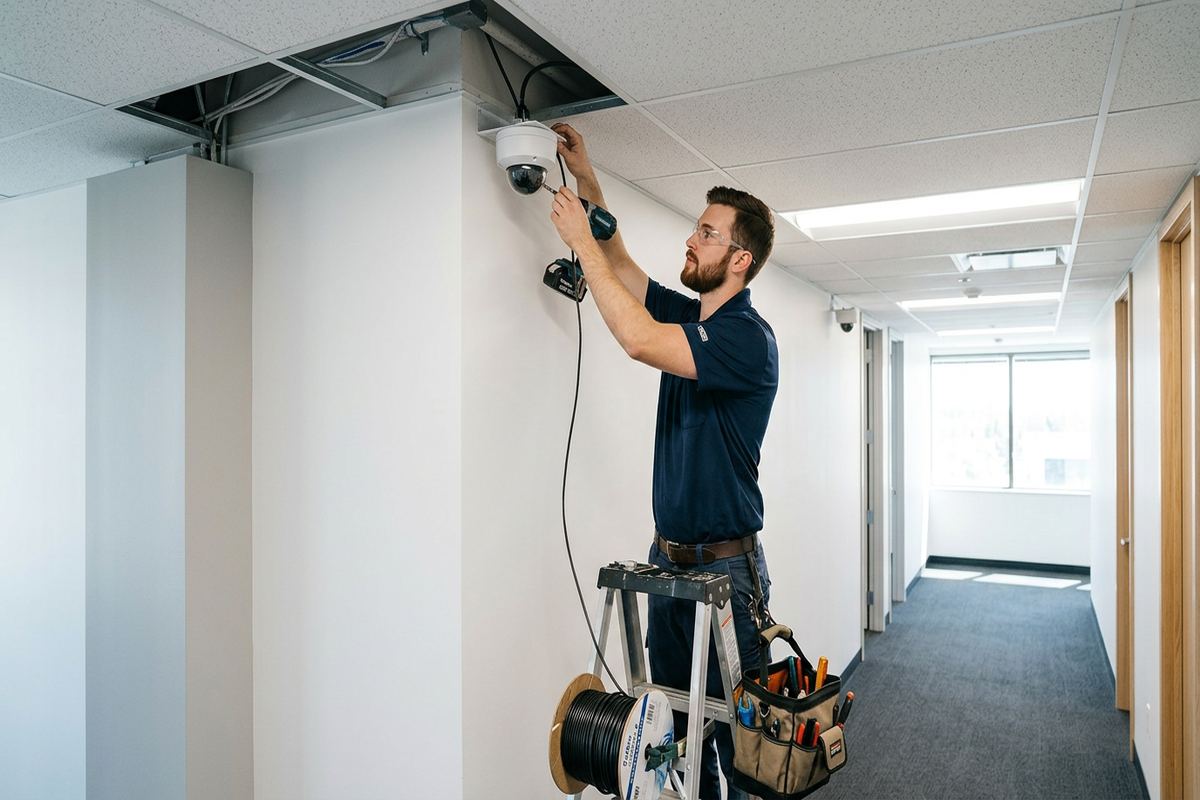
A completed system should be understandable without relying on one installer’s memory. At handover, UnifiedLink provides an as-built record showing the installed devices and relevant cable or equipment information. Camera and cable labels correspond with the final system where practical, making it easier to identify a failed link or locate the correct recorder port. The written record also helps when a Brantford business renovates, changes internet providers or adds network equipment. Any approved changes from the original scope should be reflected in the final documentation.
Customer personnel receive a practical review of live viewing, playback, export and ordinary user administration. The exact functions depend on the selected platform, but administrative credentials are handed over under the customer’s ownership. Managers should decide who can view cameras, retrieve recordings or change configuration, then remove access when staff responsibilities change. Export procedures should be tested before an incident occurs, including where files are saved and how playback software is handled. A short operational check is more useful than discovering an unfamiliar interface when footage is urgently needed.
Ongoing maintenance should include occasional inspection of camera views, timestamps, recording status and exterior seals. Spiders, dust, moved inventory and vegetation can gradually obscure an image even when the camera remains online. Brantford freeze-thaw conditions can also expose weaknesses around exterior mounts or penetrations, particularly on older masonry. Businesses should review user accounts and confirm retention performance after major configuration changes. When service is required, accurate device labels and the as-built record give the responsible contractor a clearer starting point for diagnosis.
- As-built device and pathway record
- Labels matched to installed equipment
- Customer receives administrative credentials
- Playback and export procedures reviewed
- Maintenance checks explained at handover
Requesting a Brantford Site Assessment
Pricing follows a site assessment because camera quantity alone does not describe the work. Access height, wall construction, cable distance, recorder location, network capacity, exterior conditions and operating restrictions all affect the scope. A small storefront with difficult brick pathways may require different labour and materials from a larger open warehouse. During the Brantford assessment, we ask what events the system should document and where evidence is most important. This keeps the proposal tied to defined views and installation conditions rather than a generic equipment package.
The resulting written scope covers equipment, cable routes, device placement, exclusions, equipment ownership and warranty. Customers can review how exterior devices will be mounted, where recording equipment will sit and which network or electrical provisions they must supply. If landlord, condominium or management approval is outstanding, that dependency can be identified before scheduling. Proposed work in Henderson Survey, Terrace Hill, West Brant or another Brantford area is still assessed by property conditions; neighbourhood alone does not determine the correct camera design.
Requests sent during business hours are answered the same day, while after-hours requests are answered the next business day. Site assessment timing depends on the service and travel distance. Photos, floor plans and a list of priority areas can help prepare for the visit, but they do not always replace on-site review. For a useful assessment, identify entrances, parking areas, inventory zones, existing network equipment and any recent incidents or operational concerns. UnifiedLink then develops one coordinated scope for cabling, camera installation, configuration and documented handover.
- Site assessment completed before pricing
- Written scope provided for review
- Approvals and customer dependencies documented
- Business-hour requests answered the same day
- One contractor coordinates the defined installation
Brantford neighbourhoods we cover
- Downtown Brantford
- West Brant
- Echo Place
- Henderson Survey
- Terrace Hill
- Lynden Hills
Commercial security camera installation in Brantford — common questions
How many cameras does my Brantford business need?
The number depends on the evidence required, not only the building’s floor area. Entrances, transaction points, loading doors, inventory areas and parking approaches may each need different views. A Brantford site assessment reviews viewing distance, lighting, obstructions and cable routes before equipment is proposed. Wide overview coverage and close identification coverage are normally treated as separate objectives.
Can cameras be installed on older brick buildings?
Yes, provided the mounting surface and cable pathway are assessed first. Older Brantford brick and mortar can vary in condition, and careless drilling may create weak fastening points or water entry. We plan suitable anchors, protected cable entries and exterior sealing. Where drilling is restricted or the façade is controlled by a landlord, another route or written approval may be required.
Do I need landlord or condominium approval?
Approval may be needed when cameras, cabling or raceway affect exterior walls, common hallways, ceilings or shared telecommunications rooms. This is common in leased and condominium commercial properties in Brantford. UnifiedLink can provide proposed device locations and routes for review, but the customer is responsible for obtaining the required permission from the landlord, condominium corporation or property manager before work begins.
Can I view the cameras remotely?
Remote viewing can be configured when the selected system and the business network support it. We set up access on site using the customer’s own credentials and review live view, playback and user permissions. Remote access depends on internet service and appropriate network configuration. Local recording can generally continue during an internet outage when the recorder and cameras remain powered and connected locally.
How is footage retention determined?
Retention depends on available storage, camera resolution, frame rate, compression, recording schedule and scene activity. A busy Brantford loading area may consume storage differently from a quiet interior corridor. We plan around the requested retention period and explain the relevant configuration. Because activity and settings can change actual results, retention should be checked after the system has operated under normal business conditions.
How do Brantford winters affect exterior cameras?
Snow, ice, glare and freeze-thaw cycles affect mounting and image performance. Exterior penetrations need effective sealing, connectors need protection, and cameras should not be placed where snowbanks routinely block the view. Reflected infrared light and blowing snow can also cause unwanted alerts. We review these conditions during placement and adjust detection areas and image settings on site.
Coverage in Brantford is confirmed against the address before we quote. See everything we install in Brantford or the province-wide commercial security camera installation page.