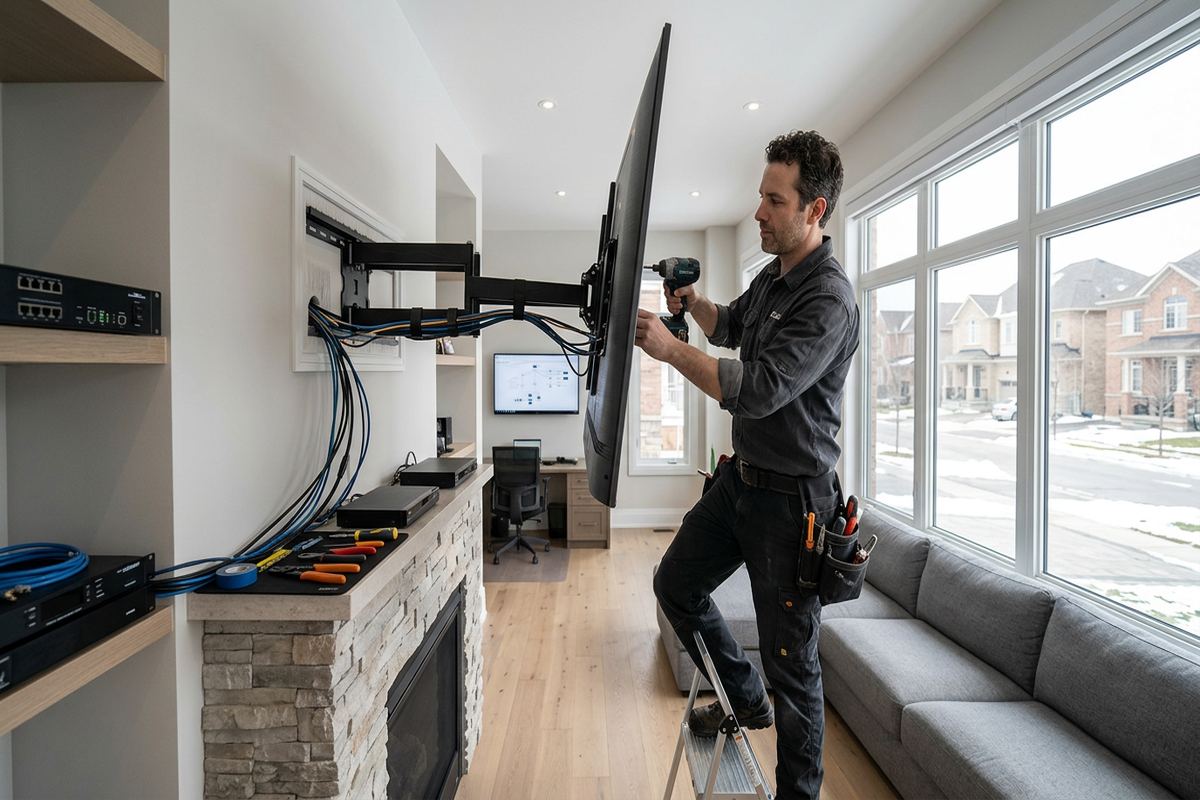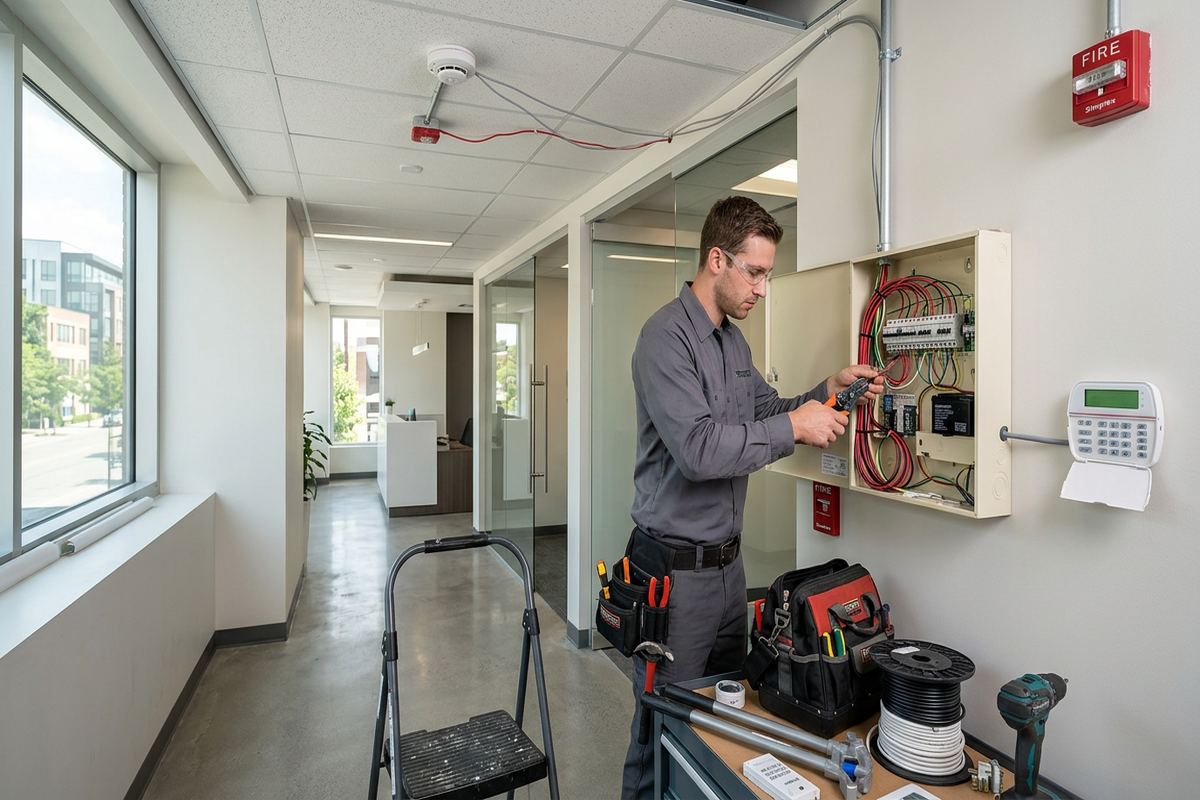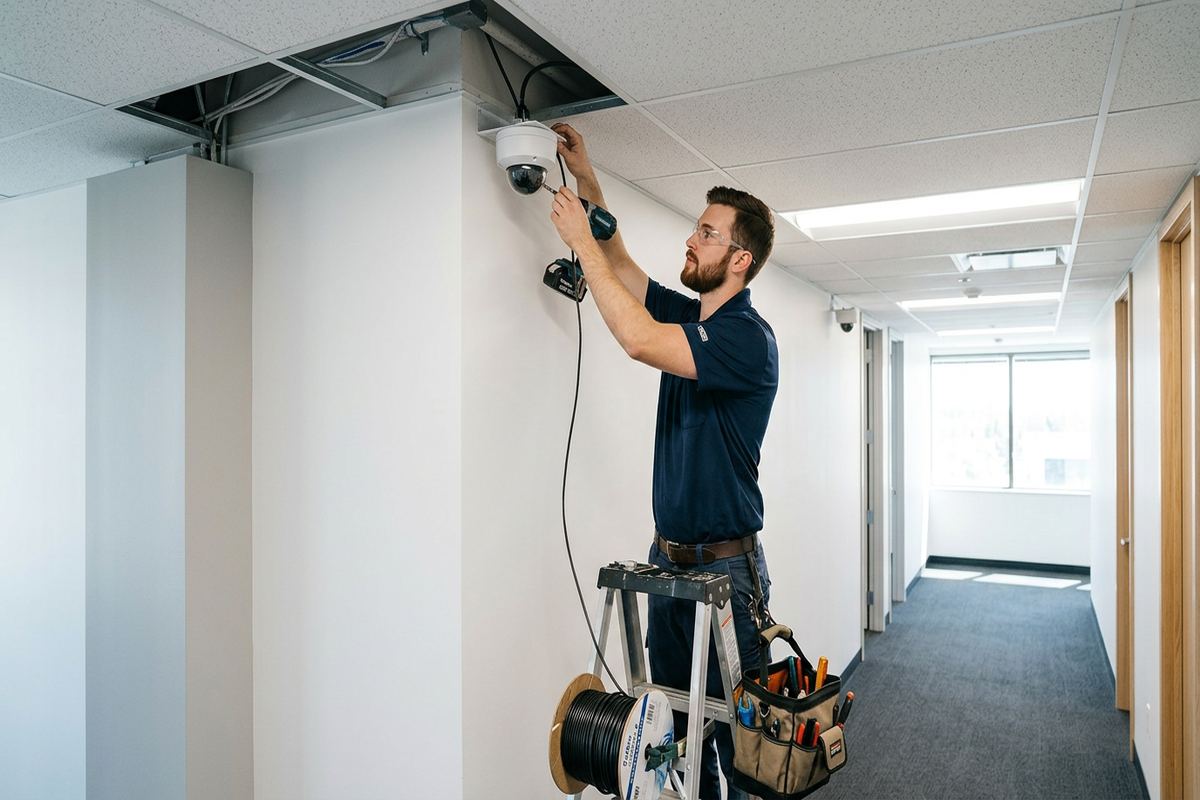
UnifiedLink installs commercial networks for offices, shops, industrial units and mixed-use properties across Brantford and Brant County. We plan cable pathways, equipment locations, Wi-Fi coverage and network capacity around the building’s construction and day-to-day operations. Each project starts with a site assessment and concludes with labelled connections, on-site configuration and clear handover records.
Commercial Network Planning in Brantford
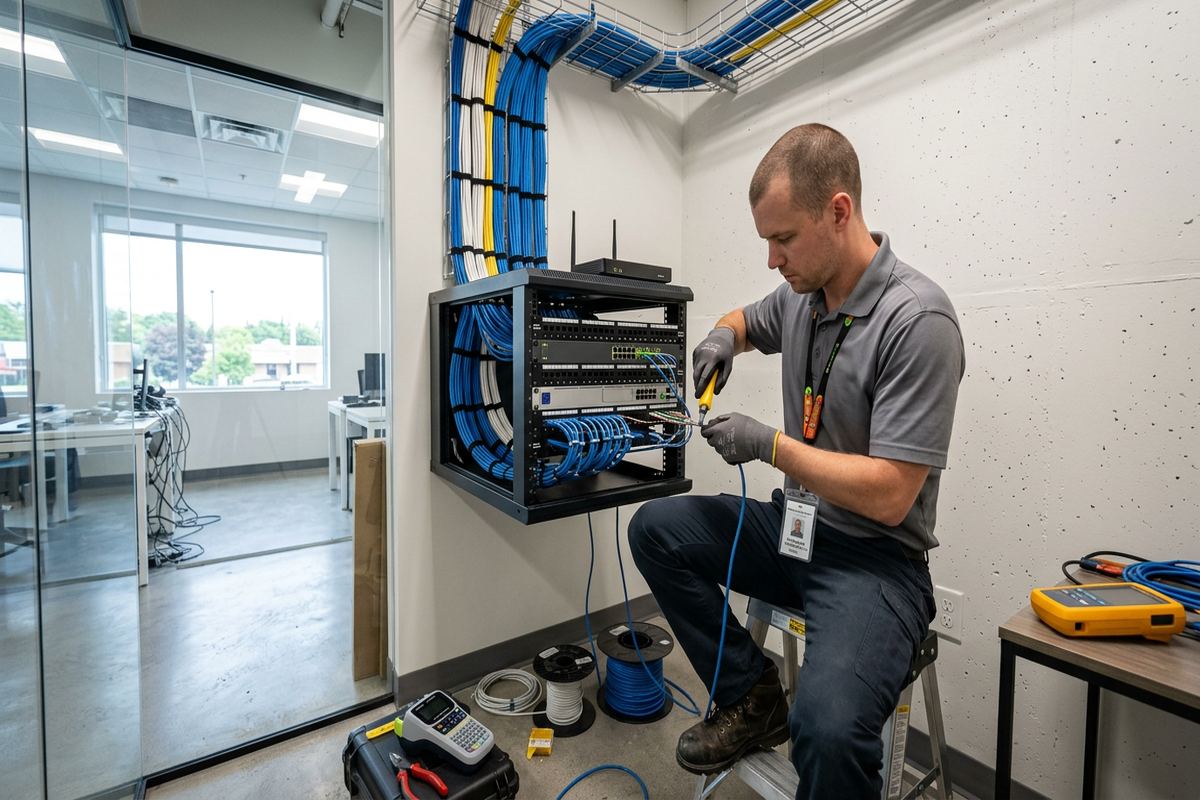
A reliable commercial network begins with understanding how the property is used, not simply counting outlets. During a Brantford site assessment, we review work areas, communications rooms, internet entry points, wireless requirements, connected equipment and likely future changes. Staff movement, public access, production activity and tenant boundaries can all affect the design. The resulting plan identifies practical device locations and cable routes while accounting for walls, ceilings, electrical infrastructure and restricted spaces. Pricing follows the assessment so that it reflects the building and the agreed work rather than a generic allowance.
Different parts of Brantford present different installation conditions. Converted industrial buildings near Downtown Brantford may have thick masonry, high ceilings, exposed structure and long distances between usable pathways. Newer units in West Brant often have frame construction and accessible ceiling spaces, but finished surfaces can limit later alterations. Older brick properties adapted for professional or retail use may combine multiple additions and undocumented renovations. We trace realistic routes before installation, identifying where conduit, surface raceway, sleeves, supports or carefully placed penetrations may be needed to produce serviceable network runs.
The written scope sets out equipment, device placement, proposed cable routes, exclusions, equipment ownership and warranty details. It also distinguishes network installation from work supplied by an internet service provider, electrician, landlord or other trade. This is particularly important in leased offices, commercial strips and multi-unit buildings where access may depend on property management. One accountable contractor coordinates the low-voltage portion, reducing uncertainty between cabling, racks, wireless access points and configuration. Any assumptions requiring approval are documented before work begins, allowing the customer to review operational effects and responsibilities.
- Site assessment before project pricing
- Review of internet entry and equipment locations
- Documented routes, placements and exclusions
- Capacity planning for expected devices
- Coordination with landlords and other trades
Structured Cabling for Brantford Workplaces
Structured cabling provides the fixed foundation for computers, phones, printers, wireless access points, cameras, access control and other connected systems. UnifiedLink installs continuous labelled cable runs between approved endpoints and the network rack or cabinet. Cable selection depends on distance, bandwidth requirements, environmental conditions and the connected equipment rather than a single specification for every property. Runs are supported independently and routed away from avoidable interference. At termination points, consistent labels help staff and service providers identify circuits without pulling ceiling tiles or guessing which wall outlet returns to a particular patch-panel port.
Cable pathways must suit the construction. Drilling and fastening into solid brick or concrete requires different methods from routing through wood or metal framing. In older Brantford properties, plaster finishes, concealed masonry and irregular joist spaces can make direct routes impractical. Converted industrial units may offer open ceilings but require long supported runs around ducts, lighting and production equipment. We choose pathways that protect the cable, preserve access and limit unnecessary disturbance. Where concealed installation is not reasonable, surface raceway or conduit can provide an orderly route that remains accessible for inspection, repair or future additions.
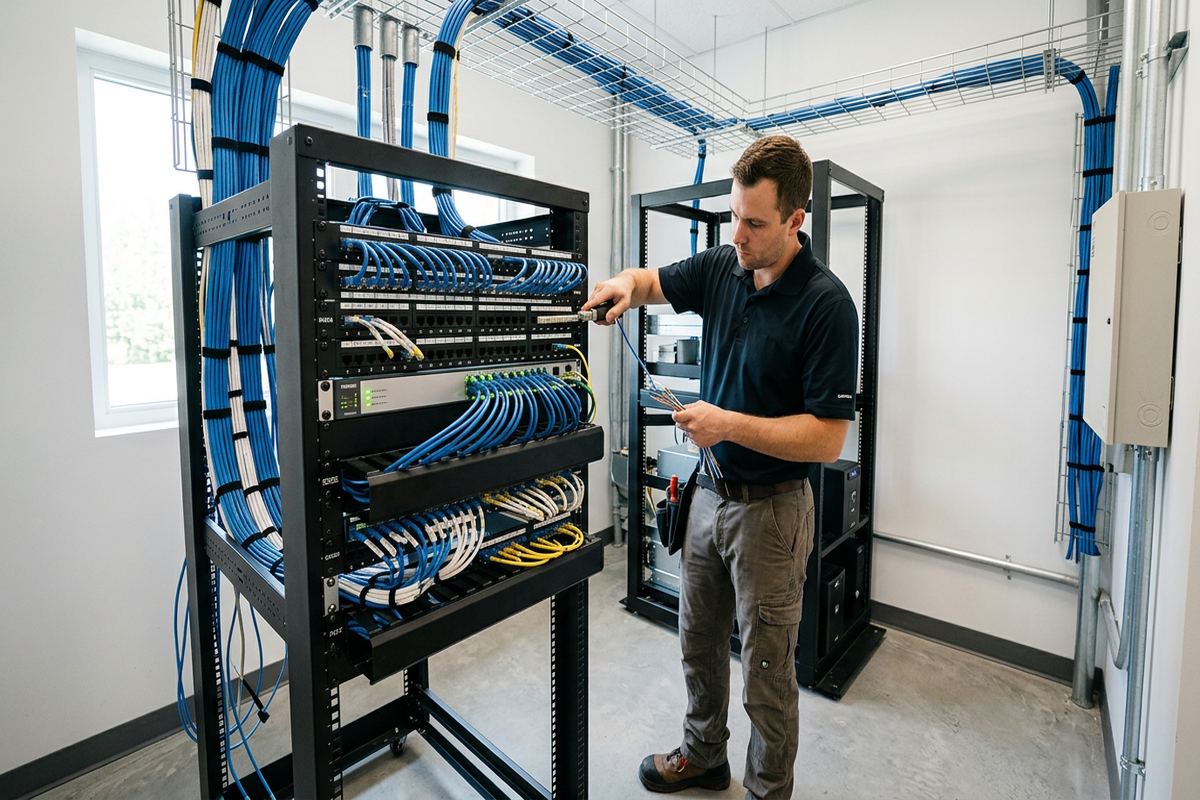
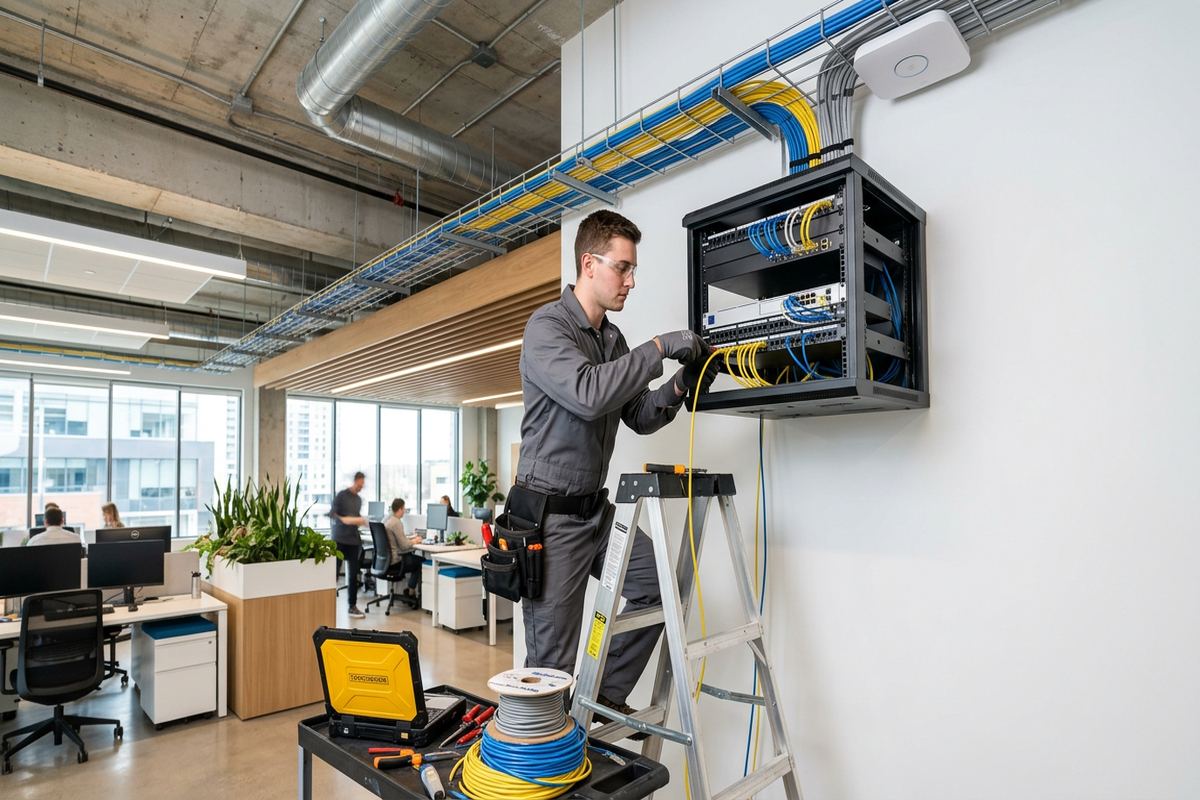
Network cabinets and racks are positioned where equipment can be secured, powered, ventilated and maintained. A convenient empty corner is not always suitable if it is exposed to dust, moisture, stock movement or uncontrolled public access. We review mounting surfaces, available clearances, cable entry and the location of internet-provider equipment. Patch panels organize permanent building cabling, while properly sized patch leads connect those circuits to switches. The completed arrangement is labelled so that changes can be made methodically. Customers receive an as-built record showing installed outlet identities and their corresponding rack terminations.
- Copper and fibre pathway planning
- Labelled outlets and patch-panel ports
- Supported runs separated from interference
- Wall cabinets and floor racks
- As-built cable identification records
Wi-Fi Coverage and Access Point Placement
Commercial Wi-Fi performance depends on access point location, building materials, channel conditions and user demand. A powerful device placed in the wrong room cannot reliably overcome brick, concrete, metal shelving or machinery. We assess occupied areas, meeting rooms, customer spaces, storage zones and operational areas before selecting locations. In Downtown Brantford conversions, masonry partitions can divide coverage more sharply than modern drywall. Industrial units may have open sightlines until racking and inventory are added. The design therefore considers both the present layout and foreseeable changes that could alter signal paths or increase device density.
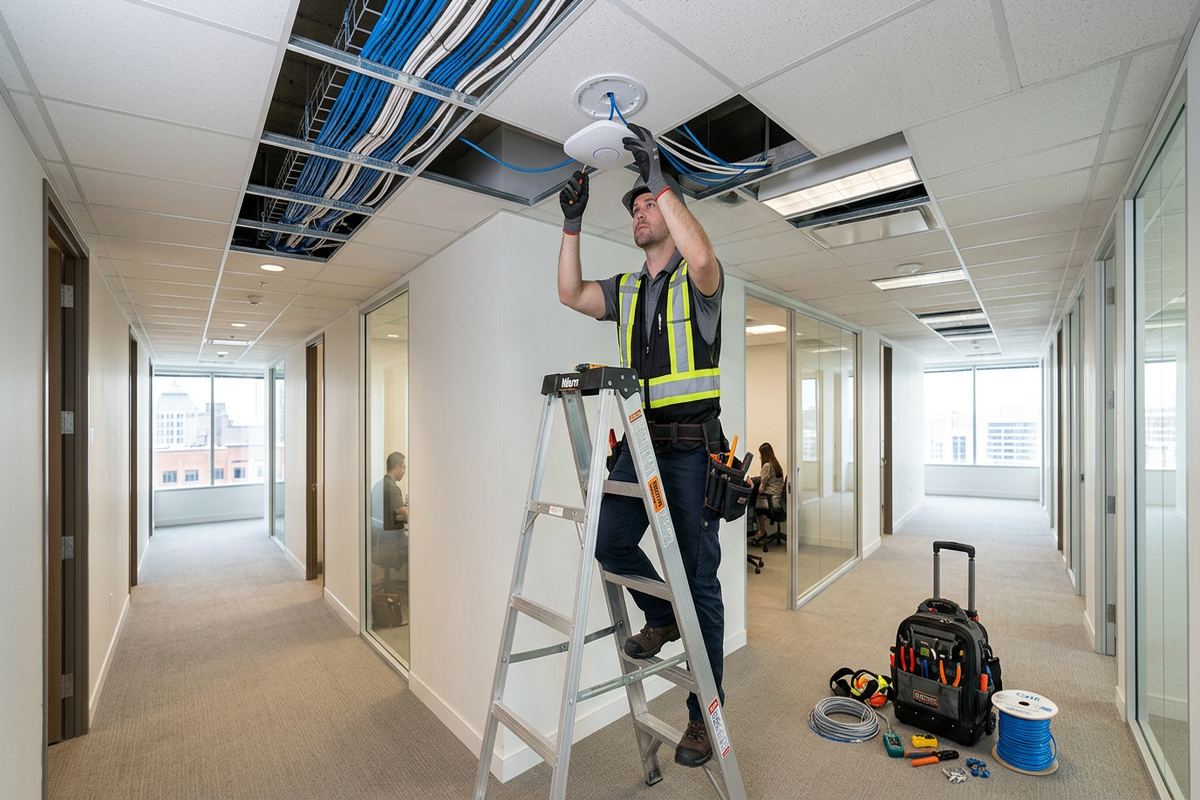
Ceiling-mounted access points generally provide predictable coverage when cabling, mounting surfaces and ceiling height permit. Some spaces require wall mounting or alternative positions because of exposed structure, decorative finishes or restricted access above a suspended ceiling. Each access point receives a dedicated network run where practical, and power requirements are coordinated with the selected network switch. Guest, staff and operational devices may need separate network access rather than sharing one unrestricted wireless network. Configuration can include appropriate wireless names, authentication settings and logical separation based on the customer’s approved design and equipment capabilities.
Coverage between interior and exterior areas requires particular care through Brantford winters. Outdoor or semi-exposed access points must be suited to their environment, firmly mounted and connected through properly sealed entries. Freeze-thaw cycles can exploit poorly sealed penetrations, while water following a cable can reach interior equipment if routing and drip management are neglected. Exterior cable also needs appropriate protection from sunlight, moisture and physical damage. We assess loading areas, patios, yards and detached workspaces individually. Indoor equipment is not placed outdoors simply because it can temporarily receive a signal through a nearby wall.
- Access points positioned for actual layouts
- Separate staff and guest network options
- Dedicated cabling to wireless access points
- Exterior penetrations sealed against weather
- Coverage planning around masonry and metal
Brantford, Ontario
Commercial network installation in Brantford, scoped in writing first
Book a site assessment and get equipment, routes, exclusions, and warranty on paper before anything is installed.
Network Equipment Installation in Brantford
Switches, routers, firewalls and related devices must match the number and type of connections being installed. Planning includes current wired ports, access points, internet equipment and devices that may require power over Ethernet. Spare capacity can be considered without filling a rack with unnecessary hardware. We confirm customer-supplied equipment responsibilities and identify equipment included in our scope. The network design also addresses physical fit, ventilation, mounting accessories and power availability. When specialized cybersecurity policies or managed information technology services are involved, we coordinate technical requirements with the customer’s IT provider rather than making unsupported assumptions.
On-site configuration connects the physical installation to the customer’s intended operations. Depending on scope and equipment, this can include switch setup, wireless configuration, network segmentation, device naming and connection testing. Internet-provider credentials and account changes remain under the customer’s control unless explicitly included and authorized. We avoid leaving systems tied to installer-only accounts. At handover, the customer receives access using their own credentials, together with relevant configuration information agreed for the project. This approach supports future maintenance and allows the customer or their designated IT provider to manage the installed network without avoidable account barriers.
Power and environmental conditions around network hardware deserve attention, especially in workshops, warehouses and older utility areas. Dust, temperature, moisture and accidental contact can shorten equipment life or interrupt service. The cabinet location should remain accessible without placing hardware in a traffic path or beneath plumbing where a leak could cause damage. UnifiedLink identifies low-voltage installation concerns during assessment, while electrical circuit changes are referred to the appropriate trade when required. In Brantford industrial units, equipment locations may also need protection from forklifts, stored materials, vibration and changes to production-floor arrangements.
- Switch and router installation
- Power-over-Ethernet capacity review
- Customer-controlled administrator credentials
- Coordination with existing IT providers
- Testing of configured network connections
Pathways in Older and Converted Buildings
Older brick homes converted to offices, clinics or studios can contain multiple construction layers from different renovation periods. A route that appears open at one end may be blocked by masonry, fire stops, finished basements or later additions. Before proposing cabling, we inspect accessible areas and look for existing pathways that can be reused appropriately. Small exploratory steps may still be necessary where construction is concealed, and those limitations are included in the scope. In neighbourhoods such as Terrace Hill and Henderson Survey, careful routing can reduce disruption to original trim, plaster and occupied rooms.
Converted industrial buildings bring another set of constraints. Thick walls may require approved sleeves or alternate routes, while high open ceilings require suitable cable supports and safe access planning. Existing trays and conduit cannot automatically be assumed available; ownership, fill, condition and destination must be verified. Where spaces are subdivided among tenants, a cable path may cross areas controlled by another occupant or the landlord. Written permission should be obtained before penetrations or shared-space work begins. We document these dependencies so that the installation does not proceed on uncertain access or interfere with another tenant’s infrastructure.
Newer west-end subdivisions and commercial developments can provide more regular framing and purpose-built utility spaces, yet pathways still require planning. Finished ceilings, insulation, vapour-control layers and fire-rated assemblies should not be disturbed casually. For a home-based business or condominium unit, exterior devices and visible raceway may require condominium, landlord or property-management approval. West Brant properties can also have detached work areas where trenching, conduit or a wireless bridge must be considered separately. We identify approval requirements and pathway options, but property owners remain responsible for granting or obtaining the necessary permissions.
- Routes adapted to masonry or framing
- Care around finished and heritage-style surfaces
- Verification before using existing conduit
- Tenant and condominium approval planning
- Accessible pathways for future maintenance
Exterior Network Connections in Brantford
Exterior connections may support loading areas, detached offices, yard coverage, signs, cameras or outdoor point-of-sale operations. The method depends on distance, available pathways, electrical separation and the environment around the cable. Copper is not automatically suitable for every building-to-building link, particularly where grounding differences or long distances create concerns. Fibre or a properly designed wireless bridge may be more appropriate. During a Brantford assessment, we review attachment points, line of sight, vegetation, vehicle movement and planned construction before recommending a route. Underground work also requires coordination around utilities, drainage and property boundaries.
Every exterior penetration needs more than a bead of sealant applied after the cable is pulled. Entry direction, sleeve choice, cable support and water-shedding details all matter. Cables should not create a path that directs rain or melting snow into the wall. Brantford’s freeze-thaw conditions can widen gaps where unsuitable materials or poorly prepared surfaces are used. Masonry entries require methods compatible with brick or concrete, while framed walls must account for cladding and concealed weather layers. We plan mounting and sealing as part of the pathway rather than treating weather protection as a final cosmetic step.
Outdoor network equipment must be rated for its location and mounted where it can be serviced safely. An enclosure can protect terminations, but it must still address condensation, temperature, drainage and cable entry. Devices placed near parking areas or commercial lanes may need protection from impact and snow-clearing activity. In Echo Place, Lynden Hills or other mixed residential-commercial settings, visible equipment may also be subject to lease conditions or property rules. We confirm the proposed mounting area with the customer and document exclusions where structural repair, electrical work or specialized civil work falls outside the network scope.
- Outdoor-rated cable and equipment selection
- Weather-managed wall penetrations
- Fibre and wireless bridge options
- Mounting protected from vehicle activity
- Planning around underground services
Testing, Documentation and Handover
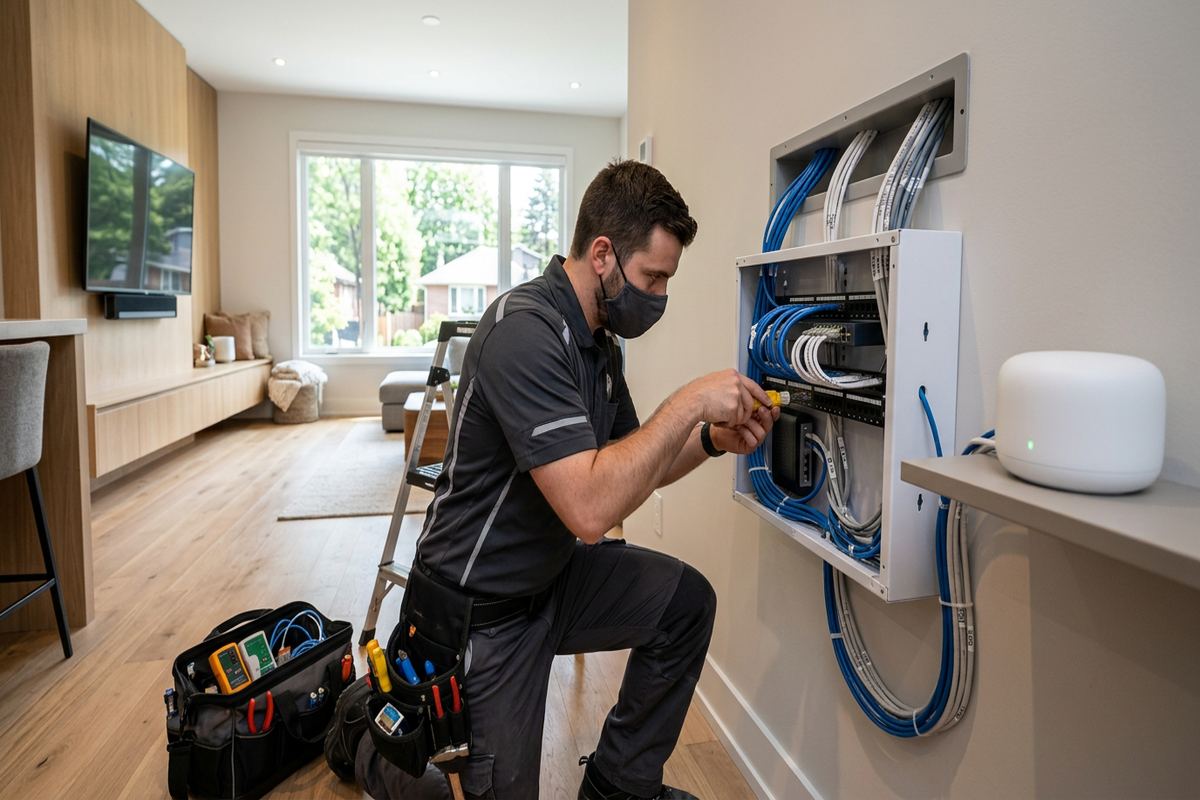
Installation is not complete when the cable merely reaches both ends. Each copper run is checked for termination and connectivity using methods appropriate to the agreed scope, and faults are corrected before handover. Fibre work receives suitable inspection and testing based on the installed system. Access points and network devices are checked from their intended locations rather than only at the rack. Results are reviewed against the project design, recognizing that internet speed also depends on the subscribed service, provider equipment, remote servers and connected client devices outside the installer’s control.
Labelling and documentation reduce the time needed for later changes. Outlet identifiers should correspond to patch-panel positions and appear consistently in the as-built record. The record describes installed device locations and cable relationships based on the completed work, including approved deviations from the original route where relevant. Customers can use it when adding staff, moving desks or engaging an IT provider. In a multi-tenant Brantford building, clear records also help distinguish one unit’s network from another. Documentation does not replace physical access, but it provides a reliable starting point for troubleshooting and expansion.
Handover includes customer-controlled credentials for configured equipment included in the project. We explain the basic arrangement, identify network and internet-provider demarcation points, and note any customer actions or third-party work still outstanding. Equipment ownership and warranty terms follow the written scope rather than being left ambiguous after installation. If some devices are customer-supplied, their support responsibilities are recorded separately. This structured handover gives the Brantford property owner, tenant or IT contact the information needed to operate the network and request future changes without relying on undocumented installer accounts or unlabelled cabling.
- Connection checks before handover
- Matching outlet and rack labels
- Recorded changes to planned routes
- Customer-owned administrative credentials
- Clear equipment ownership and warranty details
Arranging a Brantford Network Installation
The process starts with a discussion about the property, current problems and intended network use. Helpful details include floor plans, device counts, internet-service location, working hours, landlord contacts and any planned renovations. A site assessment then confirms conditions that cannot be established remotely, such as ceiling access, wall construction, rack space and exterior routes. Assessment timing depends on the service and travel distance. Requests sent during business hours are answered the same day, while after-hours requests are answered the next business day. This response wording does not promise immediate attendance or project completion.
After assessment, UnifiedLink prepares a written scope describing equipment, cable routes, device placement, exclusions, equipment ownership and warranty. The customer can review choices affecting appearance, access, downtime and future capacity before authorizing work. In active offices or retail spaces, installation may need to be phased around customer traffic and staff operations. Industrial sites may require coordination with production schedules, site orientation or access controls. Where another trade must provide power, coring, structural work or a pathway, that dependency is identified so the sequence can be arranged before network devices are commissioned.
Commercial network installation can also be coordinated with other UnifiedLink low-voltage work, including security cameras, access control, audio, displays and related Internet and Networking services. Combining plans can reduce conflicting routes and duplicated penetrations, but each system still requires suitable cabling, equipment and documentation. Whether the property is in Downtown Brantford, West Brant, Echo Place or elsewhere in Brant County, the objective remains practical: an installation matched to the building, labelled for service, configured on site and handed over under the customer’s own credentials with one accountable contractor for the agreed scope.
- Same-day reply during business hours
- Assessment timing based on service and travel
- Written scope before work authorization
- Phasing around active business operations
- One contractor for the agreed low-voltage scope
Brantford neighbourhoods we cover
- Downtown Brantford
- West Brant
- Echo Place
- Henderson Survey
- Terrace Hill
- Lynden Hills
Commercial network installation in Brantford — common questions
Do you assess my Brantford property before pricing?
Yes. Commercial network pricing follows a site assessment because cable routes, wall construction, ceiling access and equipment locations affect the scope. In Brantford, an older brick conversion can require very different pathways from a newer West Brant unit. Assessment timing depends on the requested service and travel distance. The written scope identifies equipment, routes, placements, exclusions, ownership and warranty details.
Can you install a network in an occupied business?
Yes, provided access and working arrangements can be planned safely. For occupied Brantford offices, shops and industrial units, we discuss customer traffic, staff schedules, restricted areas and any required service interruption. Work may be divided into stages where practical. The scope identifies dependencies on landlords, electricians, internet providers or IT teams so that cabling and equipment configuration can be sequenced without relying on undocumented assumptions.
Will Wi-Fi work through brick walls?
Brick and masonry can significantly reduce or reshape Wi-Fi coverage, particularly in older Brantford properties and converted industrial buildings. Rather than relying on one access point to transmit through several solid walls, we plan multiple wired access-point locations where needed. Placement also considers metal shelving, high ceilings and occupied areas. Final performance can still depend on client devices, interference, internet service and changes to the building layout.
Do I need landlord or condo approval?
Approval may be required if work affects common areas, exterior walls, shared pathways or visible building finishes. Brantford tenants and condominium owners should confirm their alteration rules before drilling, mounting equipment or using shared communications rooms. UnifiedLink can document proposed routes and device locations for review, but the customer or property owner remains responsible for providing authorization and arranging access to areas controlled by a landlord, condominium corporation or property manager.
Can you connect a detached office or building?
Yes, subject to a site assessment. Options can include fibre in an approved pathway, outdoor-rated cabling where suitable, or a wireless bridge with a usable line of sight. Brantford weather, freeze-thaw conditions, distance, vehicle traffic and underground services all affect the method. Exterior mounting and penetrations must be planned for drainage, sealing and physical protection rather than treated as ordinary indoor cable routes.
What do I receive when installation is finished?
At handover, you receive labelled connections, an as-built record and customer-controlled credentials for configured equipment included in the scope. We identify relevant network components, cable relationships and any outstanding customer or third-party actions. Equipment ownership and warranty details follow the written scope. This gives a Brantford owner, tenant or IT provider a clear basis for operating, maintaining or expanding the network later.
Coverage in Brantford is confirmed against the address before we quote. See everything we install in Brantford or the province-wide commercial network installation page.